
⏱️ Estimated reading time: 18 min

The best earplugs for musicians are reusable high-fidelity earplugs that turn the volume down without muffling the sound, so the music still comes through clear and natural, just quieter. Ordinary foam plugs dull the high frequencies and make everything sound flat, which is why most musicians avoid them on stage. A passive high-fidelity plug gives you enough protection to get under the safe 85 dB limit while keeping the detail you need to play. We recommend the Music SoundPRO, a passive two-lamella silicone earplug rated SNR 24 dB, reusable up to 100 times at £26.95, which brings a loud stage down to a safe level while keeping the mix intact. The sections below cover the ratings to look for, comfort over a full gig, and the best options for drummers, guitarists, singers, and DJs.
Key Takeaways
Choosing the best earplugs for musicians is not about blocking sound out, it is about turning the dangerous parts down while keeping the music. A typical band rehearsal sits between 95 and 110 dB, and at those levels your hearing is on a countdown clock that most players never notice until tinnitus arrives. The World Health Organization estimates that 1.1 billion young people are at risk from recreational and occupational sound exposure.
The honest problem is the one every guitarist and drummer raises first. Plenty of players resist protection because they tried hardware-store foam once, hated how dead and muffled everything sounded, and never went back. That is a fair complaint about foam, and it is exactly the trap this guide is built to get you out of.
At Bollsen, we are a hearing protection specialist whose silicone earplugs are independently tested and certified in Germany, trusted by over 1,000,000 people. This guide explains how loud your instrument really is, what attenuation you actually need, and how passive silicone earplugs for music sound compared with foam. If you want the wider picture first, our hub on earplugs for music covers concerts, festivals, and nightlife alongside the musician focus here.
Do musicians really need earplugs?
Musicians face a measurably higher risk of permanent hearing damage than almost any other group, with research showing they are roughly 400% more likely to develop hearing loss and 57% more likely to suffer tinnitus than the general public. The reason is simple physics: repeated exposure to high sound pressure levels fatigues and eventually kills the hair cells in the cochlea, and those cells do not grow back.
A 2025 scoping review in Frontiers in Public Health found rock and pop musicians reporting noise-induced hearing loss rates as high as 63.5%, with classical players around 32.8%. A separate study of 329 student musicians measured a 45% prevalence of NIHL, and 78% of those hearing notches sat at 6000 Hz, the classic signature of noise damage.
This is the urgency behind every recommendation that follows, and it is worth understanding the mechanism in more detail through our explainer on the noise-induced hearing loss risk for musicians who play long sets without protection.
How loud is a band rehearsal or concert in decibels?
A live band rehearsal typically runs between 95 and 110 dB, and a gig or club night regularly pushes past 100 dB, well above the 85 dB(A) limit that defines safe exposure over a full eight-hour day. The danger is how fast the safe time collapses as the level rises.
According to the NIDCD, safe listening time halves for every 3 dB increase. So 85 dB is safe for eight hours, 88 dB for four, 91 dB for two, and by the time you reach a 100 dB stage, roughly 15 minutes uses up your entire daily dose. A two-hour set without protection is not a grey area.
Different instruments put very different numbers at your ears, which is why a single blanket recommendation rarely fits a whole band. The table below maps common playing positions to the protection that suits them.
| Source at playing position | Typical SPL | Risk level | Suggested attenuation |
|---|---|---|---|
| Electronic / mesh drum kit | 60–80 dB | Low | Optional, light protection |
| Acoustic drum kit at 1m (snare peaks ~130 dB) | 90–100 dB | High | Around 24 dB SNR |
| Stage monitor / floor wedge | 95–105 dB | High | Around 24 dB SNR |
| Electric guitar amp stack | 110–115 dB | Very high | 24 dB SNR minimum |
| Club / festival front of stage | 100–115 dB | Very high | 24 dB SNR |
What SNR or dB rating do musicians actually need?
Most musicians are well protected by a plug rated around SNR 24 dB, the single-number rating measured under EN 352-2. Subtract that figure from your playing level and you get your effective exposure: a 100 dB stage drops to about 76 dB, an electric guitar stack at 113 dB lands near 89 dB, and both move from dangerous toward sensible.

SNR is the headline number, but the standard also reports H, M, and L values for high, medium, and low frequencies. A rating of H24 / M21 / L19 tells you the plug works slightly harder on the highs, which matters for the honesty point in the next section.
There is no benefit to over-protecting either. A 30+ dB plug on a quiet acoustic set can leave you straining to hear, so matching the rating to the real level is the goal. If you want to weigh the trade-offs by playing level, our guide to whether custom or universal earplugs are right for your playing level breaks down where each option earns its keep.
What about earplugs for band practice and rehearsals?
Rehearsal rooms are quietly the most dangerous place a musician spends time, because a small room with hard walls pushes a full band to 95 to 110 dB with nowhere for the sound to go, and you practise there far more hours than you ever gig. The exposure adds up across every session, which is why band practice earplugs matter as much as stage protection.
A reusable SNR 24 dB pair lives in your gig bag and gets used every week without the per-session cost of disposables. Make it a habit the way you tune up, and the rehearsal-room dose stops being the thing that ages your ears.
Do earplugs muffle the music or make it sound bad?
This is the single biggest reason musicians stop wearing protection, and the honest answer is that it depends entirely on what you put in your ears. Dense foam earplugs seal the canal and smother the sound, leaving that dead, plugged-up feeling players hate. Passive silicone earplugs work differently: they bring the overall volume down to a safer, quieter level so the music still sounds clear and far less muffled than foam.
It helps to be precise about what passive silicone does and does not do. Per its EN 352-2 test data, a plug like ours reduces across the whole range and attenuates the highs the most, climbing toward 35 dB at 8 kHz. So it is not a flat filter and it will not leave the music tonally identical, just quieter. What it does is take the painful intensity out of the top end while keeping the music musical, which is exactly what most players describe wanting.
Musicians who make the switch often say the plugs cut the intensity out of the noise without blocking it out completely, and that they can hear each part more clearly once the harsh peaks are gone. If you want the wider category context, our explainer on what makes high-fidelity earplugs different sets out honestly where electronic and custom filters sit versus passive plugs.
What is the difference between custom and universal-fit musician earplugs?
A universal-fit silicone earplug arrives ready to wear and is shaped to seal in the majority of ear canals straight out of the case, typically from £26.95. A custom-moulded earplug is made from a physical impression of your specific ear and usually costs £130 to £155, which buys a tailored fit but takes a fitting appointment and a wait.
For most gigging and rehearsing musicians, a quality universal-fit plug covers the job at a fraction of the price. The Musicians’ Hearing Health Scheme in the UK offers subsidised custom plugs from around £50 for those who qualify, which is worth knowing if you play full time.
There is also a middle ground that most buyer guides miss entirely. A universal-fit plug can be upgraded to a custom-like fit using how AR KI TECH measures your ear canal for a custom fit from two photos, so you get a tailored seal without the moulding appointment.
Universal-fit silicone vs foam vs custom moulds: which suits you?
The three realistic options for a musician are disposable foam, reusable universal-fit silicone, and custom moulds, and they sit at very different points on cost, comfort, and sound. Foam is cheapest per pair but smothers the music; custom moulds fit best but cost the most; universal-fit silicone is the practical middle that most players land on.
The comparison below weighs them by the things that actually decide whether a plug stays in your ears all night rather than in your gig bag.
| Factor | Disposable foam | Universal-fit silicone | Custom moulds |
|---|---|---|---|
| Typical cost | Pennies per pair, single use | From £26.95, up to 100 uses | £130–£155 |
| How the music sounds | Dead and muffled | Clear, just quieter | Clear, tailored |
| Attenuation | High but uneven | SNR 24 dB | Set by filter choice |
| Comfort over a full set | Pressure build-up common | Soft silicone, low pressure | Best, made to fit |
| Reusable | No | Yes, washable | Yes |
| Ready to wear now | Yes | Yes | No, needs fitting |
Which earplugs do we recommend for musicians?
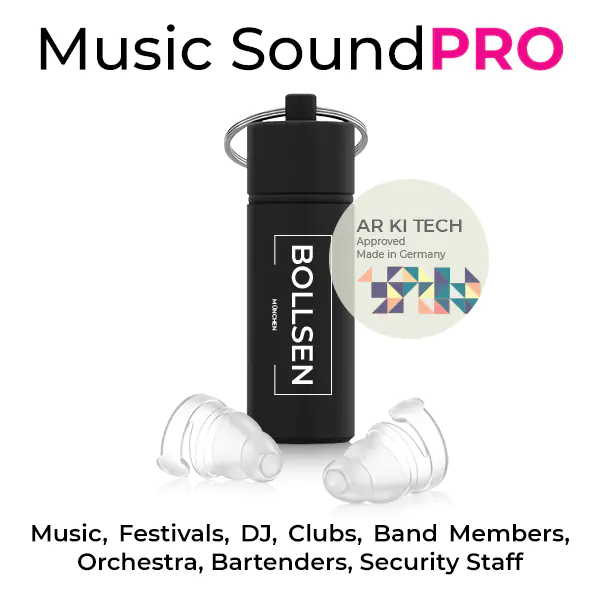
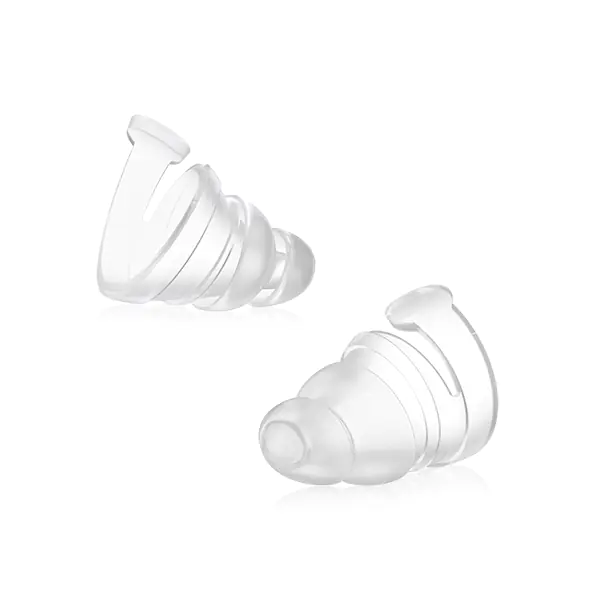
Our recommendation for most musicians is the Music SoundPRO, a passive two-lamella silicone earplug rated SNR 24 dB (H24 / M21 / L19) under EN 352-2, reusable up to 100 times, at £26.95 a pair. It is transparent so it stays invisible on stage, comes with an aluminium case, and is backed by our 40-day money-back guarantee.
It earns the pick because it solves the muffling complaint without over-promising. The SNR 24 dB rating brings a 100 dB stage down to roughly 76 dB, taking the harsh intensity out while leaving the music clear, which is the honest middle ground between dead foam and a £150 mould. As techno DJ and Bollsen partner UMEK puts it, “You have to protect your ears, I’m ready for the gig.”
You can read the full specification and reviews for the Music SoundPRO earplugs for musicians who need protection that brings stage volume down without sealing the music off. Bollsen is German-tested and independently certified at 24 dB, and has featured in BBC Science Focus, Which?, and Mixmag.


How comfortable are silicone earplugs over a full gig?
Comfort decides whether a plug survives the gig or ends up in your pocket by the second song, and soft medical-grade silicone wins here because it seals without the expanding pressure of foam. The Music SoundPRO sits flush in the canal with a low-profile fit, so there is no pressure feeling and nothing protruding to knock against a headset or in-ear monitor.
Expect a short adjustment. Musicians often note it takes a rehearsal or two to get used to playing with protection, and then it feels normal, which matches what players report when switching from foam to silicone. That first session feeling slightly different is expected, not a fault.
If your ears are an awkward shape or you want the most secure seal, the same plug pairs with our AR KI TECH service, the Music SoundPRO with AR KI TECH for a custom-like fit that tailors the size to your ear canal from two photos.
What are the best earplugs for drummers?
Drummers sit closest to the loudest source in the room, with an acoustic kit measuring 90 to 100 dB at one metre and a close snare peaking near 130 dB, so they need reliable attenuation more than almost anyone in the band. A plug rated around SNR 24 dB takes the sting out of the cymbals while leaving the groove intact.
The cymbal crash is where foam fails drummers most, smothering the high end into mush. Passive silicone keeps the kit sounding like a kit, just at a level your ears can survive over a long set.
We cover this audience in detail, including kit positioning and electronic-kit notes, in our dedicated guide to the best earplugs for drummers who practise and gig on acoustic kits week after week.
What are the best earplugs for guitarists?
Guitarists standing in front of a valve amp stack take 110 to 115 dB straight to one side of the head, which is why so many long-serving players report a high-frequency notch and ringing in one ear. An SNR 24 dB plug brings that down toward a far safer 89 dB while keeping the tone and dynamics you play for.
The win for guitarists is that you still feel the amp and hear the bite of the pick, just without the ice-pick top end that does the damage. Protection here is the difference between a long playing life and an early one.
For amp positioning tips and stage-volume tactics aimed specifically at six-string players, see our guide to earplugs for guitarists who play loud through valve and solid-state rigs.
What are the best earplugs for singers and vocalists?
Vocalists have a particular worry: they need to hear their own pitch and the band clearly, and they fear that protection will leave them singing flat or shouting over a wall of mud. Passive silicone earplugs answer this by reducing the overall level rather than blocking specific sounds, so your voice and the monitors stay audible at a safer volume.
Many singers find their pitching actually improves once the stage roar is tamed, because they stop pushing against an overwhelming wall of sound. The bone conduction of your own voice also means you never lose yourself with a well-fitted plug in.
Our dedicated piece on earplugs for singers and vocalists who need to monitor their own pitch goes deeper into fit and monitor-mix tactics for front-of-stage performers.
What are the best earplugs for DJs?
DJs spend hours beside booth monitors that often run at 100 to 115 dB across a long set, which is a cumulative exposure problem rather than a single loud moment. An SNR 24 dB plug lets you ride the energy of the room and still read the mix while protecting your hearing across the whole night.
Because passive silicone simply lowers the level rather than sealing you off, you keep the low-end weight that beat-matching relies on while the volume comes down to a safer place. Our brand partner UMEK has built a long career behind the decks while protecting his ears, which is exactly the model to follow.
For booth-specific advice on monitor levels and headphone use, our guide to the best earplugs for DJs who work long club sets covers everything from warm-up to peak time.
How do in-ear monitors compare to earplugs for musicians?
In-ear monitors and earplugs solve overlapping but different problems: IEMs replace the stage sound with a controlled feed at a volume you set, while passive earplugs simply reduce the acoustic level reaching your ears. IEMs can protect hearing when used sensibly, but only if you resist cranking the mix, whereas a passive plug cannot be turned up by mistake.
For many players the practical answer is both: earplugs for rehearsal and load-in, IEMs for the show. They are not mutually exclusive, and the SoundPRO is slim enough to wear under some monitor setups.
If you are weighing a monitoring upgrade against simple protection, our breakdown of how in-ear monitors compare to earplugs for musicians lays out the cost and protection trade-offs side by side.
Are musician earplugs reusable and how long do they last?
Good silicone musician earplugs are reusable up to 100 times, washable with water and mild soap, and stored in a protective case between gigs, so a single £26.95 pair can cover a year or more of regular playing. That is a few pence per session against a fresh pair of disposable foam every night.
Reusability is also the sustainability argument. One reusable pair keeps dozens of single-use foam plugs out of the bin, which matters when you gig several times a week. Replace them when the silicone loses its shape or seal rather than on a fixed schedule.
Looked after properly, a quality pair is close to the last set of musician earplugs you will need to buy for a long time, which is where reusable silicone quietly beats foam on both cost and waste.
Protecting your hearing as a musician comes down to three things: know how loud your instrument really is, match it to a plug rated around SNR 24 dB, and pick reusable silicone that brings the volume down without smothering the music. The Music SoundPRO does that at £26.95, reusable up to 100 times, German-tested and certified, with a 40-day money-back guarantee so you can try it at your next rehearsal risk-free. Your hearing is the one piece of gear you can never replace, so protect it before the tinnitus does the talking. Find your fit and play loud for longer.

His connection to hearing protection stems from personal experience with sound sensitivity during live events and work in noisy environments, an issue that made him more aware of the long-term risks of unmanaged noise exposure. Today, as both a communicator and a user of BOLLSEN products, he is passionate about raising awareness around the importance of proactive hearing care.
At BOLLSEN, he develops data-driven marketing campaigns, writes SEO-focused articles, and manages communication channels that connect customers with practical knowledge about hearing protection. His work ensures that BOLLSEN’s message—prioritizing health, performance, and sustainability reaches a global audience in an engaging and trustworthy way.
Passionate about writing since childhood, Timotej combines creativity with a strong analytical approach, continuously testing new ideas in digital marketing, performance advertising, and social media. He believes in learning through innovation and collaboration, balancing leadership with openness to new perspectives.
Beyond his professional role, Timotej is committed to a healthy lifestyle and finds inspiration in fitness, sports, and quality time with friends. His personal passion for well-being aligns with BOLLSEN’s core values, making his work not only a career but also a cause he deeply believes in.
Comments are closed.