
⏱️ Estimated reading time: 19 min

The best hearing protection for drummers is a reusable high-fidelity earplug that lowers the volume without muffling the kit, so you can still hear the cymbals, the click, and the rest of the band at a safe level. Acoustic drums are one of the loudest instruments a musician sits behind, often 100 to 110 dB, and cheap foam plugs dull the cymbals and snare so much that timing suffers. A passive high-fidelity plug brings the whole kit down cleanly without dulling it. We recommend the Music SoundPRO, a passive silicone earplug rated SNR 24 dB, reusable up to 100 times at £26.95; for the loudest kits or long rehearsals, some drummers pair earplugs with earmuffs for extra protection.
Key Takeaways
The best earplugs for drummers are the ones that bring a loud kit down to a safe level without making it sound dead. Sit at an acoustic kit and you are inside 90–100 dB(A) at the throne, with a hard snare hit peaking close to 130 dB right by your head. That is louder than the point at which the UK’s HSE expects hearing protection, and it is why so many drummers end up with ringing ears after a single rehearsal.
Plenty of drummers try cheap foam plugs first, then stop wearing them because the kit sounds muffled, like playing underwater, and the cymbals disappear. We get that complaint a lot. At Bollsen, a family-run hearing protection company founded in 2016 and now trusted by over 1,000,000 people, we make reusable silicone earplugs that are independently tested and certified in Germany.
This guide gives you the honest numbers: how loud your kit really is, what SNR rating you actually need, and how passive silicone protection works so you keep your groove. We also cover the question drummers keep asking, whether an electronic kit needs plugs at all.
How loud is a drum kit in decibels?
An acoustic drum kit produces roughly 90–100 dB(A) at the playing position around 1 m from the heads, and a close snare hit can peak near 130 dB in short impulses right beside your ear. Those are the levels that put drummers among the highest-exposure musicians.
The World Health Organization guidance on hearing loss sets the safe sustained-exposure threshold at 85 dB, and notes that the resulting noise-induced hearing loss is permanent and preventable. A rehearsal at 95 dB clears that line within minutes, and the cymbals and snare add sharp high-frequency peaks the ear is especially sensitive to.
Research collected on the NCBI Bookshelf on music-induced hearing loss places percussionists and drummers near the top for exposure risk, which is the case for putting protection in your kit bag from the start.
It helps to picture where the energy comes from. The kick and floor tom carry the low-end weight, the snare delivers a sharp transient that your ear catches as a crack, and ride and crash cymbals throw a wash of high frequency straight up toward your head. You sit in the middle of all of it, closer to the source than anyone else in the room, which is exactly why a drummer’s exposure is higher than the audience hears out front.
A useful way to read the table is by exposure time, not just peak level. A 95 dB rehearsal is well past the 85 dB threshold, and because risk accumulates, two hours behind the kit twice a week adds up across a year. The figures below are typical ranges, and your own room, kit, and playing style will move them, but the order of magnitude is what matters.
| Source | Typical level | What it means for you |
|---|---|---|
| Electronic kit (mesh heads, unamplified) | 60–80 dB | Lower risk, protection often optional |
| Acoustic kit at the throne (1 m) | 90–100 dB(A) | Above the 85 dB action level, protection needed |
| Snare close-position peak | up to ~130 dB | Sharp impulse peaks, high-frequency heavy |
| HSE upper action value | 85 dB LEP,d | Hearing protection expected in UK workplaces |
Do drummers really need ear protection?
Yes, because an acoustic kit at 90–100 dB sits well above the 85 dB level at which damage risk rises sharply, and drummers sit in that field for hours each week. The NHS guidance on hearing loss and tinnitus describes the early warning signs as tinnitus and muffled hearing, which often creep in gradually before becoming permanent.
The UK’s HSE Control of Noise at Work Regulations set a lower action value at 80 dB, an upper action value at 85 dB, and an exposure limit at 87 dB LEP,d. Those figures are written for workplaces, but a drummer’s exposure regularly exceeds all three.
The risk is cumulative rather than dramatic, so it rarely feels urgent in the moment. By the time the ringing sticks around, the damage is already done, which is the whole argument for protecting your hearing before the symptoms arrive.
UK musicians have good support to draw on. The British Tinnitus Association publishes musician-specific guidance on preventing tinnitus, the Royal National Institute for Deaf People covers hearing protection and early signs of loss, and the Musicians’ Union runs campaigns on safe listening for performers. The common thread across all of them is the same: protect early, because the loss does not reverse.
Tinnitus is the symptom drummers notice first, usually as a ringing or hissing that lingers after a loud session. Early on it fades by morning, which is easy to ignore, but each unprotected session that leaves your ears ringing is a session that has done measurable harm. Treating that temporary ringing as a warning, rather than a normal part of playing, is the mindset shift that keeps a drummer’s hearing intact.
What dB rating (SNR) do I need for drumming?
For an acoustic kit you want around SNR 24 dB, because it brings a 100 dB kit down to roughly 76 dB at the ear, comfortably under the 85 dB action level while still leaving the kit clearly audible. Less attenuation leaves you exposed, and far more can over-isolate you from your own playing.

The reason the maths works is the 3 dB exchange rate. CDC and NIOSH guidance on occupational noise explains that every 3 dB increase doubles the sound energy reaching your ear, so a 24 dB reduction does far more than the number suggests. It is the difference between a damaging hour and a safe one.
SNR stands for Single Number Rating, the figure from the EN 352-2 standard that estimates how many decibels a plug removes overall. It is the European equivalent of the NRR figure you will see on some imported packaging, and for drumming the SNR is the number to read first. A higher rating is not automatically better here, because over-attenuating can leave you isolated from the very dynamics you play by.
There is a floor as well as a target. Many general-purpose music plugs are rated nearer 17 dB, which is fine for an audience member but leaves an acoustic drummer at the kit still sitting in the low 80s, on the edge of the action level rather than safely under it. That gap is why we point drummers at the 24 dB band specifically, rather than a lighter everyday music plug.
| Scenario | Kit level | Suggested SNR | Level at the ear |
|---|---|---|---|
| Electronic kit, no monitoring | 60–80 dB | Optional | Already near safe |
| Acoustic practice, quiet room | 90 dB | ~24 dB SNR | ~66 dB |
| Acoustic gig / loud rehearsal | 100 dB | ~24 dB SNR | ~76 dB |
| Behind a loud band on stage | 105 dB+ | 24 dB SNR minimum | ~81 dB |
For a deeper look at how attenuation ratings work across different gigs, our guide to the best earplugs for musicians covers the wider range of stage and audience situations beyond the kit.
Are earplugs or earmuffs better for drummers?
For most drummers, passive silicone earplugs at SNR 24 dB are the better day-to-day choice, because they protect to the right level while staying low-profile and letting you hear the kit. Earmuffs and monitoring headphones each have a place, but they trade comfort or clarity for that protection.
The right answer depends on what you are doing that day. For a standard acoustic rehearsal or gig, in-ear plugs win on comfort and the fact that you will actually keep them in. For a teaching studio where you hear back-to-back kits at volume all day, the higher reduction of earmuffs can be worth the bulk. The three options below are not really rivals, they cover different jobs.
Earmuffs deliver high isolation and suit very loud rehearsal rooms or teaching, though they get hot, clamp over your head, and can flatten how the kit sounds. Noise-isolating monitoring headphones are built for playing to a click or backing track, blocking outside sound while feeding you a controlled mix, which makes them a recording and click-track tool rather than an everyday protector.
The practical knock against earmuffs for drummers is the cup itself. A drummer’s head moves constantly, you sweat under the band, and a hard hit can knock a cup’s seal, all of which interrupt a long session in a way a flush in-ear plug never does. They earn their place when you need maximum reduction for short bursts, but most players will not reach for them every day.
Monitoring headphones solve a different problem. If your work is click-track sessions, in-ear monitor feeds, or studio tracking, isolating cans give you a clean mix and block the room. They depend on a feed to work, though, so they protect by replacing the room with a controlled signal rather than simply turning the room down, which is why they sit alongside earplugs rather than replacing them.
| Protection type | Typical reduction | Best for | Trade-off |
|---|---|---|---|
| Passive silicone earplugs | SNR 24 dB | Daily practice, gigs, low-profile use | Some top-end roll-off |
| Earmuffs | High (often 25–30 dB) | Very loud rooms, teaching | Hot, bulky, can flatten the sound |
| Noise-isolating monitoring headphones | Varies with seal | Click tracks, recording | Bulky, needs a mix feed |
Will earplugs muffle my drumming or affect my timing?
No, well-fitted passive silicone earplugs bring the whole kit down to a quieter, safer level rather than blocking it, so you still hear enough to stay in the pocket and play by ear. They are far less muffled than foam, which is the plug drummers complain makes the kit sound dead.
Being straight about it, passive silicone is not a flat or hi-fi filter, and the top end is reduced more than the lows and mids. Under the EN 352-2 lab test, attenuation rises with frequency, climbing from about 22 dB in the low and mid range to around 35 dB at 8 kHz, so cymbals and hi-hats sound a touch softer rather than absent. What you do not get is the underwater, lost-the-feel effect of foam.
In practice, you keep your sense of timing and dynamics because the kit stays audible at every level, just turned down. That is what lets you control the decay of a cymbal or the weight of a backbeat while your ears stay protected.
The honest trade-off, and the one the old version of this article got wrong, is that no passive earplug leaves the sound untouched. Anyone promising a flat filter that lets you hear every note exactly as it was is overselling it. What 24 dB of passive silicone gives you is a quieter, slightly mellower kit you can still play to, which beats the alternative of foam that turns the whole thing to mush or, worse, no protection at all.
Most drummers adjust within a session or two. Your ears recalibrate to the new level quickly, the cymbals stop sounding distant, and your timing settles. The first rehearsal can feel slightly unfamiliar, which is normal, and is a far smaller adjustment than relearning your feel through the dead wall of foam.
Which earplugs are best for drummers?
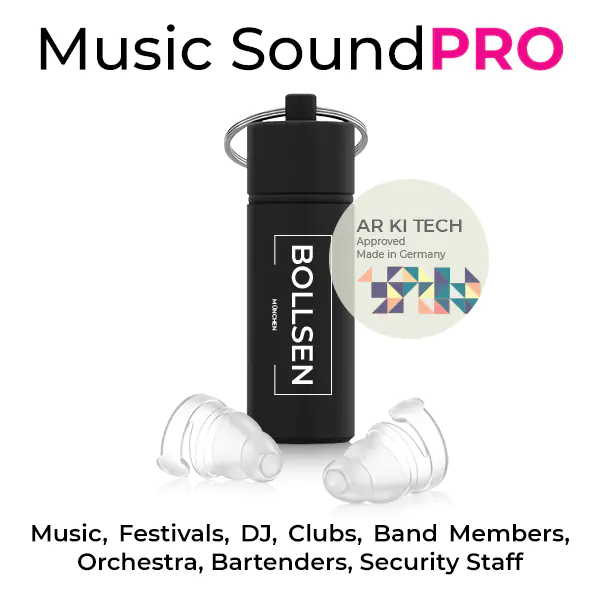
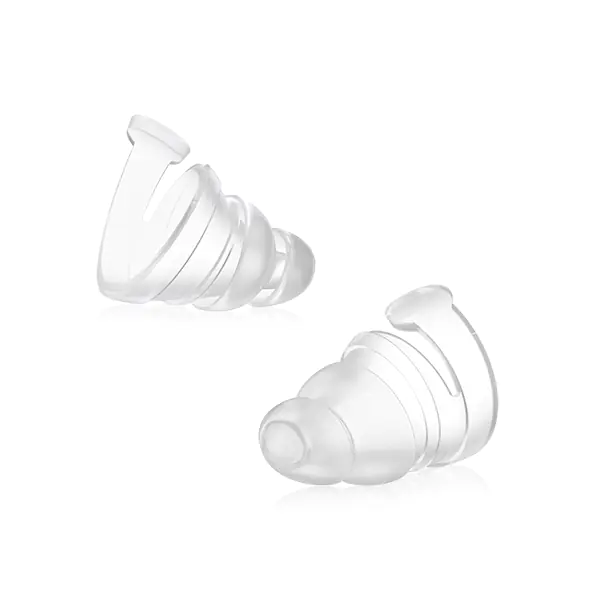
The Bollsen Music SoundPRO is our recommended passive in-ear option for drummers, a transparent 2-lamella silicone earplug rated SNR 24 dB (H24 / M21 / L19) that brings a loud acoustic kit down to a safe level while keeping it audible. It is reusable up to 100 times and is independently tested and certified in Germany.
Because it is passive silicone rather than a tuned acoustic filter, it does what a drummer needs most. It lowers the overall volume by around 24 dB so you can sit at a 100 dB kit at roughly 76 dB at the ear. The high frequencies are reduced most, so the kit sounds quieter and a little softer on top, never dead like foam. It is invisible when worn, comes with an aluminium case, and carries a 40-day money-back guarantee.
The material matters for a job this physical. The body is medical-grade silicone that is hypoallergenic and free of BPA, PVC and latex, and it washes with water and mild soap between sessions. At £26.95 for a pair reusable up to 100 times, the cost works out to a few pence per rehearsal, which makes the throwaway cycle of foam look expensive over a year of playing.
We do not claim it is the loudest-rated plug you can buy, and for drumming that is the point. The 24 dB rating is matched to the job: enough to pull a gig-volume kit under the action level, not so much that you lose the dynamics you play by. It is the everyday plug that lives in the stick bag and actually gets worn, which is the only kind that protects anyone.
If you want the kit-ready option, the Music SoundPRO earplugs for drummers bring an acoustic kit under the action level while keeping your groove audible at the throne. They are the passive silicone choice we recommend for daily practice and gigs alike.
Fit and seal are what make the volume reduction reliable, and a flush seal is also what lets the plugs sit comfortably under closed-back monitoring headphones for hybrid e-kit or click-track use. If you want the fit dialled in precisely, our AR KI TECH ear-measurement service matches your size from two photos and brings the return rate down to 3%.
You can compare the kit-specific scenarios above against the full stage and audience range in our guide to the best earplugs for musicians, which sits above this article as the hub for the wider earplugs for music topic.


Do you need earplugs for an electronic drum kit?
An unamplified electronic kit with mesh heads sits at around 60–80 dB, a materially lower risk than an acoustic kit, so dedicated earplugs are often optional when you play it dry. The acoustic impact of stick on mesh is real but modest compared with a snare and cymbals.
The exposure changes the moment you monitor through headphones. Many e-kit drummers turn the mix up to hear themselves over the room and stick noise, and that amplified level through closed-back cans can climb back toward the danger zone without you noticing.
This is where the hybrid trick helps. A flush-fitting silicone earplug under your monitoring headphones lets you set the mix lower and still hear it clearly, so an e-kit session stays comfortable and your ears are covered even when you crank the click.
It is worth separating the two e-kit risks, because they are not the same. The mesh-head impact and module speaker in a quiet room rarely trouble your hearing on their own. The headphone level you choose to play over them is the part that creeps up, and it is fully within your control once a plug lets you hear a quieter feed clearly.
If you switch between an acoustic and an electronic kit, one pair covers both. You wear them straight in for acoustic practice, and slip them under your cans for e-kit and click work, which keeps a single habit running across everything you play.
Will earplugs fall out when I’m sweating or playing hard?
A correctly sized silicone earplug seats flush in the ear canal and holds its seal through a sweaty, physical session far better than foam, which loosens as it slowly re-expands. The 2-lamella shape grips the canal wall, and a small removal tab makes it easy to take out without breaking the seal early.
If you have ever had a plug work loose mid-fill, the cause is almost always sizing rather than the design. Getting the right size is the single biggest factor in both comfort and how much the plug actually attenuates, which is why we offer photo-based sizing for drummers who play hard.
There is a comfort point here too. A flush silicone plug sits inside the canal without a stem poking out, so it does not catch on in-ear monitors, glasses arms, or a hat, and you forget it is there within a song. That is part of why drummers keep wearing silicone when they abandoned foam.
As the central topic for kit and stage protection, the broader earplugs for music resources sit alongside this guide so you can match the right fit to every playing situation. Drummers are one entity within that wider topic, alongside guitarists, DJs, and front-of-house crew who each face their own dB profile.
Your hearing is the one piece of kit you can never replace or re-skin, and an acoustic drummer loses it 90–100 dB at a time without protection. The honest fix is not a magic filter that hides the volume, it is bringing the whole kit down by around 24 dB so you can keep playing by feel for decades. Passive silicone does that without the dead, underwater muffle of foam, which is the reason drummers actually keep wearing it. If you want one pair to live in your stick bag, the Bollsen Music SoundPRO is built for exactly this, backed by a 40-day money-back guarantee so you can try it risk-free at your next rehearsal.

His connection to hearing protection stems from personal experience with sound sensitivity during live events and work in noisy environments, an issue that made him more aware of the long-term risks of unmanaged noise exposure. Today, as both a communicator and a user of BOLLSEN products, he is passionate about raising awareness around the importance of proactive hearing care.
At BOLLSEN, he develops data-driven marketing campaigns, writes SEO-focused articles, and manages communication channels that connect customers with practical knowledge about hearing protection. His work ensures that BOLLSEN’s message—prioritizing health, performance, and sustainability reaches a global audience in an engaging and trustworthy way.
Passionate about writing since childhood, Timotej combines creativity with a strong analytical approach, continuously testing new ideas in digital marketing, performance advertising, and social media. He believes in learning through innovation and collaboration, balancing leadership with openness to new perspectives.
Beyond his professional role, Timotej is committed to a healthy lifestyle and finds inspiration in fitness, sports, and quality time with friends. His personal passion for well-being aligns with BOLLSEN’s core values, making his work not only a career but also a cause he deeply believes in.