
⏱️ Estimated reading time: 10 min
Summarize with AI

Key Takeaways
Why do you need earplugs for water sports?
Repeated cold water and wind exposure can cause surfer’s ear and infections. Earplugs keep water out and protect the ear canal.
What earplugs are best for water sports?
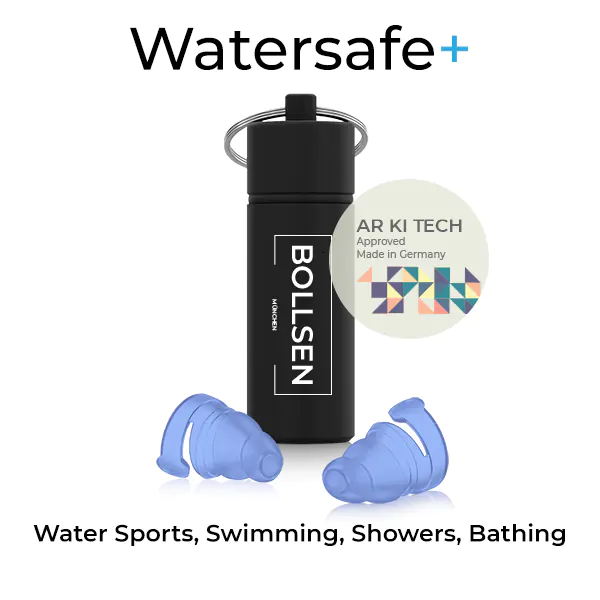
Reusable water-specific plugs with an acoustic filter, such as Bollsen Watersafe+ at 24 dB, which seal against water while still letting you hear.
Which water sports need ear protection?
Surfing, kayaking, paddleboarding, open-water swimming and diving all benefit, especially in cold water below about 15C.
Do water sports earplugs let you hear?
Yes. Filtered water plugs block water and cut wind noise while still letting you hear voices and signals, unlike solid plugs.
Can you use regular earplugs for water sports?
No. Foam and standard sleep plugs are not water-resistant and can trap water. Use plugs designed for water like Watersafe+.
Most people reach for a wetsuit, a leash, goggles all the right gear. But ears? Ears rarely make the pre-session checklist, right until the first infection. If you swim, surf, dive, or paddle regularly, this article is for you. Because the risks are real, the damage is cumulative, and protecting yourself takes less than ten seconds.
What Actually Happens to Your Ears in the Water
Every time you dip your head under the surface, your ear canal is exposed to whatever is in that water chlorine, bacteria, cold temperatures, and pressure. Once or twice, no problem. Do it hundreds of times a year, and your ears start to push back. There are two conditions that should be on every water athlete’s radar:Surfer’s Ear (Exostosis)
Cold water and wind cause the bone lining your ear canal to grow extra bony bumps a condition called exostosis, or surfer’s ear. It sounds dramatic, and it is: once the bone starts growing, it does not stop on its own. Over time, those growths narrow the canal, making it harder to drain water, easier to trap bacteria, and eventually leading to partial hearing loss. The hard part? It is completely silent until it is too late. You will not feel the bone changing. You will just notice that water stays stuck in your ear longer after each session. By the time it becomes uncomfortable, you likely already have significant growth and the only fix is surgery.Swimmer’s Ear (Otitis Externa)
Where surfer’s ear is a long-term structural problem, swimmer’s ear is an acute one. Water trapped in the ear canal creates the perfect warm, moist environment for bacteria to multiply. The result is an outer ear infection that causes pain, itching, swelling, and sometimes discharge. Pool swimmers are particularly vulnerable because chlorinated water disrupts the ear’s natural protective layer, making it easier for bacteria to take hold. But open water swimmers, divers, and surfers are equally exposed especially in warmer seas or freshwater lakes where bacterial counts are higher.Why Most Earplugs Are Wrong for Water Sports
Here is the problem most athletes run into: they grab a pair of foam earplugs from the pharmacy, shove them in, and find they either fall out mid-session or block so much sound they cannot hear anything. Neither works. Foam earplugs were designed for noise environments factories, gigs, construction sites. They create a near-total sound block, which is exactly what you do not want when you are in the water. You need to hear waves, your coach, your crew, oncoming boats, and everything else happening around you. There is also the fit problem. Foam compresses and expands to seal it works in a static ear. But the moment you duck dive, wipe out, or do a flip turn, the seal breaks and water gets in anyway. You have blocked your hearing for nothing.The Technology That Makes the Difference: Acoustic Filters
The breakthrough in modern water sports earplugs is the acoustic filter a micro-engineered component built into the earplug that works like a one-way valve for your ear. Water and debris cannot get through, but sound waves can. Different brands achieve this with different technologies: hydrophobic meshes, ceramic Venturi-shaped channels, and vented membrane systems all solve the same problem from different angles. What they share is the ability to dramatically reduce the earplug’s sound attenuation typically to between 5 dB and 15 dB while still creating a waterproof barrier. To put that in perspective: a standard foam earplug blocks around 25–33 dB of sound, enough to make a conversation feel like it is happening underwater. A filtered water sports earplug brings that down to 5–15 dB roughly the difference between being in a quiet room and being in a very quiet room. You notice it slightly, but you can still hear everything that matters. This is why Bollsen’s Watersafe+ uses an acoustic filter as its core technology. The filter keeps the sea, the pool, and the cold wind out of your ear canal, while letting you stay fully present in your session.

Which Water Sports Actually Need Ear Protection?
The short answer: any sport that puts cold water in your ear canal on a regular basis. But there are some that carry higher risk than others.Surfing
The highest-risk group. Cold water exposure plus wind creates the ideal conditions for surfer’s ear. Wipeouts mean repeated, high-velocity water entry into the ear. Studies consistently show surfers have the highest rates of exostosis among all water sport athletes. If you surf more than a handful of times a year in cold water, ear protection is not optional it is overdue.Open Water Swimming
Open water is colder, dirtier, and more bacteria-laden than a pool. The risk of swimmer’s ear is higher, and the cold water component accelerates surfer’s ear development too. Competitive open water swimmers often train daily that exposure adds up fast.Pool Swimming
Lower cold water risk, but chlorinated water disrupts the ear’s natural protective layer. Swimmers who train multiple times a week are surprisingly prone to otitis externa, and the repeated exposure takes its toll on the delicate skin of the ear canal over time.Kayaking, Kayak Surfing, Canoe Polo
Rolling, capsizing, and wet exits mean frequent full water submersion. Cold river and sea temperatures add the surfer’s ear risk factor. Paddlers rarely think of themselves as needing ear protection until the first winter season of regular paddling catches up with them.Kitesurfing and Windsurfing
Wind exposure is a key driver of surfer’s ear, and kitesurfers and windsurfers are among the most wind-exposed athletes in any sport. Add cold water and regular wipeouts, and the risk profile is similar to surfing.Diving and Snorkelling
Pressure changes with depth and repeated water entry both contribute to ear problems. Divers should pay particular attention to ear health as a general rule an infected or compromised ear canal is also a diving safety issue.Bollsen Watersafe+
Context: Masters swimmer at a mid-size UK triathlon club (~80 active members), training 4 sessions per week in a 50m pool. Had 3 confirmed otitis externa infections in the 12 months prior, each requiring a 7-day antibiotic course and 5-day training break.
Solution: Switched to Bollsen Watersafe+ with size M acoustic-filter tips. Worn consistently across all pool sessions for a full 6-month training block leading into the season.
Result: 0 ear infections across 98 training sessions over 6 months – down from 3 infections in the prior 6 months. Estimated 15 training days recovered and roughly £120 in avoided GP and pharmacy costs. Hearing during sessions fully intact: lane calls, coach instructions, and the pace clock all audible without removing the plugs.Bollsen Watersafe+
Context: Amateur surfer and kiteboarder, surfing cold North Sea conditions 3× per week year-round for 8 years. Diagnosed with early-stage exostosis (bilateral, 25–30% canal narrowing) at routine ENT check. Surgeon recommended immediate consistent earplug use as a non-surgical intervention.
Solution: Introduced Bollsen Watersafe+ with leash attachment across 100% of sessions, including kiteboarding. Previously tried 2 other universal-fit brands that fell out during wipeouts.
Result: Follow-up ENT scan after 12 months of consistent use showed zero measurable progression of bone growth – the first stable result in 3 years of annual monitoring. Zero plugs lost across 52 weeks of sessions. Previously lost an average of 2–3 pairs per season to wipeouts.
Content & Digital Marketing Manager at BOLLSEN at Bollsen
Timotej Prosenc is the Marketing Manager at BOLLSEN Hearing Protection, where he leads the company’s SEO strategy, content creation, and email marketing initiatives. With a background in journalism and sales, Timotej brings both storytelling skills and commercial insight to BOLLSEN’s mission of promoting healthier hearing.
His connection to hearing protection stems from personal experience with sound sensitivity during live events and work in noisy environments, an issue that made him more aware of the long-term risks of unmanaged noise exposure. Today, as both a communicator and a user of BOLLSEN products, he is passionate about raising awareness around the importance of proactive hearing care.
At BOLLSEN, he develops data-driven marketing campaigns, writes SEO-focused articles, and manages communication channels that connect customers with practical knowledge about hearing protection. His work ensures that BOLLSEN’s message—prioritizing health, performance, and sustainability reaches a global audience in an engaging and trustworthy way.
Passionate about writing since childhood, Timotej combines creativity with a strong analytical approach, continuously testing new ideas in digital marketing, performance advertising, and social media. He believes in learning through innovation and collaboration, balancing leadership with openness to new perspectives.
Beyond his professional role, Timotej is committed to a healthy lifestyle and finds inspiration in fitness, sports, and quality time with friends. His personal passion for well-being aligns with BOLLSEN’s core values, making his work not only a career but also a cause he deeply believes in.
His connection to hearing protection stems from personal experience with sound sensitivity during live events and work in noisy environments, an issue that made him more aware of the long-term risks of unmanaged noise exposure. Today, as both a communicator and a user of BOLLSEN products, he is passionate about raising awareness around the importance of proactive hearing care.
At BOLLSEN, he develops data-driven marketing campaigns, writes SEO-focused articles, and manages communication channels that connect customers with practical knowledge about hearing protection. His work ensures that BOLLSEN’s message—prioritizing health, performance, and sustainability reaches a global audience in an engaging and trustworthy way.
Passionate about writing since childhood, Timotej combines creativity with a strong analytical approach, continuously testing new ideas in digital marketing, performance advertising, and social media. He believes in learning through innovation and collaboration, balancing leadership with openness to new perspectives.
Beyond his professional role, Timotej is committed to a healthy lifestyle and finds inspiration in fitness, sports, and quality time with friends. His personal passion for well-being aligns with BOLLSEN’s core values, making his work not only a career but also a cause he deeply believes in.
Latest posts by Timotej Prosenc (see all)