
⏱️ Estimated reading time: 15 min

Key Takeaways
Forty-seven percent of UK divorcees cite a partner’s snoring as a contributing factor. If you’ve spent months being woken 10, 15, or 20 times a night, that number won’t surprise you. Most people searching for best earplugs for snoring get lists of products and NRR ratings. What they don’t get is an explanation of why snoring is acoustically harder to block than most noises, or why earplug design matters as much as the number on the box.
At Bollsen, we design and test earplugs for sleeping around how sleep noise actually behaves: the frequencies, the volumes, the physical demands of a pillow-pressed ear. This guide covers the acoustic physics of snoring first, then gives you a framework to evaluate any earplug against those specific requirements. Thousands of people sleeping next to snorers have written to us saying the same thing: “still faintly hear it, but I can sleep through it now.” That is the goal. Not silence. Sleep.
Why Is Snoring So Hard to Block with Earplugs?
Snoring is a low-frequency sound, with most of its acoustic energy sitting between 110 and 500 Hz. That puts it in the same range as traffic rumble, thunderclaps, and the lowest bass notes on a piano. Research published in the Laryngoscope on the acoustics of snoring (PMID 19665907) found that palatal snoring produces tonal, low-frequency vibrations with strong fundamental frequencies and harmonics in this band.
Low-frequency sound is harder to block because long acoustic wavelengths pass through physical barriers more easily. That’s why you can hear the bass thud of a neighbour’s music through a wall but not the treble. It’s also why how an earplug seals matters more than its headline SNR rating.
There is also a partial bone conduction effect at very low frequencies. Some snoring vibration reaches the cochlea via the skull regardless of what you put in your ears. Worth knowing upfront: earplugs get snoring down to a sleep-permitting level for most people, but for extreme cases above 80–90 dB, some residual sound will remain audible.
How Loud Is Snoring, and What dB Reduction Do You Need?
Typical snoring measures 60–77 dB at the bed partner’s ear, about the same as a busy restaurant. A KBB-Forum study on snoring and noise-induced hearing loss in bed partners recorded two groups: a lower-snoring group averaging 59 dB, and a higher-snoring group averaging 69 dB, with some severe obstructive sleep apnoea cases exceeding 90 dB.
Sleep researchers put the approximate awakening threshold for sensitised sleepers at 50.3 dB. These are people whose arousal threshold has dropped over time from repeated disturbance. A 24 dB SNR earplug brings 69 dB snoring down to roughly 45 dB, which falls below that threshold. For the loudest cases (80 dB and above), the reduced level sits at 56 dB or higher, still audible but substantially quieter. The maths isn’t perfect, but it explains why most Life+ users sleep through the night without needing to block every sound completely.
Why Do Snoring Partners Experience Hearing Loss?
Most people think of snoring as a sleep problem. For the person lying closest to the source, it’s also a noise exposure problem. The measurable hearing damage from sustained snoring exposure is documented: 37.1% of bed partners in the higher-snoring group in the KBB-Forum study showed a hearing threshold shift greater than 20 dB at 8,000 Hz in the ear facing the snorer.
It’s the same mechanism as occupational noise-induced hearing loss. Sustained nightly exposure to 65–77 dB without protection causes cumulative cochlear damage. Sleep and partner health research cited by SleepApnea.org confirms that bed partners of heavy snorers are three times more likely to have chronic difficulty sleeping and twice as likely to report daytime fatigue. Our article on how loud snoring can damage a listener’s hearing covers what years of unprotected exposure actually does.
Are Silicone or Foam Earplugs Better for Snoring?
Silicone earplugs outperform foam for snoring because of how they seal. A conical silicone earplug creates a lamellae-based pressure seal that holds against the canal wall regardless of head position. Foam expands in all directions, which works fine in open air. On a pillow, the external pressure compresses the foam outward rather than inward, and the seal breaks.
The difference is significant. People switching from foam to silicone consistently report the same frustration: finding their earplugs on the pillow or mattress in the morning. “Fell out halfway through the night” is the phrase that comes up again and again in forum discussions. A conical silicone earplug sits flush at the canal opening without any protrusion, leaving nothing for the pillow to grip.
| Earplug Type | SNR / NRR | Low-Freq Performance | Side-Sleeper Seal | Cost Per Night | Reusable |
|---|---|---|---|---|---|
| Silicone conical (Life+) | 24 dB SNR | Strong: lamellae seal holds at low frequencies | Excellent: flush, no pillow protrusion | 30p (or 10p with 10x Pack) | Up to 100 times |
| Disposable foam | 28–33 dB NRR | Moderate: lab-rated, real-world degraded by pillow contact | Poor: protrudes and is pushed out by pillow | ~40p per pair (single use) | No (single use) |
| Wax earplugs | 20–23 dB SNR | Moderate: mouldable seal, variable quality | Good: low profile when correctly moulded | ~30–50p per pair (single use) | No (typically single use) |
| Custom moulded (audiologist) | Variable, up to 30 dB | Excellent: canal-matched seal | Excellent: flush fit by design | Pence (amortised over years) | Yes (indefinitely) |
How Much Does an SNR Rating Reduce Snoring in Practice?
The SNR (Single Number Rating) is the European standard for earplug noise reduction, and it’s what you’ll see on UK-sold products. NRR is the US equivalent. Neither figure matches what you actually experience in a bedroom. Both are measured in controlled lab conditions with a perfect insertion. Real-world attenuation for a 24 dB SNR plug typically falls between 18 and 24 dB, depending on insertion depth and fit.
If you’re comparing products across different markets, understanding how SNR rating reduces snoring noise differently from NRR matters. In practice, a 24 dB SNR earplug brings 69 dB average snoring down to roughly 45–51 dB. That sits below the 50.3 dB awakening threshold for most sensitised sleepers. The difference, practically speaking, is sleeping through the night rather than lying awake listening to it.

What Makes Life+ Earplugs Specifically Suited to Blocking Snoring?
The Bollsen Life+ was designed around the sleep environment, and snoring is one of the more demanding things it needs to handle. Three design properties are particularly relevant: the seal mechanism, the frequency filter profile, and how it behaves on a pillow.
The patented conical 2-lamellae design (Patent D961,757 USPTO) creates a layered seal at the canal opening rather than expanding inside it. Each lamella acts as a pressure ring against the canal wall. The seal holds whether you sleep on your back, stomach, or side. Because the plug sits flush without protruding, there’s nothing for a pillow to grab and lever out of position.
The frequency profile lets high-frequency sounds through: alarm clocks (1,000–4,000 Hz), baby monitors, smoke alarms. It attenuates the low-frequency range where snoring is most intense. This isn’t passive filtering. It’s a function of the conical geometry: low-frequency waves are blocked by the lamellae seal, while shorter high-frequency wavelengths pass around the edges at reduced amplitude. Foam blocks everything at the same rate, which is why foam users sometimes sleep through alarms they needed to hear.


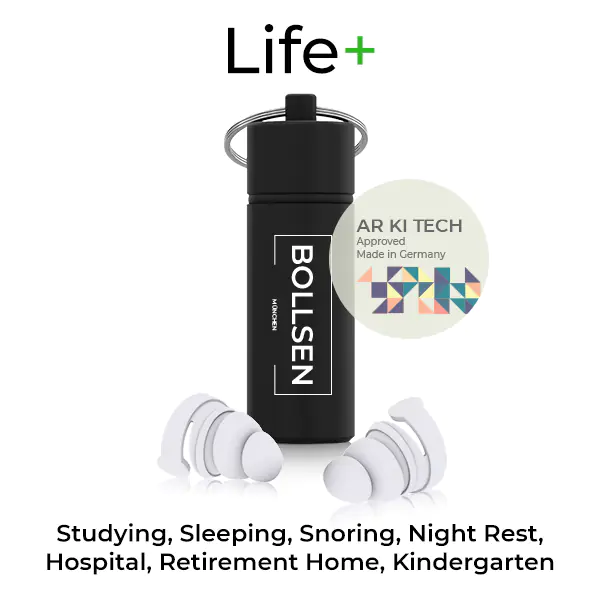
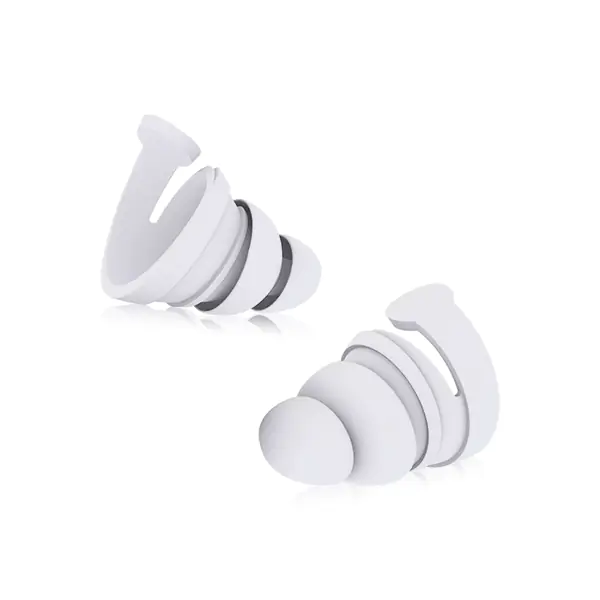
Life+ uses 100% medical-grade silicone, free of BPA, PVC, plasticisers, latex, and cadmium. Each pair is reusable up to 100 times and comes with an aluminium carry case. Over 1,000,000 people use them. Backed by a 40-day money-back guarantee, they’ve been recommended by BBC Science Focus and Glamour UK.
Is the Cost of Snoring Earplugs Worth It for a Nightly Problem?
Snoring is a nightly problem, not an occasional one. That makes the cost calculation more important than it is for concert or travel earplugs. Disposable foam at roughly 40p a pair costs around £146 a year if you’re using them every night. A single pair of Life+ costs £29.95 for up to 100 uses, which works out to 30p per night.
For couples where both partners need earplugs, or anyone who wants a year’s supply sorted in one go, the Life+ 10x Pack at £99.95 brings that down to 10p per night per pair. Over 12 months: roughly £36 versus £146 for disposable foam, and no 2am scramble for a replacement pair. Our complete sleep earplugs buyer’s guide covers cost-per-use comparisons across all earplug types in more depth.
Which Life+ Option Is Right for You?
There are four Life+ variants, and the right one depends on how you sleep and how often you need earplugs.
| Product | Best For | SNR | Price | Cost/Night |
|---|---|---|---|---|
| Life+ (standard) | Most adults: medium ear canals, all sleep positions | 24 dB | £29.95 | 30p |
| Life+ 10x Pack | Couples, shift workers, frequent travellers, anyone who wants a year’s supply | 24 dB | £99.95 | 10p |
| Life+ Pink Edition | Smaller ear canals, which are more common in women: comes in two sizes, a small and a medium pair, so you keep whichever seals without pressure | 24 dB | £34.95 | ~17p |
| Life+ AR KI TECH | Anyone with larger or smaller ears who has struggled with fit. AI ear measurement via two photos, 3% return rate | 24 dB | £44.95 | 39p |
If you’ve tried earplugs before and found they didn’t stay in or felt uncomfortable, the issue is almost always fit rather than design. The AR KI TECH ear sizing system uses two photos taken on a phone and AI analysis to recommend the correct size, reducing the return rate to just 3% compared to a significantly higher industry average for standard earplugs.
Is It Safe to Wear Earplugs Every Night for Snoring?
Medical-grade silicone earplugs are safe for nightly use when maintained properly. Silicone doesn’t harbour bacteria the way foam does, doesn’t degrade and shed particles into the canal, and doesn’t need to be pushed deep enough to press against the eardrum. Life+ seals at the canal rim, not inside it.
Rinse them after each use, let them dry before putting them back in the carry case, and replace the pair when the silicone starts showing visible wear (usually well beyond 100 uses). Our guide on whether it is safe to sleep with earplugs every night covers the full picture, including when not to use them and what to watch for.
What If Earplugs Do Not Fully Block the Snoring?
The observation that comes up most from people who’ve found an earplug that works: “still faintly hear it, but I can sleep through it now.” That’s not a failure. That’s exactly what you’re aiming for. The goal isn’t silence. It’s getting snoring from above the awakening threshold to below it, and that’s achievable for most people with a 24 dB SNR silicone earplug.
For the loudest snoring, particularly from partners with obstructive sleep apnoea (OSA) producing above 80 dB, earplugs alone may not be enough. Whether earplugs help block snoring noise depends on both the snoring volume and the listener’s arousal threshold. The right first step is a 24 dB SNR silicone earplug with a proper canal fit. The 40-day money-back guarantee means you can test it without any financial risk.
If the volume or pattern of snoring suggests obstructive sleep apnoea, the snoring partner should see a GP. OSA is a medical condition that needs diagnosis. Earplugs help the listener cope with the symptom. They don’t address the underlying cause.
How to Sleep Better Next to a Snoring Partner Tonight
Reducing snoring to below the awakening threshold is the most reliable single intervention available to you. If you want to combine approaches, the evidence supports white noise (which masks the irregular rhythm of snoring even when it can’t mask the total volume), sleeping position changes for the snorer (side-sleeping reduces palatal snoring intensity in most people), and consistent sleep timing to improve your own arousal threshold over time.
Managing the relationship side of chronic snoring, including the couples who end up in separate bedrooms when they don’t need to, is covered in our guide on how to sleep next to a snoring partner. If you want the physiology behind why earplug design matters for this specific noise, why snoring produces low-frequency noise explains it properly.
UK sleep prevalence research (PubMed PMID 30597439) puts the figure at 41% of UK adults who snore, approximately 15 million people. Their partners are, statistically, the ones looking for answers. The physics of snoring work against you without protection. A well-designed earplug closes most of that gap.
Life+ starts from 10p per night. If it doesn’t work for your situation, the 40-day money-back guarantee means you get your money back, no questions asked. Try it tonight.

His connection to hearing protection stems from personal experience with sound sensitivity during live events and work in noisy environments, an issue that made him more aware of the long-term risks of unmanaged noise exposure. Today, as both a communicator and a user of BOLLSEN products, he is passionate about raising awareness around the importance of proactive hearing care.
At BOLLSEN, he develops data-driven marketing campaigns, writes SEO-focused articles, and manages communication channels that connect customers with practical knowledge about hearing protection. His work ensures that BOLLSEN’s message—prioritizing health, performance, and sustainability reaches a global audience in an engaging and trustworthy way.
Passionate about writing since childhood, Timotej combines creativity with a strong analytical approach, continuously testing new ideas in digital marketing, performance advertising, and social media. He believes in learning through innovation and collaboration, balancing leadership with openness to new perspectives.
Beyond his professional role, Timotej is committed to a healthy lifestyle and finds inspiration in fitness, sports, and quality time with friends. His personal passion for well-being aligns with BOLLSEN’s core values, making his work not only a career but also a cause he deeply believes in.