
⏱️ Estimated reading time: 14 min

Key Takeaways
If you have been searching for the best earplugs for swimming and landing on articles written for children, you are not alone. The site’s own data shows over 8,900 impressions per month for “ear plugs for swimming” arriving on a kids’ article, because until now no dedicated adult buyer guide existed. This one does. For children aged 3–12, see our children’s swimming earplugs guide instead.
We are Bollsen Hearing Protection, a hearing specialist trusted by 1,000,000+ people worldwide, with products independently certified by PZT GmbH (Notified Body No. 1974). This guide covers every earplug type available for adult swimmers, the data behind each option, and one clear recommendation. Swimmer’s ear affects around 10% of people at some point in their lifetime, according to PubMed research on otitis externa, and the right earplug is one of the simplest preventive steps you can take.
Why Do Swimmers Need Earplugs?
Swimmer’s ear (otitis externa) develops when water trapped in the ear canal disrupts the skin’s natural barrier, allowing bacteria to multiply rapidly: more than 90% of cases are bacterial, most commonly Pseudomonas aeruginosa or Staphylococcus aureus, according to PubMed. Symptoms typically appear within 48 hours of barrier disruption, and while 65–90% of cases resolve with topical antibiotics within 7–10 days, the condition causes enough discomfort to keep swimmers out of the water for the entire treatment course.
The scale of the problem is larger than most people realise. In the United States alone, swimmer’s ear accounts for 2.4 million GP visits per year. In the UK, the NHS otitis externa guidance specifically recommends wearing earplugs during swimming as a primary prevention measure alongside keeping ears dry. Adult swimmers over the age of 20 represent 53% of all otitis externa cases, which means this is far from a children’s condition.
Beyond infection risk, regular water exposure contributes to surfer’s ear (auditory exostosis), a bony growth inside the ear canal caused by repeated cold-water contact. For open-water and cold-water swimmers especially, earplugs provide a second layer of long-term protection. Our dedicated guide on how to prevent swimmer’s ear effectively covers both conditions in full clinical detail.
What Are the Different Types of Swimming Earplugs?
Flanged silicone earplugs are the most widely recommended type by ENT specialists for water sports: soft silicone flanges create a mechanical seal that outperforms foam and moldable putty in water penetration studies, as cited by Advantage ENT & Audiology. Flanged designs withstand the pressure of flip turns and open-water swimming, and a good pair lasts a full season or longer.
Moldable silicone putty is the most commonly purchased type in pharmacies. It forms to the shape of the outer ear canal on insertion, which sounds appealing but presents a consistent real-world problem: one of the most common complaints from regular lap swimmers is that moldable plugs simply fail to stay in place, particularly in one ear. The moldable material also degrades with chlorine exposure faster than pre-moulded silicone, meaning most pairs last only 2–4 weeks with daily use before the seal becomes unreliable.
Wax earplugs offer good water resistance and conform well to the outer ear, with a typical noise reduction of around 22 dB SNR. They are single-use, however, making them expensive and wasteful for daily or twice-daily swimming sessions.
Custom-moulded earplugs made by an audiologist are the highest-quality option available, offering a precision fit from an individual ear canal impression with a typical SNR of around 27 dB. The barrier is cost: audiologist custom earplugs typically run £150–£250+ per pair, and they require an appointment. They are the right choice for competitive swimmers or anyone with challenging ear anatomy. Our comparison guide to custom versus over-the-counter swimming earplugs weighs both options in detail.
| Type | SNR (typical) | Durability | Price range (UK) | Best for |
|---|---|---|---|---|
| Flanged silicone | ~24 dB | Months to a full season | £15–£40 | Regular lap swimmers, open water |
| Moldable silicone putty | ~20 dB | 2–4 weeks (daily use) | £3–£10 | Occasional swimmers |
| Wax | ~22 dB | Single use | £5–£15 per pack | Occasional use, sensitive ears |
| Custom (audiologist) | ~27 dB | Years | £150–£250+ | Daily competitive swimmers |
| Foam (standard) | N/A for water | N/A | N/A | Do not use in water |
For a full breakdown of every type, including silicone variants, thermoplastic, and Kraton materials, our guide to the different types of swimming earplugs and how they compare covers each in technical detail.
How Do You Choose the Right Swimming Earplugs for Adults?
The two most important factors are seal reliability and durability relative to your swimming frequency. A casual weekend swimmer and a daily lap swimmer need fundamentally different products. Below are the criteria that matter most when comparing options for adult ears specifically.
Waterproof rating: Look for a stated depth rating. The minimum useful standard for pool swimming is 1–2 metres, covering submersion during turns and push-offs. Open-water swimmers need at least 3 metres. Earplugs with no stated depth rating have not been tested for underwater pressure and should be treated with caution.
SNR value: In the UK and EU, noise reduction is expressed as SNR (Single Number Rating), not the US NRR (Noise Reduction Rating). The two metrics are not directly comparable, so disregard NRR figures when shopping in the UK. For swimming, SNR matters primarily when you also want to reduce noise poolside or during open-water events.
Reusability: Moldable silicone putty degrades quickly, while pre-moulded flanged silicone maintains its seal for significantly longer. Reuse count matters most for daily swimmers: a pair rated to 100 uses works out at a fraction of the cost per session compared with replacing putty plugs every few weeks.
Fit for adult ear anatomy: Most standard swimming earplugs are designed for average ear canals but are not specifically sized for adult anatomy. Flanged designs with multiple lamella tiers adapt to a wider range of canal diameters than single-flange or putty options. If you have one ear that always seems to trap water regardless of the earplug you use, fit asymmetry is usually the reason.
Our Recommendation: Which Swimming Earplugs Are Best for Adults?
The Bollsen Watersafe+ is our recommendation for adult swimmers in the UK. It is a dual-flange silicone earplug certified to 24 dB SNR by PZT GmbH (Notified Body No. 1974), waterproof to 3 metres depth, made from medical-grade silicone that is BPA-free, PVC-free, latex-free, and cadmium-free (ISO 10993 biocompatible), and reusable up to 100 times. The CDC’s swimmer’s ear prevention guidance and the Chelsea and Westminster NHS otitis externa leaflet both recommend waterproof earplugs as the primary prevention measure, and Watersafe+ has been recognised as the best earplug for swimming in 2021, 2022, and 2023.


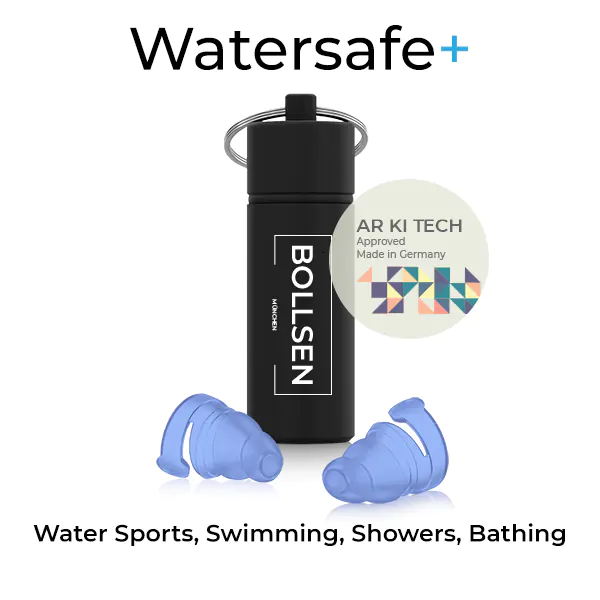
The standard Watersafe+ (£29.95) is the right choice for the vast majority of swimmers, covering pool sessions, open-water swims, and surf. If you have struggled with earplugs not seating properly in one or both ears (a complaint seen consistently among regular lap swimmers who find no plug maintains a reliable seal), the Watersafe+ AR KI TECH (£44.95) adds AI-based ear measurement. You upload two photos of your ears, the system analyses your individual ear canal dimensions, and the correct-fit earplug is shipped directly. The return rate on AR KI TECH orders is 3%, versus the typical return rate for standard-size earplugs. That is 55% cheaper than audiologist custom earplugs and requires no clinic appointment.

Every Watersafe+ purchase is backed by our 40-day money-back guarantee, with over 10,000 verified reviews across the Bollsen range. As featured in BBC Science Focus and Which?
What About Swimming Earplugs for Open Water and Triathletes?
Open-water swimming introduces challenges that pool swimming does not: cold water temperatures, wave exposure, the inability to pause and re-seat an earplug mid-session, and longer sustained immersion periods. The earplug that holds through a push-off in a 25-metre pool needs to hold through a 1.5 km lake crossing in current.
Watersafe+ is specifically designed for this environment. The dual-flange creates a seal that withstands turbulent water entry rather than just static immersion, and the 3-metre depth rating means it is not overwhelmed by wave pressure or diving starts. Our dedicated guide for open water swimming earplugs and the specific demands of wild swimming covers depth ratings, cold water risks, and surfer’s ear prevention in detail.
For triathletes, the transition from open-water swim to bike to run adds a specific requirement: earplugs that can be removed cleanly and quickly in T1 without fumbling, and ideally stored safely in a case that clips to a kit bag. Our earplug guide for triathlete swim stages addresses transition management, case storage, and race-day insertion technique in full.
How Do You Use Swimming Earplugs Correctly?
Insertion technique makes a greater difference to seal quality than most swimmers realise. For flanged silicone earplugs, the correct method (as described by U.S. Masters Swimming’s earplug technique guide for adult competitive swimmers) is to pull the earlobe upward and outward with one hand to straighten the ear canal, then press the earplug fully into position and release the earlobe. A light tug on the earplug after insertion should confirm the seal: it should feel snug, not pop out easily.
After swimming, remove the earplug by twisting gently and pulling in a single motion to release the vacuum seal rather than pulling straight back, which can cause discomfort. Rinse with clean water after each session and allow to dry before returning to the case. Never use cotton buds to dry your ear canal after swimming: they push debris deeper and are a leading cause of otitis externa alongside water exposure itself.
One important safety note: standard swimming earplugs, including Watersafe+, should not be used for scuba diving or freediving below 3 metres. At greater depths, water pressure increases significantly and can force an earplug harder against the eardrum, creating a pressure differential that is damaging. Earplugs are protective in the pool and in open water at the surface; they are not designed to equalise pressure at depth. For a full safety breakdown, our article on whether swimming earplugs are safe for different conditions and age groups covers this in detail.
For a step-by-step visual walkthrough of insertion, seating, and removal, see our dedicated guide on how to insert swimming earplugs for a secure watertight seal.
Where Do Swimming Earplugs Fit in the Wider Earplugs for Water Guide?
Swimming is one of several water-exposure contexts where earplugs are clinically recommended alongside showering, surfing, and any activity that involves regular water in or near the ear canal. Our full earplugs for water hub covers all use cases from pool to surf, with product recommendations for each scenario and links to every specialist guide in the water cluster.
If you are shopping for a child rather than yourself, Watersafe+ is designed exclusively for adult ear canals. Our separate guide to the best swimming earplugs for children covers the Bollsen Kidz+ and the specific anatomy and safety considerations for ages 3–12.
Which Swimming Earplugs Are Right for You?
If you swim regularly and want an earplug that stays in reliably, withstands flip turns, holds up in open water, and lasts an entire season, Bollsen Watersafe+ is the right answer. It is the only swimming earplug in the UK independently certified to 24 dB SNR, waterproof to 3 metres, reusable 100 times, and backed by a 40-day money-back guarantee. At £29.95 per pair with up to 100 uses, it costs less per session than replacing moldable putty plugs every fortnight.
If fit accuracy has been your barrier (one ear never quite sealing, plugs that shift mid-length), Watersafe+ AR KI TECH at £44.95 solves that with AI measurement and a 3% return rate. That is audiologist-level fit without the £150–£250 audiologist fee. Try either option risk-free: our 40-day money-back guarantee means you can test them across a full month of sessions before committing.

His connection to hearing protection stems from personal experience with sound sensitivity during live events and work in noisy environments, an issue that made him more aware of the long-term risks of unmanaged noise exposure. Today, as both a communicator and a user of BOLLSEN products, he is passionate about raising awareness around the importance of proactive hearing care.
At BOLLSEN, he develops data-driven marketing campaigns, writes SEO-focused articles, and manages communication channels that connect customers with practical knowledge about hearing protection. His work ensures that BOLLSEN’s message—prioritizing health, performance, and sustainability reaches a global audience in an engaging and trustworthy way.
Passionate about writing since childhood, Timotej combines creativity with a strong analytical approach, continuously testing new ideas in digital marketing, performance advertising, and social media. He believes in learning through innovation and collaboration, balancing leadership with openness to new perspectives.
Beyond his professional role, Timotej is committed to a healthy lifestyle and finds inspiration in fitness, sports, and quality time with friends. His personal passion for well-being aligns with BOLLSEN’s core values, making his work not only a career but also a cause he deeply believes in.