
⏱️ Estimated reading time: 14 min

Key Takeaways
The best earplugs for open water swimming need to solve a different problem from pool earplugs, and most swimmers don’t discover that until they’ve lost a plug mid-lake. In a temperature-controlled lane, the challenge is keeping water out. In a UK lake, estuary, or coastal swim, the challenges multiply: cold water at or below 15°C causes vestibular disruption the moment it reaches an unprotected eardrum; repeated sighting strokes work loose any plug that does not fit with precision; mass race starts churn turbulent water against the ear from every direction; and sustained exposure to water below 19°C triggers bony ear canal growth that accumulates year after year without any symptoms until the canal is measurably narrower.
This guide covers what a waterproof seal needs to do in moving cold water, how to choose between standard and AI-matched fit, and which options are built for the conditions UK open water swimmers actually face from January to December. For a complete overview of earplugs for water sports across all swim types and environments, the cluster pillar covers every use case.
Why Do Open Water Swimmers Face Higher Ear Risks Than Pool Swimmers?
Open water swimmers face two structural ear risks that pool lanes eliminate entirely: cold-water exostosis and caloric vertigo, neither of which develops in temperature-controlled pool environments. UK pool water is regulated to 27–29°C; UK lakes and reservoirs average 10–17°C from September through June and rarely exceed 19°C even during the warmest weeks of summer. That 19°C threshold is clinically significant: below it, repeated cold contact with the outer ear canal stimulates bone growth along the canal walls.
The second risk is caloric vertigo. When cold water reaches an unprotected eardrum, the temperature differential stimulates the vestibular system and produces brief but genuine dizziness. In a 25-metre pool lane, this is a recoverable nuisance. In open water 400 metres from shore, it is a safety concern.
Swimmer’s ear (otitis externa) is the third risk, and unlike exostosis it is not temperature-dependent. According to NHS guidance on otitis externa, prolonged water exposure softens the skin lining the ear canal and disrupts its natural acidic pH, creating conditions for bacterial infection. Open water carries a higher bacterial load than treated pool water, which raises that risk further with every unprotected session.
Does Cold Water Swimming Cause Permanent Ear Damage?
Repeated cold water swimming without protection causes permanent bony ear canal narrowing in a clinically significant proportion of long-term open water swimmers, triathletes, and year-round wild swimmers. The condition is external auditory exostoses, informally called surfer’s ear, though the mechanism is identical for any swimmer regularly entering cold water. According to StatPearls clinical data, each additional year of cold water exposure increases exostosis risk by approximately 12%, and the general population prevalence rises to 26–73% among those with sustained cold water activity.
Stanford Health Care data reports that people who have swum regularly in cold water for 20 years have approximately a 50% chance of developing significant canal obstruction. The damage accumulates silently. Early exostoses produce no symptoms. As the canal narrows, water and earwax trap more readily, recurrent infections follow, and in advanced cases the canal narrows to the point where surgical removal under general anaesthetic becomes the only resolution.
Why Do Swimming Earplugs Fall Out in Open Water but Stay in the Pool?
Swimming earplugs fall out in open water because three mechanical forces act on them simultaneously that pool swimming does not produce. The first is sighting: open water swimmers lift their head every 6–10 strokes to spot a buoy or landmark, which changes the angle of the outer ear canal relative to the waterline. A plug seated without full lamellae contact works progressively loose across a 1–2 kilometre swim as this movement repeats.
The second force is turbulence. A pool lane produces directional laminar water movement. Open water produces multi-directional chop, and in mass race starts the churned turbulence of close-contact swimmers creates unpredictable water pressure on the outside face of every earplug from angles that pool conditions never replicate.
The third factor is thermal contraction. Cold water causes mild vasoconstriction in the tissues around the ear canal, which can fractionally reduce the snug contact of a plug that was sized and inserted at room temperature. A conical 2-lamellae design addresses all three by providing two independent seal contact points: when one lamella shifts slightly under angular loading, the second maintains the waterproof barrier. Foam, putty, and single-flange alternatives rely on one contact surface and fail progressively under the cumulative stress of an open water session.
What Type of Earplug Works Best for Open Water Swimming?
Flanged silicone earplugs with a conical 2-lamellae design outperform foam, putty, and single-flange alternatives in open water because the dual seal survives the sighting rotations, mass start turbulence, and cold-water contraction that dislodge single-contact designs.
| Type | Water seal | Open water retention | Reusable | Approx. price |
|---|---|---|---|---|
| Flanged silicone, 2-lamellae | High | High, dual contact seal resists sighting rotation and chop | Up to 100 uses | £29.95–£44.95 |
| Foam | Low | Low, compresses unpredictably in cold water; fragmentation risk | Single use | £0.20–£0.50 per pair |
| Putty / moldable silicone | Medium | Low, softens at body temperature, stiffens in cold; inconsistent seal | 2–3 uses | £1.50–£3.00 per pair |
| Single-flange silicone | Medium | Medium, one contact point fails progressively under angular load | 20–50 uses | £5–£15 per pair |
Foam earplugs carry a specific open water risk: fragments can detach inside the ear canal in cold water, and retrieving a foam fragment without specialist tools is not straightforward in the field. Wax earplugs are designed for noise, not water pressure, and deform under repeated cold water immersion.
How Do Watersafe+ and Watersafe+ AR KI TECH Compare for Open Water?
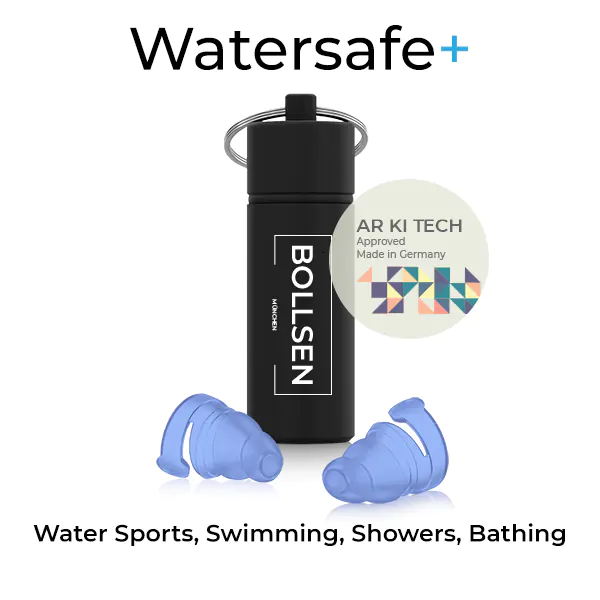
At Bollsen, our Watersafe+ and Watersafe+ AR KI TECH use the same 24 dB SNR medical-grade silicone conical 2-lamellae seal. The only difference is how the fit is determined, and in open water that difference has a direct effect on whether the earplug holds for the full session.
Watersafe+ (24 dB SNR, £29.95) comes in a universal size that suits the majority of adult ear canals. It is reusable up to 100 times, comes in a durable carry case, and is the practical starting point for recreational open water swimmers who have not previously experienced earplug slippage. Watersafe+ AR KI TECH (£44.95) adds AI ear measurement from two photos to match the earplug to your exact canal dimensions, taking approximately 2 minutes via browser with no app required. The result is a 3% return rate, compared to the significantly higher industry average. The sizing service is also available separately at ar-ki-tech for £12.00.
| Watersafe+ | Watersafe+ AR KI TECH | |
|---|---|---|
| SNR | 24 dB | 24 dB |
| Material | Medical-grade silicone | Medical-grade silicone |
| Design | Conical 2-lamellae | Conical 2-lamellae, AI-sized |
| Fit method | Standard universal size | AI measurement from 2 photos (~2 min) |
| Return rate | Industry average | 3% |
| Price | £29.95 | £44.95 |
| Best for | Recreational open water | Training, racing, triathletes |
| Reusable | Up to 100 uses | Up to 100 uses |
Both products are adults-only. For children swimming in open water, see our guide to swimming earplugs for children for age-appropriate options including the Bollsen Silicone Kidz+.


Can You Still Hear Coaching and Safety Signals While Wearing Swimming Earplugs?
Watersafe+ reduces ambient open water noise from a typical 85–90 dB to approximately 61–66 dB, within normal conversation range, while filtering out the cold-water roar and wave noise that impairs a swimmer’s orientation. The SNR arithmetic is direct: a 24 dB reduction applied to a 90 dB environment leaves 66 dB at the eardrum, approximately the level of a normal conversation in a quiet room.
A safety whistle at close range produces 100–110 dB. Through a 24 dB earplug, that registers as 76–86 dB, still clearly audible and distinct from background water noise. Voices directed at you from within 5 metres remain distinguishable. A rescue craft engine at 50 metres produces directional low-frequency sound that flanged silicone does not attenuate significantly.
The concern about situational awareness is more relevant to high-attenuation foam earplugs, which can reduce perceived sound by 33 dB or more and genuinely impair responsiveness to instructions. The 24 dB SNR of Watersafe+ sits below that threshold deliberately. US Masters Swimming recommends testing earplugs in a shallow, familiar venue before using them in unfamiliar open water.
When Should Triathletes Use Earplugs in Open Water?
Triathletes benefit more from open water earplugs than casual swimmers because their cold water exposure is systematic: 2–4 sessions per week from April through September in UK water averaging 14–18°C adds up to 50–100 cold water exposures per season. At the 12% annual exostosis risk increment identified in clinical literature, a triathlete completing 3 seasons of open water training without ear protection has accumulated approximately 36% additional baseline risk. Over a ten-year career, that is not a theoretical concern.
The T1 transition creates a practical requirement that recreational swimmers do not face: earplugs must come out quickly and cleanly in transition without fumbling. For full guidance on earplug selection across triathlon training and racing, including mass start technique and winter block preparation, see our article on swimming earplugs for triathletes. For triathletes who train through the UK winter at lake temperatures between 4–8°C, see our guide on earplugs for cold water swimming.
How Do You Insert Swimming Earplugs Before an Open Water Swim?
The correct insertion technique for swimming earplugs before an open water session is to pull the outer ear gently upward and back to straighten the ear canal, then insert with a slow twisting motion until both lamellae have seated against the canal walls and the plug does not shift on a deliberate head rotation. US Masters Swimming confirms that pulling the earlobe upward and outward straightens the canal to a more vertical alignment, reducing insertion resistance and allowing the earplug to reach the correct seating depth.
On race morning, insert earplugs during warmup rather than at the start line. Cold water causes mild vasoconstriction in the tissues of the ear canal, and a plug inserted in cold wet tissue seats differently from one inserted dry. Inserting during warmup gives the seal 10–15 minutes to settle before the mass start, which is when turbulent forces on the plug are at their highest. If a plug repeatedly shifts during the head rotation test despite correct technique, that is a fit signal rather than a method problem, AR KI TECH sizing addresses it by matching the plug to your specific canal geometry.
Are Earplugs Worth It for Recreational Open Water Swimmers?
Yes, earplugs are worth it for any open water swimmer who enters UK water more than a few times a year, because the 19°C exostosis threshold is exceeded for roughly nine months of the UK calendar and the damage that accumulates without protection is permanent. Prevention costs £29.95 per pair and lasts for 100 sessions, less than 30p per swim. Surgical correction for advanced exostosis requires general anaesthetic and carries a recovery period measured in weeks.
Watersafe+ is waterproof to full immersion, holds through sighting strokes with a correct seal, and reduces cold-water disorientation without blocking voices or safety signals. Watersafe+ AR KI TECH adds AI-confirmed fit for swimmers who need verified retention across high-frequency training sessions and race starts. Trusted by 1,000,000+ people and backed by a 40-day money-back guarantee, both products are built for the conditions UK open water swimmers face year-round. For a complete comparison of all swimming earplug types, see our complete swimming earplugs buyer’s guide.

His connection to hearing protection stems from personal experience with sound sensitivity during live events and work in noisy environments, an issue that made him more aware of the long-term risks of unmanaged noise exposure. Today, as both a communicator and a user of BOLLSEN products, he is passionate about raising awareness around the importance of proactive hearing care.
At BOLLSEN, he develops data-driven marketing campaigns, writes SEO-focused articles, and manages communication channels that connect customers with practical knowledge about hearing protection. His work ensures that BOLLSEN’s message—prioritizing health, performance, and sustainability reaches a global audience in an engaging and trustworthy way.
Passionate about writing since childhood, Timotej combines creativity with a strong analytical approach, continuously testing new ideas in digital marketing, performance advertising, and social media. He believes in learning through innovation and collaboration, balancing leadership with openness to new perspectives.
Beyond his professional role, Timotej is committed to a healthy lifestyle and finds inspiration in fitness, sports, and quality time with friends. His personal passion for well-being aligns with BOLLSEN’s core values, making his work not only a career but also a cause he deeply believes in.