
⏱️ Estimated reading time: 12 min

Key Takeaways
Cold water swimming in the UK means rivers, lakes, and coastal stretches that sit below 15°C for the majority of the year. For the ear canal, that temperature has one specific consequence that builds silently across years of exposure: bony narrowing of the canal that starts long before any symptom appears and eventually requires surgery to correct. The earplug question in cold water is not about comfort or noise. It is about whether you are accumulating damage that will surface a decade from now.
Do You Actually Need Earplugs for Cold Water Swimming?
Cold water swimmers need earplugs because water below 19°C repeatedly stimulates bone-producing cells in the wall of the ear canal, causing progressive bony growth that narrows the canal over years of unprotected exposure. According to research published in StatPearls (NCBI), the risk threshold is 19°C, below which cold water contact induces vasodilation in the bony auditory structure, triggering a slow bone-laying response. UK sea temperatures average 6–10°C in winter and reach only 15–20°C at their warmest. Rivers and inland lakes typically sit at 8–15°C year-round.
The misconception that costs wild swimmers their hearing is that auditory exostosis is a problem for surfers and not for open water or wild swimmers. The condition is triggered by cold water temperature, not by the sport. A swimmer doing two sessions per week in a Scottish loch, a Yorkshire reservoir, or an English coastal stretch accumulates equivalent cold water exposure to a regular surfer and carries equivalent risk.
Many in the wild swimming community report going years without earplugs and feeling completely fine. This is precisely how the condition works: bone growth begins well before it produces any symptom. The canal narrows in silence, and the first signs, trapped water, recurring ear infections, muffled hearing, appear a decade after the damage started.
At What Water Temperature Does Ear Damage Begin?
Auditory exostosis begins to develop at repeated cold water exposure below 19°C (66°F), with risk increasing measurably each year of continued contact at or below this threshold. The Irish Health Service Executive clinical guidance on surfer’s ear confirms that swimmers and water sports participants with frequent cold water contact are in a high-risk group, noting that coastal waters in the British Isles average 13–17°C even in their warmest months.
Research quantifies how quickly risk accumulates. Each year of sustained cold water exposure increases exostosis risk by approximately 12%. Among surfers, approximately 1 in 2 males who have been in the water for 20 or more years develop clinically significant exostosis. The condition is almost never diagnosed early because early-stage bone growth produces no symptoms and does not affect hearing. By the time a swimmer notices reduced hearing or recurrent ear infections, the canal has typically narrowed substantially.
Wind chill compounds the temperature effect. Cold wind across a wet ear after exiting the water adds thermal stress to the canal even when the swimmer is no longer submerged. This is particularly relevant for wild swimmers who cover distance in exposed coastal or upland environments and spend time on shore between sessions.
What Is Surfer’s Ear, and Do Cold Water Swimmers Develop It?
Surfer’s ear, or auditory exostosis, is the progressive bony narrowing of the external ear canal caused by repeated cold water contact, confirmed by medical literature to affect 26–73% of surfers depending on years of exposure. Cold water entering the canal triggers inflammation and an increase in vascular tension within the bony auditory structure. The body responds by laying down new bone across repeated exposures. Over 10–15 years, the canal narrows enough to trap water and earwax, cause recurrent otitis externa, and eventually produce conductive hearing loss. Severe cases require canalplasty surgery, in which the excess bone is drilled away under general anaesthetic, followed by a 2–3 month recovery period before returning to the water.
Wild swimmers and open water swimmers in the UK face the same exostosis risk as surfers because the triggering mechanism is the same. A study of 207 UK surfers found that exostosis prevalence and severity increased significantly after five years of cold water exposure. Open water swimmers who enter UK cold water two or three times per week accumulate equivalent exposure over the same period.
Which Type of Earplug Is Best for Cold Water Swimming?
For cold water swimming, flanged medical-grade silicone earplugs with a multi-lamellae design outperform foam, moldable wax, and single-flange alternatives because multiple independent sealing rings maintain a waterproof barrier through the thermal, mechanical, and movement conditions specific to cold open water.
| Earplug type | Waterproof | SNR | Reusable | Open water retention | Cold water suitable |
|---|---|---|---|---|---|
| Flanged silicone (multi-lamellae) | Yes | 24 dB | Up to 100 uses | High | Yes |
| Moldable wax or putty | Partial | 8–15 dB | 2–4 uses | Unreliable | Partially |
| Custom-moulded (audiologist) | Yes | Variable | Years | High | Yes |
| Foam | No | 26–33 dB | Single use | No | Not recommended |
Foam earplugs absorb water and should never be used in any water environment. Moldable wax and putty plugs can form a surface seal in still pool water but are unreliable in rough or turbulent open water, particularly in cold conditions where the wax hardens and loses its pliability. The practical choice for most cold water swimmers is a flanged medical-grade silicone earplug with at least two lamellae.
What Makes Earplugs Stay In During Cold Open Water Swimming?
Earplugs stay in during cold open water swimming when the design uses multiple independent sealing lamellae, because a single-ring seal cannot hold against the combined forces of cold-induced tissue contraction, wave pressure, and rotational head movements that open water swimming creates across a full session. Wild swimmers encounter conditions that pool swimmers rarely face: waves applying lateral pressure to the earplug, cold shock during immersion altering how the canal wall contacts the plug, and sustained head rotation during breathing and sighting.
Multi-lamellae designs address this with redundancy. If the outer flange flexes away from the canal wall briefly under a wave impact, the inner flange maintains the barrier. Cold water causes slight vasoconstriction and tissue firming around the ear canal after 15–20 minutes in the water. An earplug that fits well at the water’s edge may feel fractionally different by the time a swimmer has covered 500 metres in cold water, and a precisely fitted plug narrows this variation significantly.
One practical detail that experienced open water swimmers share: insert earplugs on dry land before putting on a wetsuit hood, not after. Inserting through a hood reduces precision and makes it difficult to confirm the seal by feel. Cold and numb fingers make the problem worse.
The same retention demands apply to earplugs for triathletes, where an open water mass start adds turbulence and bilateral head rotation to the challenge of keeping a plug seated through a full swim leg.
Are Bollsen Watersafe+ Earplugs Suitable for Cold Water Swimming?
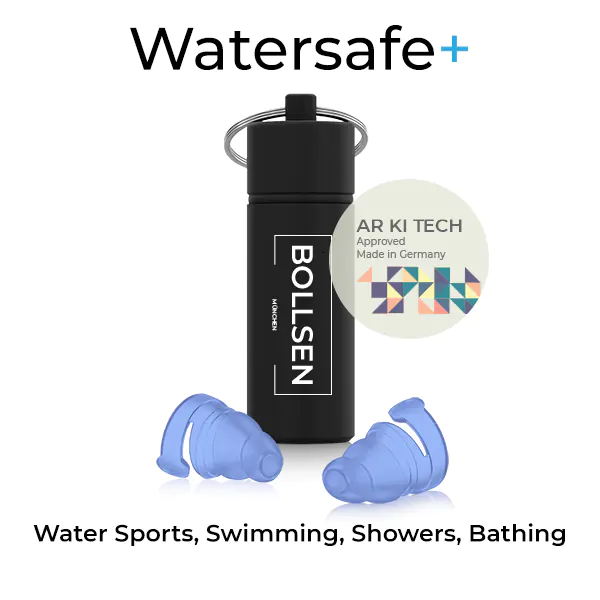
At Bollsen, our Watersafe+ earplugs are designed specifically for swimming and open water use, with a conical 2-lamellae design that creates a dual-ring waterproof seal. The outer lamella forms a broad initial contact point against the outer ear canal. The inner lamella provides a secondary pressure ring that holds when the outer seal is challenged by wave pressure, head movement, or the tissue changes that cold water causes over a long session. The medical-grade silicone is free of BPA, PVC, plasticisers, latex, and cadmium, and each pair is reusable up to 100 times.
For cold water swimmers who have previously struggled with standard sizing, Bollsen’s AR KI TECH sizing system analyses two photos of the ear using augmented reality and AI in approximately 2 minutes to recommend the correct size for each individual canal. Watersafe+ AR KI TECH achieves a 3% return rate, compared to a significantly higher industry average for standard earplugs. No app or download is required. For a complete guide covering all earplug types, the complete swimming earplugs buyer’s guide covers the full range from moldable wax to AR KI TECH custom sizing.


How Should You Insert Earplugs Before a Cold Water Session?
Insert swimming earplugs before entering the water, while your hands are still dry and at full dexterity, because cold water numbs fingers quickly and makes it difficult to seat the inner lamella correctly or confirm the seal by feel once you are standing at the water’s edge. The correct sequence for a cold water session is: earplugs in first, hood on, then enter. Reversing any step compromises the seal at the moment of first immersion when cold water pressure is highest.
Cold water swimmers wearing neoprene gloves should insert earplugs before the gloves go on. If swimming with a partner, ask them to confirm both earplugs are visibly flush and seated before entering the water. One detail the wild swimming community often learns the hard way: click the carry case lid shut before putting it down near the water. An open aluminium case at a windy river bank is not a retrieval plan.
Why Protecting Your Ears Now Matters More Than It Will Later
Auditory exostosis develops silently over years of cold water exposure, and UK rivers, lakes, and coastal waters sit below the 19°C risk threshold for most or all of the year. The swimmer who feels fine today may already be building the bone growth that will require a canalplasty under general anaesthetic in a decade. Academic research on auditory exostosis is unambiguous: consistent earplug use is the most effective and cost-effective way to reduce exostosis risk in cold water athletes.
Flanged medical-grade silicone earplugs are the only earplug type that reliably creates a waterproof seal in cold open water conditions. Trusted by 1,000,000+ people and backed by a 40-day money-back guarantee, Bollsen Watersafe+ (24 dB SNR, medical-grade silicone, reusable up to 100 times) is built for this use case, with a dual-lamellae seal that holds through open water head movements, wave exposure, and cold-induced tissue changes. For detailed advice on open water retention and cold water conditions, the complete guide to open water swimming earplugs covers the specific performance challenges that cold water swimmers face.

His connection to hearing protection stems from personal experience with sound sensitivity during live events and work in noisy environments, an issue that made him more aware of the long-term risks of unmanaged noise exposure. Today, as both a communicator and a user of BOLLSEN products, he is passionate about raising awareness around the importance of proactive hearing care.
At BOLLSEN, he develops data-driven marketing campaigns, writes SEO-focused articles, and manages communication channels that connect customers with practical knowledge about hearing protection. His work ensures that BOLLSEN’s message—prioritizing health, performance, and sustainability reaches a global audience in an engaging and trustworthy way.
Passionate about writing since childhood, Timotej combines creativity with a strong analytical approach, continuously testing new ideas in digital marketing, performance advertising, and social media. He believes in learning through innovation and collaboration, balancing leadership with openness to new perspectives.
Beyond his professional role, Timotej is committed to a healthy lifestyle and finds inspiration in fitness, sports, and quality time with friends. His personal passion for well-being aligns with BOLLSEN’s core values, making his work not only a career but also a cause he deeply believes in.