
⏱️ Estimated reading time: 14 min

Key Takeaways
The question most swimmers are actually asking is not “should I wear earplugs?” but “which type is going to stay in and do something?” At Bollsen, we make earplugs for water and have spent years looking at the research behind how different earplug materials and designs perform in the water. One finding from a 2013 Otolaryngology–Head and Neck Surgery study (Mahboubi et al., PubMed 23283829) stays with us: even in controlled surface swimming conditions, 44% of ears showed water intrusion across nine commercial earplug types. That number rises to 88% during vertical submersion. Earplug type and fit are not minor variables.
There is also a vestibular angle that barely gets mentioned. One swimmer, after years of feeling dizzy and sick after every session, was told to try earplugs. The problem vanished entirely. Water entering the ear canal does not just cause infection risk. It disrupts the balance signals the inner ear sends. The right earplug type changes both outcomes. Here is what each type actually offers, with the numbers to back it up.
What Are Flanged (Pre-Moulded) Silicone Swimming Earplugs?
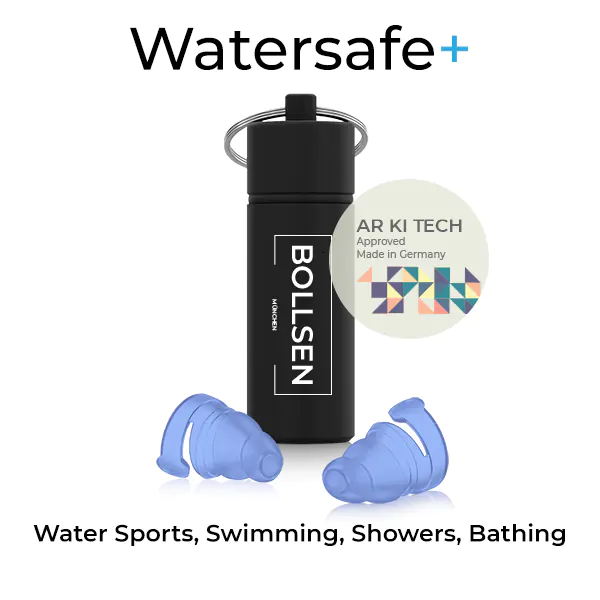
Flanged silicone earplugs are the most widely used type for regular swimmers: a firm medical-grade silicone body with one or two flanges (ridges) that compress against the walls of the ear canal to create a physical seal. Our Watersafe+ (£26.95, up to 100 uses, medical-grade silicone) is German-tested, independently certified 24 dB SNR by PZT GmbH (Notified Body No. 1974) and waterproof to 3m depth.
The dual-flange design is why this type holds up during dynamic movement. Each flange locks at a different point in the canal, so the plug cannot rotate out during a tumble turn or get dislodged when a wave hits. Triathlete communities are consistent on this point: plugs without a secure flanged fit dislodge during rough water starts, which is one of the main reasons swimmers abandon cheaper single-flange designs after their first open water event.
Flanged silicone earplugs are also the most cost-effective type over a full swim season. At up to 100 uses per pair, the per-swim cost sits below any disposable alternative. Our guide on how to insert flanged swimming earplugs correctly covers the insertion depth that makes the difference between a seal that holds through 60 turns and one that pops out after five.



What Are Mouldable Silicone Putty Swimming Earplugs?
Mouldable silicone putty earplugs are a pliable, non-inserted type: you press the putty over the ear canal opening rather than into it, and body heat allows it to conform to the outer ear geometry, producing a surface-level seal with the lowest water intrusion rate of any commercial type in surface swimming conditions (Mahboubi et al., 2013).
That research finding comes with an important caveat. The putty performed best during surface swimming specifically, not during submersion. And there is a preparation condition that product pages rarely explain: any water on the ear or in the canal before insertion prevents the putty from sealing properly. One experienced swimmer noted, after switching to mouldable silicone at age 43, that wet ears are the single most common reason mouldable putty fails. This is a practical differentiator that flanged plugs do not share.
Putty earplugs are typically single-use or rated for 3–5 uses before the material degrades. At approximately £0.30–£1.00 per swim depending on brand, they cost more per session than a reusable flanged pair over a full season. They are a reasonable choice for occasional pool swimmers who prioritise surface-level comfort, less so for open water or competitive training.
What Are Wax Earplugs and Do They Work for Swimming?
Wax swimming earplugs work on the same over-canal-opening principle as mouldable silicone putty: the user warms the wax between their fingers, shapes it into a disc, and presses it over the ear canal entrance to create a soft seal, typically lasting 3–5 uses before the wax hardens and loses adhesion.
Wax does not carry an SNR noise reduction rating for water use in the same way certified silicone earplugs do, because the seal quality varies significantly between uses depending on body temperature, water temperature, and how well the user preps the material. For casual pool swimming where the head rarely goes below the surface, wax provides adequate protection. For lap swimming with regular submersion, the inconsistency is a problem.
The economics are worth examining. A wax pair at £1.50–£3.00 for 3–5 uses works out at roughly £0.50–£1.00 per swim. A reusable flanged silicone pair at £26.95 for 100 uses costs £0.27 per swim. Wax looks cheap at point of purchase and expensive over a season.

Are Custom-Moulded Swimming Earplugs Worth the Cost?
Custom-moulded swimming earplugs are produced from impressions of your ear canal taken by an audiologist: the resulting silicone plugs fit your anatomy precisely, providing a consistent seal that does not depend on insertion technique or preparation conditions, at an initial cost of approximately £150–£250 with a lifespan of 3–5 years.
The case for custom earplugs is strongest for post-surgical swimmers (grommets, perforated eardrum, previous ear surgery) and for cold water swimmers at elevated exostosis risk. A 2002 study published in Otolaryngology–Head and Neck Surgery (Kroon et al., PubMed 12075223) found that 61–80% of cold water surfers develop auditory exostosis, with an odds ratio of 5.8 compared to non-cold-water exposure. For that group, fit accuracy is not a comfort preference; it is a clinical requirement. Whether custom earplugs are the right choice is a decision worth making with an ENT specialist, and you can read more about the safety of different swimming earplug types before that conversation.
There is now a middle option. AR KI TECH is Bollsen’s AI ear-measurement service, available with Watersafe+ AR KI TECH (£38.95): you upload two photos of your ears, the AI determines your correct size, and the correctly sized pair is shipped. The return rate on AR KI TECH orders is 3%, compared to the industry average for standard OTC earplugs, which is substantially higher. It closes the fit gap between off-the-shelf and audiologist custom without the audiologist fee. For more on how the two approaches compare, see our piece on whether custom swimming earplugs are worth it against the OTC alternatives.
Why Should You Never Use Foam Earplugs for Swimming?
Foam earplugs absorb water rather than repelling it: the material draws moisture into its porous structure, traps it against the ear canal wall, and creates the warm, damp environment in which the bacteria responsible for otitis externa thrive: the opposite of what a swimming earplug should do.
This is not a precautionary note. The NHS, the CDC, United States Masters Swimming, and the American Academy of Otolaryngology all explicitly warn against foam earplugs in water. Otitis externa clears with treatment in 7–10 days (ENT Health / AAO-HNS), but the CDC guidance on preventing swimmer’s ear is clear that prevention through the correct earplug type is preferable to treatment. Foam is not in that category.
How Do the Four Types Compare?
The table below compares each type across the attributes that actually affect a purchase decision: seal mechanism, certified noise reduction, reuse count, cost per swim, and the swimmer profiles where each type works best.
| Type | Seal method | SNR (certified) | Reuse count | Cost per swim | Best for |
|---|---|---|---|---|---|
| Flanged silicone | Dual-flange canal insertion | 24 dB (PZT GmbH certified) | Up to 100 | ~£0.27 | Pool, open water, competitive, triathlon |
| Mouldable silicone putty | Over-canal-opening compression | Varies (no standard cert) | 3–5 | ~£0.30–£1.00 | Occasional pool, surface swimming |
| Wax | Over-canal-opening adhesion | None applicable | 3–5 | ~£0.50–£1.00 | Casual pool, heads-above-water |
| Custom-moulded | Audiologist impression fit | Varies by manufacturer | 3–5 years’ lifespan | £150–£250 upfront | Post-surgical, cold water, high-frequency use |
Our full breakdown of the best-performing options at every price point is in our complete swimming earplugs buyer’s guide, which covers size selection, condition-specific picks, and the questions to ask before buying.
Which Type Should You Choose Based on How You Swim?
Type selection should follow swimmer profile, not price alone. The research on water intrusion and exostosis risk makes clear that the stakes vary considerably depending on how and where you swim.
| Swimmer profile | Recommended type | Notes |
|---|---|---|
| Recreational pool swimmer | Flanged silicone | Cost-effective, consistent seal, no preparation fuss |
| Competitive / lap swimmer | Flanged silicone (dual-flange) | Survives flip turns; 24 dB SNR reduces ambient pool noise during training |
| Open water / triathlete | Flanged silicone + AR KI TECH sizing | Retention under rough water starts is the priority; correct sizing is non-negotiable. See our guide on the best earplug type for open water swimming |
| Cold water / regular sea swimmer | Flanged silicone or custom | Exostosis risk is real at sustained cold water exposure; consistent fit matters most |
| Occasional / holiday pool | Mouldable putty or wax | Low investment appropriate for low frequency use; prepare dry ears before insertion |
| Post-surgical / grommets | Custom-moulded or flanged per ENT advice | Consult your ENT before swimming; flanged silicone is sometimes approved where custom is not available |
For a closer look at how each type performs in the medical context of otitis externa and what the NHS guidance covers, our article on the earplugs for water topic page pulls together the cluster’s evidence base in one place.
What Makes a Swimming Earplug Medically Appropriate?
A medically appropriate swimming earplug does three things: it repels water rather than absorbing it, it does not irritate ear canal skin on repeated use, and it can be kept clean between sessions. NHS guidance on otitis externa (Chelsea and Westminster NHS Trust) specifies that silicone rubber earplugs should not irritate the canal lining and recommends their use over cotton buds or other objects inserted into the ear.
The material matters because the ear canal is skin. Foam that traps moisture promotes maceration of that skin, which makes it more vulnerable to bacterial entry. Medical-grade silicone that can be washed with mild soap between swims does not carry the same risk. The American Academy of Otolaryngology’s guidance on swimmer’s ear (otitis externa) confirms that infection typically clears in 7–10 days with treatment, but the more direct question is why the infection started.
For swimmers who have already experienced otitis externa or who swim regularly in cold water, the exostosis data from Kroon et al. (2002) is worth sitting with: a 5.8 times higher odds of developing auditory exostosis in cold water exposure, with risk increasing approximately 12% per year of surfing or open water swimming. Those numbers belong in any conversation about earplug type.
Conclusion: Which Type of Swimming Earplug Is Right for You?
For most swimmers, dual-flange silicone earplugs are the answer. They carry the only independently certified noise reduction rating in the category (24 dB SNR, PZT GmbH), they are waterproof to 3m depth, they last up to 100 uses, and they cost less per swim than wax or putty over any real swim season. Mouldable silicone putty has a legitimate case for surface-only recreational swimming, with the caveat that dry-ear preparation is non-negotiable. Wax is best treated as a convenience option for occasional use. Custom earplugs remain the clinical standard for post-surgical and cold water high-frequency swimmers.
At Bollsen, we are trusted by over 1,000,000 people across 30+ countries and backed by more than 10,000 verified reviews. Our Watersafe+ flanged earplugs have been recognised as the best swimming earplugs in 2021, 2022, and 2023. If you want the fit precision of custom earplugs without the audiologist fee, the Watersafe+ AR KI TECH option uses AI measurement to get sizing right before the pair ships. Both come with our 40-day money-back guarantee.

His connection to hearing protection stems from personal experience with sound sensitivity during live events and work in noisy environments, an issue that made him more aware of the long-term risks of unmanaged noise exposure. Today, as both a communicator and a user of BOLLSEN products, he is passionate about raising awareness around the importance of proactive hearing care.
At BOLLSEN, he develops data-driven marketing campaigns, writes SEO-focused articles, and manages communication channels that connect customers with practical knowledge about hearing protection. His work ensures that BOLLSEN’s message—prioritizing health, performance, and sustainability reaches a global audience in an engaging and trustworthy way.
Passionate about writing since childhood, Timotej combines creativity with a strong analytical approach, continuously testing new ideas in digital marketing, performance advertising, and social media. He believes in learning through innovation and collaboration, balancing leadership with openness to new perspectives.
Beyond his professional role, Timotej is committed to a healthy lifestyle and finds inspiration in fitness, sports, and quality time with friends. His personal passion for well-being aligns with BOLLSEN’s core values, making his work not only a career but also a cause he deeply believes in.