
⏱️ Estimated reading time: 14 min

Key Takeaways
Surfer’s ear affects 68% of regular cold-water surfers and 3–6% of the general population, according to data from NCBI’s StatPearls and a 2025 analysis in The Conversation. It is a bone condition, not an infection, and it builds silently for years before most people recognise there is a problem. Across the UK’s growing communities of wild swimmers, open water triathletes, and kayakers, that same risk exists every time someone enters water below 19°C; given UK coastal temperatures averaging 8–15°C, this means virtually every cold-water session year-round. At Bollsen, we work with earplugs for water sports across every discipline, and surfer’s ear prevention is one of the most important reasons cold-water athletes should be wearing protection from day one.
Community experience from UK kayakers and open water swimmers consistently reflects a pattern of late discovery: a referral to an ENT specialist, an X-ray, and the realisation that significant bone growth has already occurred. “Custom-fitted ear plugs stopped the bony growths from growing,” one kayaker shared on a UK rivers forum, describing finding out about their exostosis after surgery at a Bristol ENT clinic. The most important thing to understand about surfer’s ear is that it does not warn you early enough to act without protection already in place.
What Exactly Is Surfer’s Ear?
Surfer’s ear, medically termed auditory exostosis, is the growth of new bone tissue inside the external auditory canal (the passage that runs from your outer ear to your eardrum), caused by repeated exposure to cold water and wind stimulating osteoblasts (bone-forming cells) in the canal walls. The growths narrow the canal gradually over years, trapping water, earwax, and debris that cannot drain normally.
Clinicians use a three-grade classification to describe severity: Grade 1 exostosis means the growths occlude less than 33% of the canal; Grade 2 is 33–66% occlusion; Grade 3 is more than 66% occlusion. Surgical intervention (a procedure called canalplasty) is typically considered when occlusion exceeds 80% and is accompanied by persistent symptoms such as recurrent infections or significant hearing loss. Recovery from canalplasty requires 2–3 months away from cold water, and the complication rate sits between 4–14% depending on surgical technique, according to NHS Royal Cornwall Hospitals patient information.
The condition progresses without announcing itself. Research cited by Wave Plugs and Sea Swim Cornwall states that approximately 80% of bone growth has already occurred by the time a patient first notices symptoms. That is the central risk of surfer’s ear: the window in which you can prevent significant damage is the window in which you feel entirely fine.
Who Is at Risk of Surfer’s Ear in the UK?
Surfer’s ear prevalence reaches 26–73% among regular cold-water surfers, with a systematic review average of 68%, according to StatPearls on NCBI Bookshelf. Risk increases by approximately 12% for each additional year of cold-water exposure, and the threshold temperature (below 19°C) is exceeded by UK coastal waters year-round. That makes every regular open-water session a risk event, regardless of sport.
The framing of this as a “surfer’s condition” understates the actual at-risk population in Britain. Wild swimmers, open water triathletes, kayakers, and canoeists all share the same biology. The Conversation‘s February 2025 analysis of surfer’s ear and wild swimming risk confirmed that the wild swimming growth in the UK means a substantial and growing population is now exposed to conditions that generate exostosis. The RNID’s guidance on exostosis (Royal National Institute for Deaf People) equally emphasises cold water avoidance or ear protection for anyone spending extended time in cold water, not only surfers.
The higher the frequency of exposure, the steeper the cumulative risk. Someone swimming outdoors in the UK twice a week from April through October accumulates over 50 cold-water sessions per year. The StatPearls data on cold water swimming and exostosis risk makes clear that volume of sessions, not just individual session length, drives cumulative bone growth stimulation.
What Is the Difference Between Surfer’s Ear and Swimmer’s Ear?
Surfer’s ear and swimmer’s ear are distinct conditions that are frequently confused because they share the same setting. Swimmer’s ear (otitis externa) is an acute bacterial or fungal infection of the external ear canal, resolving within days with antibiotic or antifungal ear drops. Surfer’s ear is a structural bone change that builds over years and cannot be reversed without surgery. They are related, however: a canal narrowed by exostosis traps water after swimming, and that retained moisture raises the risk of developing swimmer’s ear, a different condition from surfer’s ear, repeatedly.
| Surfer’s Ear (Auditory Exostosis) | Swimmer’s Ear (Otitis Externa) | |
|---|---|---|
| Type | Structural bone condition | Acute infection |
| Cause | Cold water and wind stimulate osteoblasts | Bacterial or fungal growth in a wet canal |
| Timeline | Develops over years; asymptomatic early | Develops within days of trigger |
| Early symptoms | None until 60–80% occlusion | Pain, discharge, itching within 24–48 hours |
| Treatment | Surgery (canalplasty) for severe cases | Antibiotic or antifungal ear drops |
| Prevention | Earplugs; reduces risk by 66% | Earplugs; dry ears thoroughly after swimming |
| Reversible? | No. Bone does not resorb without surgery. | Yes, resolves with appropriate treatment. |
This distinction matters in practice because someone experiencing their first episode of swimmer’s ear should treat the infection, then treat the underlying structural vulnerability. If you have had more than two or three episodes of otitis externa as a cold-water swimmer, your canal may already have early-stage exostosis narrowing.
Do Earplugs Actually Prevent Surfer’s Ear?
The evidence is clear: earplugs that form a watertight seal reduce the risk of developing auditory exostosis by 66%, according to a 2021 PubMed meta-analysis of 367 surfers. Hoods and neoprene headwear alone did not show statistically significant protection in the same analysis: the cold water still reached the ear canal. The earplug, not the hood, is the barrier that matters.

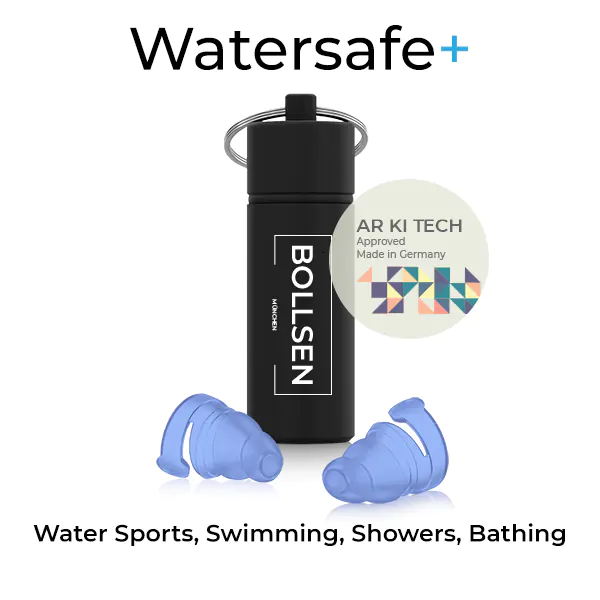
At Bollsen, we make Watersafe+ (24 dB SNR, £26.95), a dual-flange medical-grade silicone earplug certified to 24 dB SNR and waterproof to 3m depth. The dual-flange design creates a layered seal that holds during the dynamic movement of surfing, open water swimming, and kayaking, where single-flange plugs frequently unseat. Watersafe+ is rated for up to 100 uses and includes a metal carry case. Our AR KI TECH fit service, available with Watersafe+ AR KI TECH at £38.95, uses AI ear measurement from two photos to confirm correct size before dispatch, reducing the likelihood of a loose seal that would undermine protection.



For anyone asking are earplugs safe for surfers to use daily?: the answer from the clinical evidence is yes, provided the earplugs are correctly sized and do not press against the canal walls or create excessive pressure on the eardrum. Soft medical-grade silicone that conforms to the canal, rather than foam that expands aggressively, is the appropriate material for daily or near-daily use in cold water.
Which Earplugs Are Best for Cold Water Open Water Swimmers?
For cold water open water swimmers, the requirements for an effective earplug are watertight seal, stability during active movement, comfort over multi-hour sessions, and compatibility with swim caps and neoprene hoods. A 24 dB SNR rating also provides a degree of noise reduction for swimmer orientation, though the primary function here is prevention of water ingress rather than noise attenuation.
The broader context of open water swimming and exostosis prevention includes the practical question of what a swimmer can wear reliably. A plug that unseats at the turn of a flip, during a dive, or when adjusting a wetsuit hood negates its protective function. Bollsen’s dual-flange design addresses that specifically: the outer flange holds the inner flange in position even under directional water pressure up to 3m depth, which exceeds the dynamic forces encountered in all standard open water swimming scenarios.
Trusted by over 1,000,000 people and German-tested, independently certified to 24 dB SNR, Bollsen Watersafe+ has been recognised as Best Earplugs for Swimming in 2021, 2022, and 2023. For a full guide to earplug selection by swimming discipline and experience level, the earplugs for water hub covers every water sport scenario in detail.
What Does Surfer’s Ear Treatment Involve?
There is no non-surgical treatment that reverses auditory exostosis. Once bone has grown, it does not resorb on its own. The only intervention is canalplasty, the surgical removal of the bony growths using a drill or chisel technique, carried out under general anaesthetic. The procedure is well established, but carries a 4–14% complication rate (infection, temporary facial nerve sensitivity, tympanic membrane perforation) depending on technique and severity. The Royal Cornwall Hospitals NHS Trust canalplasty patient information specifies a 2–3 month recovery period during which the patient must stay out of cold water entirely.
Crucially, exostosis recurs post-surgery without continued ear protection. The surgical outcome resets the canal dimensions and does not remove the biological susceptibility to bone regrowth from cold water stimulation. Patients who return to cold-water sports without consistent earplug use after canalplasty can develop Grade 1 growths again within two to four years. Surgery is therefore not an alternative to earplugs; it is the consequence of not using them early enough.
For context on cost: the cheapest audiologist-fitted custom earplugs in the UK (Bristol Ear Health prices in the keyword research) begin at £105.50 per pair. Custom-moulded options provide an excellent fit but come with that cost and typically a waiting time for the mould appointment. For surfers who want a quality OTC alternative, Watersafe+ at £26.95 delivers certified protection at less than a quarter of the custom price, with the AR KI TECH fit service available at £38.95 for those who want size confirmation before committing.
When Should You Start Wearing Earplugs for Surfer’s Ear?
Before you have symptoms. The 80% of bone growth that accumulates silently means the decision window is early in your cold-water sporting life, not after you begin experiencing water trapping or muffled hearing. Anyone who swims outdoors in the UK with any regularity, surfs, kayaks, or participates in open water triathlon should treat ear protection as standard equipment from their first season.
The 12% annual risk increase per year of exposure means a decade of unprotected cold-water swimming carries a materially different risk profile than starting protection from year one. For those who have been swimming without earplugs for several seasons, the right time to start is now, not after a diagnosis. Even for someone who already has Grade 1 exostosis, consistent earplug use from that point prevents progression to Grade 2 and the surgical threshold of Grade 3.
The Bollsen 40-day money-back guarantee means there is no financial risk in starting. If Watersafe+ does not fit well or does not stay in during your specific water sport, return them within 40 days for a full refund. For questions about fit and daily earplug use across swimming disciplines, the cold water swimming and exostosis risk guide covers specific scenarios for year-round outdoor swimmers, triathletes, and wild swimmers in the UK.
Surfer’s ear is preventable. The clinical evidence is direct, the product solution is affordable, and the consequences of not acting are permanent. Start with protection and the 66% risk reduction works in your favour from session one. Wait until you notice symptoms, and most of the damage has already been done.

His connection to hearing protection stems from personal experience with sound sensitivity during live events and work in noisy environments, an issue that made him more aware of the long-term risks of unmanaged noise exposure. Today, as both a communicator and a user of BOLLSEN products, he is passionate about raising awareness around the importance of proactive hearing care.
At BOLLSEN, he develops data-driven marketing campaigns, writes SEO-focused articles, and manages communication channels that connect customers with practical knowledge about hearing protection. His work ensures that BOLLSEN’s message—prioritizing health, performance, and sustainability reaches a global audience in an engaging and trustworthy way.
Passionate about writing since childhood, Timotej combines creativity with a strong analytical approach, continuously testing new ideas in digital marketing, performance advertising, and social media. He believes in learning through innovation and collaboration, balancing leadership with openness to new perspectives.
Beyond his professional role, Timotej is committed to a healthy lifestyle and finds inspiration in fitness, sports, and quality time with friends. His personal passion for well-being aligns with BOLLSEN’s core values, making his work not only a career but also a cause he deeply believes in.