
⏱️ Estimated reading time: 14 min

Key Takeaways
Adult ear canals average 7–8 mm in diameter, yet most swimming earplugs are sized for children. That mismatch is why so many adult swimmers have given up on earplugs after a pair fell out on every tumble turn. At Bollsen, we hear this story constantly: someone swam for years without protection, ended up with swimmer’s ear (otitis externa) three summers in a row, and only then started looking for earplugs that actually work for adult anatomy. The CDC puts adults at 53% of all swimmer’s ear healthcare visits: the problem is common, but the solutions most adults encounter are not built with them in mind. This guide covers adult ear anatomy, the earplug types that seal correctly, and the use-case differences between pool training, open water, and daily showering. For children’s options, see our guide to swimming earplugs for children. For a broader overview of all water hearing protection, visit our earplugs for water hub.
Why Do Adult Ear Canals Need Different Swimming Earplugs?
The adult external ear canal measures approximately 25 mm in length and 7–8 mm in diameter, with an oval cross-section that differs from the more circular profile of a child’s canal. Research published in NCBI (PMC10219681) adds another layer: male adult canals run approximately 10% wider than female adult canals, meaning there is meaningful variation even within the adult population. Most mass-produced swimming earplugs are sized for the narrower end of the spectrum: if the flange diameter is built for a 5–6 mm canal, it will sit loose in a 7–8 mm adult canal and leak water under any pressure.
The outer, cartilaginous third of the canal is flexible and slightly self-adjusting. The inner two-thirds (the bony auditory canal) is rigid. A flanged earplug that seats correctly forms a perimeter seal at the canal entrance, relying on flange-to-canal-wall contact rather than compression. That contact geometry is what holds during a flip turn, a dive entry, or an open-water stroke cycle. Without it, the seal fails the moment external pressure changes.
For a detailed look at how correct earplug fit reduces swimmer’s ear incidence, see our article on how earplugs prevent swimmer’s ear in adults, where the mechanism of water-driven canal disruption is covered in full.
How Common Is Swimmer’s Ear in Adults?
Otitis externa generates approximately 2.4 million healthcare visits annually in the US alone, and the CDC reports that 53% of those visits involve adults aged 20 and older. In the UK, NHS Inform estimates that 1 in 10 people will be affected by otitis externa at some point in their lives, with swimmers 5 times more likely to develop it than non-swimmers. The condition is not, as many adults assume, primarily a children’s problem.
The mechanism is straightforward. Water trapped in the outer ear canal disrupts the protective cerumen (earwax) layer that lines the canal. This raises the canal’s pH and creates warm, moist conditions where bacterial and fungal growth accelerates. A 40% reduction in otitis externa incidence is achievable with a properly fitted earplug, according to research published in PubMed (PMID 3664417). The clinical guidance from NICE (last revised May 2024) specifically recommends earplugs for swimmers with recurrent episodes, and NHS-funded audiologist-moulded plugs are available via GP referral for persistent cases.

Adults who swim five or more times per week carry a meaningfully higher cumulative exposure than the casual pool visitor. That frequency is exactly the use case where a durable, reusable earplug earns its cost. The total cost of a prescription course of antibiotic ear drops, two GP appointments, and time off from swimming comfortably exceeds the price of earplugs that prevent the problem.
Which Type of Swimming Earplug Is Best for Adults?
Adult swimmers have four main earplug types to choose from, each with different trade-offs in fit consistency, noise reduction, and durability. For a full breakdown of all types and their use cases, see our guide to types of swimming earplugs explained.
| Type | Adult Fit Reliability | SNR | Reuse | Best For |
|---|---|---|---|---|
| Flanged silicone (dual-flange) | High: perimeter seal, consistent across uses | ~24 dB | Up to 100 uses | Lane swimming, open water, regular use |
| Moldable wax | Medium: depends on technique and canal shape | ~22 dB | Single use | Occasional use, sensitive ear canals |
| Putty/silicone moldable | Medium: reshapes each time, seal inconsistent | ~20 dB | 3–5 uses | Casual swimmers, non-chlorinated water |
| Custom moulded | Very high: exact canal impression | ~26 dB | 2–5 years | Professional and competitive swimmers |
For most adults, flanged silicone hits the right combination: enough flange diameter to seal an adult-sized canal, material that resists chlorine degradation over hundreds of pool sessions, and a consistent seal without requiring the reshaping technique that moldable types demand. Custom-moulded plugs offer the highest precision but require an audiologist appointment and typically cost £150–200 per pair.
Which Swimming Earplugs Does Bollsen Recommend for Adults?
At Bollsen, we are a hearing protection specialist trusted by over 1,000,000 people, with over 10,000 verified reviews across our range. Our Watersafe+ is built specifically for adult ear canal geometry, with a dual-flange design that creates a watertight perimeter seal rated to 3 m depth. It provides 24 dB SNR, independently certified by PZT GmbH (Notified Body No. 1974), the same German testing house that certifies our entire earplug range. Each pair lasts up to 100 uses and includes a metal carry case. We back every purchase with a 40-day money-back guarantee.


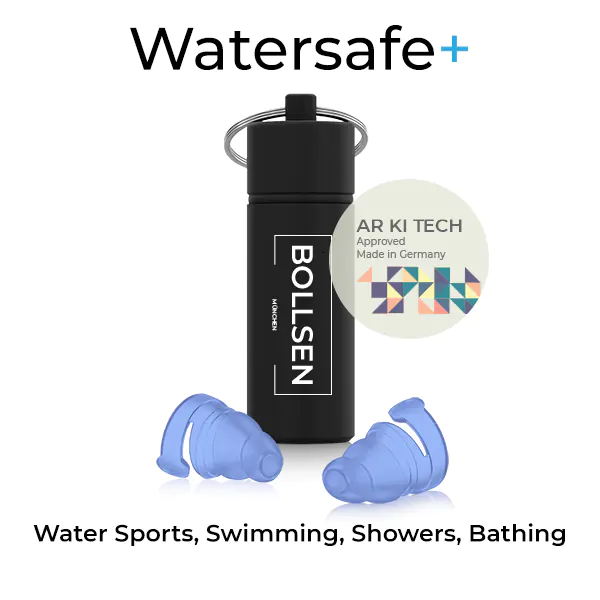

The Watersafe+ AR KI TECH adds our AI ear canal measurement service to the standard Watersafe+. You upload two photographs of your ears; the AI analyses your canal dimensions and ships the correct fit. This approach reduces our return rate to just 3% and closes the gap between off-the-shelf and custom-moulded earplugs at a fraction of the cost: roughly 55% cheaper than an audiologist-fitted pair.
For a deeper look at how we compare to other options across all swimming earplug categories, see our complete swimming earplugs buyer’s guide.
Does the Use Case Change Which Earplug Adults Need?
Adult swimmers use earplugs in three distinct contexts, each with slightly different demands on seal performance and durability.
Pool and Lane Swimming
Chlorinated pool water is the highest-frequency use case for most adult swimmers. The main mechanical challenge is pressure change: a flip turn or a hard push off the wall creates a brief pressure spike at the canal entrance that dislodges plugs with insufficient flange contact. Dual-flange silicone earplugs handle this well because the outer flange absorbs the pressure while the inner flange maintains the seal. Chlorine resistance matters here: wax and low-grade silicone degrade faster in chlorinated water, losing shape and efficacy after 10–15 sessions.
Open Water and Wild Swimming
Open water introduces colder water temperatures, which can trigger exostosis, the abnormal bone growth in the bony auditory canal caused by repeated cold-water exposure. Exostosis narrows the canal over time and is common in habitual cold-water swimmers and surfers. Earplugs reduce cold-water intrusion and are widely recommended as a preventive measure. Open water swimming also involves more variable head angles, wave impact, and body roll, so a seal that holds in a pool also needs to hold during a chaotic ocean swim. The depth rating of Watersafe+ (3 m) comfortably exceeds typical open-water submersion depth.
Showering and Daily Use
Adults with a history of otitis externa or grommets (ear tubes) often use earplugs for every shower, not just for sport. Daily use shifts the economics: a pair rated to 100 uses at £26.95 works out at 27p per use, making it one of the more straightforward medical prevention costs on a per-day basis. Medical-grade silicone can be washed with mild soap and water after each use, which matters for hygiene when earplugs are worn daily rather than occasionally.
How Should Adults Insert Swimming Earplugs for the Best Seal?
Insertion technique directly affects whether a flanged earplug seals correctly in an adult ear canal. The outer ear canal has a natural curve, and pulling gently back and upward on the outer ear while inserting the plug straightens that curve, allowing the flange to seat fully rather than catching on the canal wall at an angle. Pushing without that straightening step is the most common reason an adult reports that “earplugs don’t work for me”: the plug is not at fault, but the insertion angle is. For a full step-by-step insertion guide, see our article on correct insertion technique for adults (coming soon).
Are Swimming Earplugs Safe to Use Every Day?
Medical-grade silicone earplugs are safe for daily use when inserted and removed correctly, kept clean, and replaced when the silicone shows visible wear or the flange has lost its shape. The primary safety consideration is not the material: it is technique. Inserting too deep or using earplugs with accumulated debris can irritate the canal lining. A flanged silicone earplug with a defined insertion depth (the outer flange acts as a natural stop) is self-limiting by design and does not approach the eardrum. For a full answer to safety questions around daily earplug use, see our article on are swimming earplugs safe to use every day? (coming soon)
What Do Adult Swimmers Actually Say About Earplug Fit?
The pattern from adult swimmers is consistent: the purchase frustration is not the earplug per se, it is that the sizing problem is never explained on the packaging. U.S. Masters Swimming community threads and product review pages surface the same language repeatedly: “fell out on every tumble turn”, “I’ve tried five pairs and none seal properly”, and “cheap flanged plugs that leak water immediately.” The underlying cause in nearly every case is adult canal diameter being too large for the flange on offer. That is a geometry problem, not a user error, and it is what made us engineer a Watersafe+ with a flange profile calibrated for the 7–8 mm adult canal range.
Bollsen has been featured in BBC Science Focus and Which? as part of broader swimmer’s ear and hearing protection coverage, and our Watersafe+ has been recognised as best earplugs for swimming in 2021, 2022, and 2023.
Conclusion: Getting the Right Fit Makes the Difference
Adult ear canals are not a marginal size variation: at 7–8 mm in diameter, they are meaningfully larger than the canals most standard earplugs are designed for. That gap explains why so many adults have written off swimming earplugs after a poor experience with a product that was never built for their anatomy. A dual-flange silicone earplug with the right flange diameter seals correctly, holds during flip turns and open-water swimming, resists chlorine degradation over 100 uses, and protects against the 5x swimmer’s ear risk that every adult in the water is carrying.
If you swim regularly and have never found a pair that stays in, the issue is almost certainly fit rather than earplug type. Our earplugs for water hub covers the full Bollsen water range, or head directly to the Watersafe+ product page to find the option that fits your ear canal. We offer a 40-day money-back guarantee on every order: if it does not seal, we will sort it.

His connection to hearing protection stems from personal experience with sound sensitivity during live events and work in noisy environments, an issue that made him more aware of the long-term risks of unmanaged noise exposure. Today, as both a communicator and a user of BOLLSEN products, he is passionate about raising awareness around the importance of proactive hearing care.
At BOLLSEN, he develops data-driven marketing campaigns, writes SEO-focused articles, and manages communication channels that connect customers with practical knowledge about hearing protection. His work ensures that BOLLSEN’s message—prioritizing health, performance, and sustainability reaches a global audience in an engaging and trustworthy way.
Passionate about writing since childhood, Timotej combines creativity with a strong analytical approach, continuously testing new ideas in digital marketing, performance advertising, and social media. He believes in learning through innovation and collaboration, balancing leadership with openness to new perspectives.
Beyond his professional role, Timotej is committed to a healthy lifestyle and finds inspiration in fitness, sports, and quality time with friends. His personal passion for well-being aligns with BOLLSEN’s core values, making his work not only a career but also a cause he deeply believes in.