
⏱️ Estimated reading time: 11 min

Key Takeaways
At Bollsen, we make hearing protection worn by over 1,000,000 people worldwide, and one of the questions we hear most from swimmers is a simple one: are swimming earplugs actually safe? It is a fair concern. One swimmer put it plainly in an online forum: “I was worried earplugs would cause wax build-up, but my audiologist told me silicone ones sit at the entrance of the canal so they don’t push wax in; it’s foam ones that cause issues.” That distinction matters, and it is one the generic articles almost never make. Our earplugs for water guide covers the full range of water-use options, but this article focuses on the safety question specifically: what the evidence says about earwax, infection, tinnitus, balance, and pressure risk from wearing swimming earplugs.
Can swimming earplugs cause ear infections?
Swimming earplugs reduce the risk of otitis externa (swimmer’s ear) rather than causing it. The primary pathogen in otitis externa is Pseudomonas aeruginosa, a bacterium that thrives in warm, moist ear canals. Pool water introduces moisture; a correctly fitted silicone earplug prevents it from entering in the first place.
The CDC’s swimmer’s ear prevention guidance explicitly recommends wearing earplugs to keep ears dry during swimming. NHS Inform notes that otitis externa accounts for approximately 1 in 100 GP visits in the UK each year, and recommends custom-fitted or carefully inserted earplugs for regular swimmers. Where earplugs can increase infection risk is when they are used in an already-inflamed canal, pushed in so deeply they trap bacteria, or not cleaned between uses.
The question of whether earplugs prevent or cause swimmer’s ear is answered in depth on our article about are earplugs good for swimmer’s ear, worth reading alongside this guide if infection prevention is your main concern.
Do swimming earplugs cause earwax build-up?
Medical-grade silicone swimming earplugs carry a low earwax impaction risk because they sit at the entrance to the ear canal rather than being pressed deep inside. The impaction risk that exists with some earplug types comes from deep insertion, which physically pushes cerumen further toward the eardrum, as well as from foam earplugs specifically, which absorb water and disrupt the canal’s natural pH balance.
Cerumen is slightly acidic at approximately pH 6.1, which gives it natural antibacterial properties. Prolonged water exposure disrupts that pH balance, while foam absorption traps moisture in the canal and extends that disruption. Ear View UK’s clinical review of earplug use confirms that medical-grade silicone creates a surface seal rather than requiring deep insertion, making cerumen impaction manageable with correct technique and periodic audiologist check.
| Safety factor | Silicone swimming earplugs | Foam earplugs |
|---|---|---|
| Insertion depth | Sits at canal entrance | Inserted deep into canal |
| Water absorption | Does not absorb water | Absorbs water, traps moisture |
| Earwax impaction risk | Low: does not displace cerumen | Higher: deep insertion displaces cerumen |
| Canal pH disruption | Minimal: surface seal only | Higher: moisture retention disrupts pH |
| Reusability / hygiene | Up to 100 uses, washable | Single use or very limited reuse |
| Suitable for swimming | Yes (purpose-designed) | No (not waterproof) |
Can swimming earplugs cause tinnitus?
Swimming earplugs do not cause tinnitus. What can happen is that a sealed ear canal reduces ambient sound enough that someone with pre-existing tinnitus becomes more aware of it, but this is a perception shift, not a physiological change. The auditory nerve is not damaged by wearing correctly fitted earplugs at the surface.
ENT London’s clinical review on earplugs and tinnitus makes this distinction clearly: earplugs do not directly cause tinnitus, and silicone swim earplugs have lower tinnitus-adjacent risk than foam because they do not cause the cerumen impaction that can temporarily mimic tinnitus symptoms. If you already live with tinnitus and are concerned about swimming, our guide on can earplugs prevent swimmer’s ear covers the broader prevention picture.
Is there a risk of pressure damage or barotrauma?
Barotrauma risk from swimming earplugs is confined to sub-surface diving. At the surface (lane swimming, open water swimming, water polo, triathlons) the pressure differential is negligible and sealed earplugs are safe. The physics become relevant underwater: every 10 metres of depth increases water pressure by 1 atmosphere (100 kPa), and a sealed earplug creates a trapped air pocket that cannot equalise through the Eustachian tube.
DAN World’s barotrauma analysis explains that this pressure differential bows the tympanic membrane outward on descent, creating real injury risk. For surface swimmers (including those doing flip turns and push-offs) this mechanism is not in play. Our Watersafe+ earplugs are rated to 3m depth and are suitable for recreational surface swimming; they are not intended for scuba or freediving.

Do swimming earplugs affect your balance?
Correctly fitted earplugs do not affect the vestibular system; the balance mechanism sits in the inner ear, well past the point where a correctly positioned surface-seal earplug ends. Balance disruption from water sports is far more likely to come from water entering the ear canal and pressing against the eardrum than from an earplug blocking it.
A common experience among regular swimmers illustrates this well: “My biggest concern was whether they’d mess with my balance or make me dizzy. Turns out the opposite: before I used them I was getting water in the ear that actually made me dizzy. Earplugs fixed it.” That matches the physiology. The canal and the vestibular organs are anatomically distinct; a surface-seal earplug that prevents water ingress is protecting balance, not threatening it.
Are swimming earplugs safe if you have grommets or a perforated eardrum?
Swimming earplugs are specifically recommended for people with grommets (ventilation tubes), because the grommet creates a direct channel between the ear canal and the middle ear, and water entering through it can cause middle ear infection. A correctly fitted silicone earplug prevents water from reaching the tube altogether.
For a perforated eardrum, the same logic applies: water reaching the perforation can cause middle ear infection, so keeping the canal dry is the clinical priority. ENT guidance typically recommends earplugs for swimming in both cases. Our guide on are swimming earplugs safe for grommets covers the grommet scenario in full, including age considerations and what to look for in an earplug specifically designed for this use case.
What makes a swimming earplug genuinely safe to use regularly?
A safe swimming earplug should be made from medical-grade silicone, BPA-free, PVC-free, and latex-free: materials that do not absorb water or leach chemicals into the warm, moist environment of the ear canal. The design should create a seal at the entrance of the canal, not require deep insertion. Reusability up to 100 uses is both an environmental and a safety consideration: a cleanable earplug beats a single-use foam plug for hygiene at volume.
NHS Inform’s guidance on otitis externa prevention recommends earplugs for regular swimmers and specifically notes the benefit of careful insertion technique, consistent with the surface-seal principle. At Bollsen, our Watersafe+ swimming earplugs are independently certified at 24 dB SNR and designed to the same medical-grade silicone standard used across our full product range.


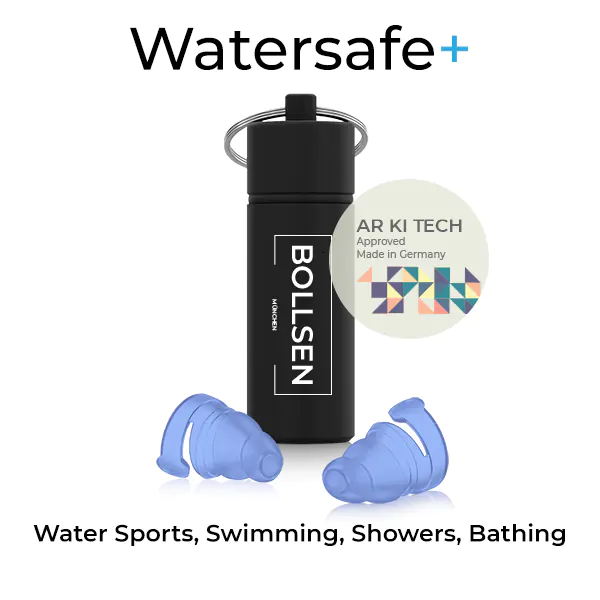

Using AR KI TECH ear measurement to confirm the right earplug size before you start swimming is worth considering if you have had fit or seal problems in the past: a correctly sized earplug stays sealed without requiring you to push it in further, which is where most of the safety risks we have covered here begin.
Swimming earplugs are safe. The caveats are real but narrow: use silicone not foam, insert at the entrance not deep, clean after every session, and do not use sealed earplugs for sub-surface diving. For most swimmers (including those with grommets, those who swim five sessions a week, and those who have been told to worry about earwax) a correctly used silicone earplug is the safer option, not a risk. Trusted by over 1,000,000 people and backed by a 40-day money-back guarantee, our Watersafe+ is designed exactly for this kind of regular, confident use. Find your fit on our earplugs for water page.

His connection to hearing protection stems from personal experience with sound sensitivity during live events and work in noisy environments, an issue that made him more aware of the long-term risks of unmanaged noise exposure. Today, as both a communicator and a user of BOLLSEN products, he is passionate about raising awareness around the importance of proactive hearing care.
At BOLLSEN, he develops data-driven marketing campaigns, writes SEO-focused articles, and manages communication channels that connect customers with practical knowledge about hearing protection. His work ensures that BOLLSEN’s message—prioritizing health, performance, and sustainability reaches a global audience in an engaging and trustworthy way.
Passionate about writing since childhood, Timotej combines creativity with a strong analytical approach, continuously testing new ideas in digital marketing, performance advertising, and social media. He believes in learning through innovation and collaboration, balancing leadership with openness to new perspectives.
Beyond his professional role, Timotej is committed to a healthy lifestyle and finds inspiration in fitness, sports, and quality time with friends. His personal passion for well-being aligns with BOLLSEN’s core values, making his work not only a career but also a cause he deeply believes in.