
⏱️ Estimated reading time: 24 min

Key Takeaways
If you are searching for earplugs for dentists, you have probably already noticed something. A faint ringing after a long list, or the way the high-pitched whine of the drill seems to live in your ears long after the patient has gone home. That whine is not just annoying. A high-speed handpiece can reach 98 to 102 dB SPL, and clinicians describe the damage as something that accumulates quietly over a career until one day it is simply there.
We are Bollsen, a family-run hearing protection company founded in 2016 and trusted by over 1,000,000 people, with all of our earplugs independently tested and certified in Germany. We wanted to understand this problem from the inside, so we spoke with a practising dentist who wears our earplugs at the chair every day.
Her name is Anita Stadler, a Zahnärztin (dentist) working in Munich. You can verify her practice at her Munich dental practice. This article is built around her experience and the occupational evidence behind it.
If you scan the dental forums and the niche product brands, the advice tends to stop in the same place. Dental tools are loud, hearing loss is a risk, and you should pick something comfortable that still lets you hear your patient. All true, and all a little vague. What follows is more specific. We will look at how loud each instrument actually is, why the pitch of the drill matters more than the raw volume, how a normal working day adds up to a hazardous dose, why so few dentists wear protection today, and what a practising clinician chose to wear at the chair once she understood the numbers.
Do dentists really lose their hearing?
Yes, and the evidence is stronger than most clinicians realise. A 2024 study in the Journal of Occupational Medicine and Toxicology on hazardous noise in dental professionals found clinically defined hearing loss in 61% of male ears and 25% of female ears, alongside a tinnitus prevalence of around 40%.
That tinnitus figure split roughly into 58% constant and 42% intermittent ringing, the kind of thing you stop noticing during a busy clinic and then hear loudly the moment you sit down in a quiet room. You can read the full peer-reviewed study on noise-induced hearing loss in dental professionals for the methodology and cohort detail.
The damage is cumulative and largely silent. The outer hair cells in the cochlea do not regenerate, so once high-frequency sensitivity is gone, it is gone for good. The World Health Organization is blunt about this. Noise-induced hearing loss is permanent, and it is almost entirely preventable. That last word is the one to hold onto. Unlike the wear and tear of age, this is a hazard you can largely remove from the job, and the tool for doing so costs less than a single box of gloves over its lifetime.
What are the early warning signs?
The first sign is rarely deafness. It is usually a temporary ringing in the ears after a long list, or a dull, blocked feeling that lifts overnight. Audiologists call that a temporary threshold shift, and it is the ear’s way of telling you it has been pushed too hard. Other early flags are familiar to a lot of clinicians: turning the television up louder than your family wants it, struggling to follow conversation in a busy restaurant, or asking patients to repeat themselves more than you used to. The trouble is that each of these creeps in slowly, so it is easy to write off as tiredness or a noisy environment.
The pattern matters because the temporary ringing of today is the warning before the permanent ringing of tomorrow. Repeated temporary shifts gradually become a fixed loss, and once the high-frequency hair cells are gone they do not come back. If any of these signs sound familiar, it is worth treating them as a prompt to start protecting your hearing now and to book a baseline hearing test, rather than as something to wait out.
How loud is a dental drill, really?
Loud enough to matter, and the easiest way to see that is to compare it to everyday sounds. A normal conversation is about 60 dB. A busy main road is around 80 dB. A petrol lawnmower or a food blender sits near 90 dB. A high-speed drill cutting a tooth measures about 91 dB, so it is roughly as loud as that lawnmower, except it is inches from your head. A high-speed handpiece can climb to 98–102 dB, closer to a road being dug up, and the ultrasonic scaler used for cleaning adds another 92–98 dB on top.
The reason those numbers are worth taking seriously is that every 3 dB roughly doubles the sound energy hitting your ear. So the jump from a normal chat at 60 dB to a drill at 91 dB is not a small step up in volume, it is a huge one. The American Dental Association guidance on hearing loss notes dental equipment runs anywhere from 60 to 99 dB, used in short 15 to 45 minute bursts several times a day, over a career that can span three or four decades. The harm does not come from one loud moment. It comes from thousands of small ones.
| Sound at the chair | How loud | What that is roughly like |
|---|---|---|
| Normal conversation (for comparison) | ~60 dB | Chatting across a desk |
| High-speed turbine on a tooth | ~91 dB | A petrol lawnmower |
| High-speed handpiece | 98–102 dB | A road being drilled up |
| Micromotor handpiece | ~92 dB | A food blender up close |
| Ultrasonic scaler (cleaning) | 92–98 dB | A powerful hairdryer or hand drill |
| 85 dB — the safety line | 85 dB | Where UK law says ears must be protected |

That last row is the one to remember. In the UK, the Control of Noise at Work Regulations 2005 treat 85 dB, averaged across the working day, as the point where an employer must step in and provide hearing protection, with a hard ceiling of 87 dB. Look back at the table and you will see that several of the tools a dentist uses are already at or past the level the law treats as a workplace hazard.
How does a working day add up to a hazardous dose?
What actually damages your ears is not how loud any single moment is, but how much loud sound they soak up across the whole day added together. A useful way to picture it is sunburn. A few minutes of fierce midday sun can do as much damage as a long afternoon of mild sun. Noise works the same way, and because of how sound adds up, a few minutes of drilling at 100 dB can harm your hearing as much as hours spent at 91 dB. The short, loud bursts count for far more than they feel like they should.
A dentist might only have the drill running for a small part of each appointment, but those bursts repeat across a full list of patients, and then again every working day. Add the scaler, the suction and the compressor humming in the background, and the running total quietly climbs. That is why a surgery which feels perfectly calm between patients can still push a dentist past the 85 dB safety line by the end of the day. You never feel the dose building up, and that is exactly what makes it easy to ignore, which is why protection works best worn as a habit for every drilling and cleaning job, rather than saved only for the loudest cases.
Why does the drill’s whine do the most damage?
Because the danger sits in the pitch, not just the volume. The air turbine spins fast enough to produce a tonal sound with its spectral energy concentrated above 6 kHz, and that is precisely the region where dentists show the worst damage, with threshold shifts clustering at 4,000 and 6,000 Hz.
Audiologists call that pattern the noise-induced hearing loss notch. It is a tell-tale dip on a hearing test, and in dental professionals it lines up almost perfectly with the frequency of the drill. Research on turbine drill noise and dentists’ hearing has documented exactly this, a tonal source with a peak above 6 kHz and elevated auditory thresholds at 4,000 and 6,000 Hz in long-serving clinicians.
This is the part most generic advice misses. A high-frequency, high-pitched source needs protection that works hardest exactly there. That single fact shapes which earplug actually helps a dentist, and it is where the conversation with Anita turned to what she wears at the chair.
So why do so few dentists wear protection?
If the evidence is this clear, the obvious question is why hearing protection is still rare at the chair. The answers come up again and again. The most common is communication: dentists worry that anything in their ears will stop them hearing the patient, the nurse or a practice alert. The second is comfort, because foam plugs that work for a single flight feel intrusive and warm across a full clinical day, and they need replacing constantly. The third is simply habit. Dental training spends a great deal of time on cross-infection, posture and radiation, and very little on noise, so protection never becomes part of the routine the way gloves and loupes have.
There is also a quieter reason, which is that the damage never announces itself. Nobody finishes a list with a sharp pain that says their hearing was harmed today, so it is easy to assume everything is fine. By the time the loss is obvious it is already permanent. Each of these objections has a sensible answer, and the rest of this article works through them, starting with what a clinician who took the problem seriously actually decided to wear.
What does Anita Stadler wear at the chair?
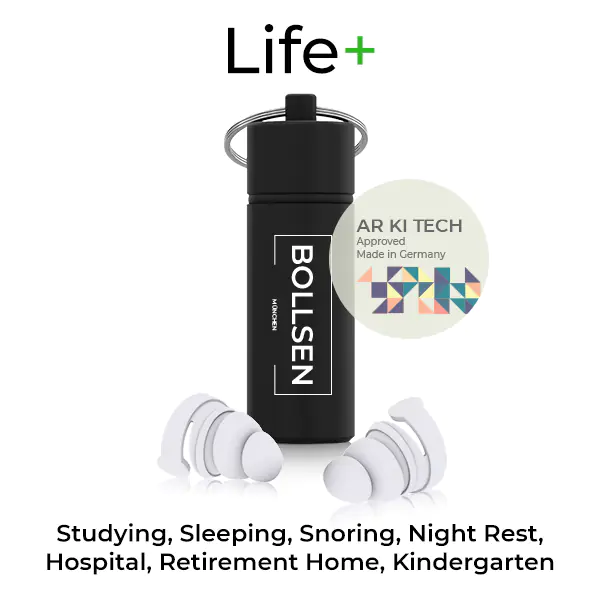
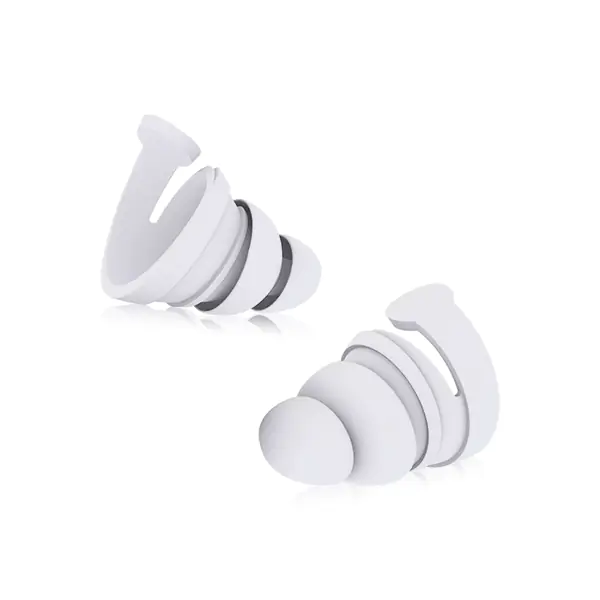
She wears Bollsen Life+, a reusable medical-grade silicone earplug certified to SNR 24 dB under EN 352-2. It sits low and flush in the ear canal with no protruding stem, which means it stays comfortable through a full list and disappears under a loupe headband or surgical cap.
The reason Life+ suits dentistry specifically comes down to its attenuation curve. A passive earplug like this attenuates high frequencies most, rising from around 22 dB in the lows to roughly 35 dB at 8 kHz. The drill’s whine lives in the highs, so the protection is strongest exactly where the risk is greatest.

Notice how neatly that lines up. The turbine’s piercing energy sits above 6 kHz, and the threshold shifts that show up on a long-serving dentist’s hearing test cluster at 4 and 6 kHz. Those are the same frequencies where a passive silicone plug like Life+ does its heaviest work, climbing well past its headline 24 dB figure as the pitch rises. So rather than knocking the whole room down by a flat amount, the protection bites hardest on the one part of the sound that does the most harm. For a dentist that is the difference between protection that feels useful and protection that just makes everything feel muffled.
Comfort over a long day is the other half of the equation, and it is where reusable silicone pulls ahead of disposable foam. Life+ has a low-profile shape with no stem sticking out of the ear, so it sits flush and disappears under a loupe headband, a surgical cap or the arms of safety glasses. There is nothing to catch when you lean over the chair or turn your head to the nurse, and because it does not expand and press the way foam does, it can stay in comfortably across back-to-back appointments rather than being pulled out and pushed back in between patients.
In the clip, Anita inserts a Life+ earplug and the shrill drill softens into a Strauss waltz, her way of picturing calm, focused work instead of the daily scream of the handpiece.
Life+ does not seal you off from the room, and that is the point. It reduces the overall noise by around 24 dB, so your patient, your nurse and the practice alerts stay audible because they are close to you and loud enough to carry, simply at a lower, less fatiguing level.


For the wider picture of how reusable hearing protection fits into a noisy job, our guide to earplugs for work covers occupational noise across trades where the daily dose climbs past 85 dB. And because so much dental hearing damage shows up first as ringing, our resource on earplugs for tinnitus is worth a look if the ringing has already started.
Will earplugs stop you hearing your patient?
No, and this is the single biggest objection dentists raise. The recurring worry across dental forums is that plugs will leave you unable to hear or communicate with the patient in the chair, and it is a fair concern that deserves an honest answer rather than a marketing line.
So here is the honest answer. A passive plug at SNR 24 dB turns the whole room down by roughly 24 dB. Your patient is sitting half a metre from your face and speaking at normal conversational volume, so their voice is still clearly there, just quieter. The drill, which was the loudest thing in the room, drops below the threshold where it does damage and stops dominating.
We are deliberately not claiming Life+ is a flat filter or that it leaves every sound untouched. It does not. It is a passive earplug that reduces noise, and it reduces the high-pitched drill most of all. That happens to be exactly what a dentist needs.
There is a counter-intuitive upside here. When the drill is no longer screaming over everything else, your brain stops straining to pick speech out of the noise, which is genuinely tiring over a full day. Several clinicians describe the opposite of what they feared. With the loudest sound brought under control, they actually follow conversation more easily because the background is calmer. The patient who is half a metre away is still clearly audible, just at a gentler level.
What about the suction alarm and the practice alerts?
This is the natural follow-up worry, and the reassuring answer is that alarms are designed to be heard. A suction or equipment alert, a colleague calling across the surgery, or a reception buzzer are all loud, attention-grabbing sounds, and reducing the room by around 24 dB does not make them vanish. It simply brings the whole soundscape down together, so the alert still cuts through, just as a phone ringing in the next room is quieter but unmistakable. Because Life+ is a passive plug rather than active noise cancellation, there is no electronics deciding what to let through and nothing to switch on, fail or run out of battery mid-procedure. What you lose is the punishing edge of the drill, not your awareness of the room.
What makes Life+ a good fit for a full clinical day?
Comfort and reusability over long hours. Life+ is made from hypoallergenic, biocompatible medical-grade silicone, with a patented low-profile shape that does not press or protrude, so it can stay in across back-to-back appointments without the soreness disposable foam causes.
Each pair is washable and lasts up to 100 uses, which works out at roughly 27p per use for a single pair at £26.95. For a clinician wearing protection every working day, that is a far cleaner option than a drawer full of single-use foam, and it ships with an aluminium travel case to keep them hygienic between sessions.
How do you fit and clean reusable earplugs in a clinical setting?
Fitting is quick once you have done it a couple of times. With clean hands, reach over the top of your head, gently lift the ear upward and back to open the canal, then ease the plug in with a small twist until it seats and the room drops noticeably in volume. If sound is still leaking, it is not yet seated, so adjust rather than force it. The seal is what delivers the protection, especially in the high frequencies, so a few seconds spent getting it right is worth it.
Hygiene fits naturally around a clinical day. Because the silicone is washable, you can rinse the plugs with mild soap and warm water and let them dry, then store them in the aluminium case rather than loose in a pocket or a drawer. Wash them at the end of a list, keep them out of the spray field during procedures, and replace the pair when the surface starts to feel rough or the fit loosens. Treated this way a single pair comfortably reaches its full lifespan, which is part of why reusable silicone ends up cleaner and cheaper than a rolling supply of disposable foam.
Fit matters more here than in almost any other setting, because a poorly seated plug loses attenuation precisely in the high frequencies you most need to block. If you are unsure of your size, our AR KI TECH ear measurement uses two photos to match you to the correct size and reduces returns to around 3%.
| Hearing protection option | Attenuation | Reusable | Fit for dental use |
|---|---|---|---|
| Bollsen Life+ silicone | SNR 24 dB (up to 35 dB at 8 kHz) | Up to 100 uses | Low-profile, all-day comfort, strongest in the highs |
| Disposable foam plugs | Varies, often poorly seated | Single use | Cheap but inconsistent fit and waste |
| Earmuffs | High | Yes | Bulky, clash with loupes and clinical movement |
Are these better than foam plugs for clinical work?
For occasional, one-off noise, foam plugs are fine. For a job you do every day, they have real drawbacks in a clinical setting. Foam has to be rolled down and inserted correctly each time, and in practice it is often seated poorly, which quietly throws away the high-frequency attenuation a dentist needs most. It expands and warms in the canal, so it tends to feel intrusive across a long list, and it is single-use, which means a constant stream of waste and cost. A reusable silicone plug like Life+ keeps a consistent shape and seal each time you insert it, sits flush under loupes and caps, wipes clean and lasts up to 100 uses. When you are protecting your hearing for hours at a stretch rather than minutes, that consistency and comfort is the difference between protection you actually keep in and protection you take out after twenty minutes.
What should you look for in earplugs for dentistry?
A few practical criteria narrow the field quickly. Look for a certified attenuation figure, ideally tested to a recognised standard such as EN 352-2, so you know the protection is real rather than a marketing claim. Favour a plug whose attenuation rises in the high frequencies, because that is where the drill whine and the risk both sit. Prioritise a low-profile, stem-free shape that will not clash with loupes, caps and glasses, and choose a material you can wear comfortably for hours, which in practice means soft medical-grade silicone over expanding foam. Reusability and easy cleaning keep the running cost and the waste down. Finally, getting the size right matters more than the brand on the box, since a loose plug leaks exactly the high frequencies you are trying to block.
Is dental hearing loss reversible, and what should you do now?
No, it is not reversible, which is the whole reason to act before the notch appears. Once the high-frequency outer hair cells in the cochlea are damaged by years of noise-induced hearing loss, they do not grow back, and no hearing aid fully restores what was there.
The practical steps are simple and worth doing this month. Get a baseline hearing test so you can monitor any threshold shift, as the ADA recommends, treat anything at or above 85 dB as a daily dose to manage, and wear protection that is strongest in the high frequencies for every drilling and scaling task. A baseline matters because it gives you something to compare against year on year, so a small slip at 4 or 6 kHz can be caught while it is still just a number on a chart rather than something you notice in conversation.
It is also worth bringing the rest of the team along. Hygienists and nurses share the exposure, so making protection standard chairside kit, the same way gloves and eye protection already are, removes the awkwardness of being the only person wearing it. The cost is small, the habit is easy once it is built, and the payoff is the one part of your sensory health that cannot be repaired or replaced later. Of everything on a dentist’s daily risk list, hearing is the quietest threat and one of the simplest to neutralise.
Protecting your hearing is the one part of the job you cannot delegate or repair later. If you want a comfortable, German-tested, independently certified 24 dB earplug you can wear through a full list, Bollsen Life+ for daily hearing protection comes with a 40-day money-back guarantee, so you can try it risk-free at the chair. Find your earplugs and protect the hearing you rely on every day.

His connection to hearing protection stems from personal experience with sound sensitivity during live events and work in noisy environments, an issue that made him more aware of the long-term risks of unmanaged noise exposure. Today, as both a communicator and a user of BOLLSEN products, he is passionate about raising awareness around the importance of proactive hearing care.
At BOLLSEN, he develops data-driven marketing campaigns, writes SEO-focused articles, and manages communication channels that connect customers with practical knowledge about hearing protection. His work ensures that BOLLSEN’s message—prioritizing health, performance, and sustainability reaches a global audience in an engaging and trustworthy way.
Passionate about writing since childhood, Timotej combines creativity with a strong analytical approach, continuously testing new ideas in digital marketing, performance advertising, and social media. He believes in learning through innovation and collaboration, balancing leadership with openness to new perspectives.
Beyond his professional role, Timotej is committed to a healthy lifestyle and finds inspiration in fitness, sports, and quality time with friends. His personal passion for well-being aligns with BOLLSEN’s core values, making his work not only a career but also a cause he deeply believes in.