
⏱️ Estimated reading time: 15 min

The best earplugs for concerts are reusable high-fidelity earplugs that bring the volume down without muffling the music, so the gig still sounds full and clear, just at a safe level. A single loud concert can run at 100 to 110 dB and do lasting damage, yet cheap foam plugs muffle the sound so much that most people take them out. A passive high-fidelity plug protects your hearing while keeping the music intact. We recommend the Music SoundPRO, a passive silicone earplug rated SNR 24 dB, reusable up to 100 times at £26.95, designed to keep concerts sounding like concerts.
Key Takeaways
If you are searching for the best earplugs for concerts in the UK, you have probably already had that walk home after a gig with a high-pitched ring in both ears. One person on a music forum described wearing high-fidelity earplugs through a five-hour EDM set in the front row and leaving with no ringing at all, still able to hear every part of the show.
That gap between the two experiences is the whole point. We are Bollsen, a hearing protection company that has made reusable, German-tested earplugs for over a million people since 2016. This guide ranks what actually matters when you are choosing concert earplugs, and matches the right level of protection to where you stand on the night.
A typical gig runs between 95 and 120 dB depending on the venue and your position. Damage starts at 85 dBA, so almost every concert you go to is loud enough to put your hearing at risk.
Do earplugs actually ruin concerts?
No. Concert earplugs turn the volume down, not off, so the music still reaches you with its energy intact, just at a level your ears can handle for the whole night. The fear that plugs will muffle everything into mush is the single biggest reason people skip protection, and it is the wrong call.
The evidence is hard to argue with. In a study cited by the NIH on how effective earplugs are, only 8% of people who wore earplugs at a 4.5-hour, roughly 100 dB concert had temporary hearing loss afterwards, against 42% who went without. Tinnitus showed up in 12% of the earplug group versus 40% of the unprotected one.
So the people most likely to leave a gig with ringing ears and a dulled night of music are the ones wearing nothing. Lowering the volume by a fixed amount is what keeps the experience clear instead of painful.
The myth comes from disposable foam, which does block sound badly and unevenly. Purpose-made concert plugs work differently, and once people try a proper pair they tend to wonder why they spent years walking home with their ears screaming.
Who needs concert earplugs the most?
Anyone who goes to live music regularly needs concert earplugs, but the risk is highest for people exposed to loud sound often or for long stretches: gig regulars, festival campers, DJs, sound engineers and bar staff working the floor. Repeated exposure adds up over a season and a lifetime, and the damage is cumulative.
Casual concert-goers still need protection, because even one 100 dB set runs well past the safe exposure time. Younger ears are not immune either, which is part of why the risk to young people from recreational noise is so widely flagged by health bodies.
If you take a child to an outdoor show or fireworks-style event, the same logic applies at a smaller scale. Our earplugs for kids are sized for ages 3–12 and rated 24 dB so younger ears get the same level of protection on a loud day out.
How loud is a concert, really?
A concert ranges from about 95 dB at an intimate club to 120 dB right in front of the speakers, with festival main stages sitting around 100–115 dB. For comparison, hearing damage risk begins at 85 dBA, the same threshold the UK uses in its Control of Noise at Work Regulations.
What makes loud music sneaky is the 3-dB exchange rate. According to the CDC guidance on noise-induced hearing loss, every extra 3 dB halves the time you can safely listen. At 100 dB you have about 15 minutes, and at 115 dB that drops to roughly 28 seconds.
Most sets run an hour or more, so the maths runs out long before the encore. The table below shows how venue type maps to volume and the protection that suits it.
Your position in the room changes the picture as much as the venue does. Standing at the barrier in front of a speaker stack can add 10 dB or more over the same gig heard from halfway back, which is the difference between a few minutes and a quarter of an hour of safe exposure.
| Venue type | Typical volume | Safe time unprotected | Recommended attenuation |
|---|---|---|---|
| Intimate club / small gig | 95–105 dB | ~15 min to 1 hr | 15–24 dB SNR |
| Outdoor festival main stage | 100–115 dB | ~28 sec to 15 min | 20–25 dB SNR |
| Front-of-stage / near speakers | 110–120 dB | under 1 min | 24 dB SNR or higher |
How many dB should earplugs be for concerts?
For concerts, look for earplugs rated between 15 and 30 dB on the SNR or NRR scale, with around SNR 24 dB being the sweet spot for most gigs and festivals. That much reduction pulls a 110 dB stage down to roughly 86 dB, close to the safe threshold, while leaving plenty of music to enjoy.

Going much higher than 30 dB is usually overkill for live music and can leave you feeling cut off from the room. Going much lower leaves the loudest stages still in damage territory. The 24 dB mark covers club nights and festival main stages without forcing you to compromise on the experience.
One thing worth understanding is that no passive earplug removes the same number of decibels at every pitch. Like most silicone plugs, the higher frequencies are reduced a little more than the low end, so the bass still comes through with real weight. That is normal and expected, and it is why a passive plug brings the whole gig down to a safer level while still sounding like the show you came for.
What is the difference between SNR and NRR?
SNR (Single Number Rating) is the European measure and NRR (Noise Reduction Rating) is the American one, and both describe roughly how many decibels a plug removes. A UK buyer will mostly see SNR figures, and an SNR 24 dB plug is a strong, dependable choice for live music.
Which earplugs are the best for concerts in the UK?
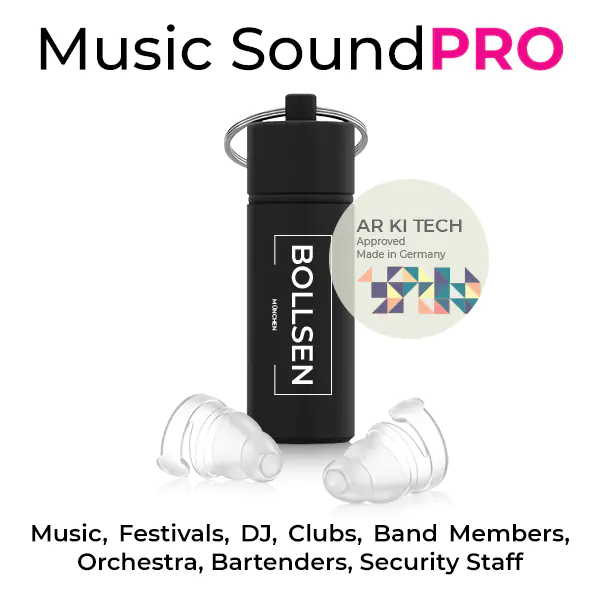
The best concert earplugs for most UK gig-goers are reusable silicone plugs rated around SNR 24 dB, and our pick is the Music SoundPRO, which brings the volume down so you still hear the music, just quieter. They are passive plugs that reduce the overall sound level rather than reshaping it, which is exactly what a loud stage calls for.
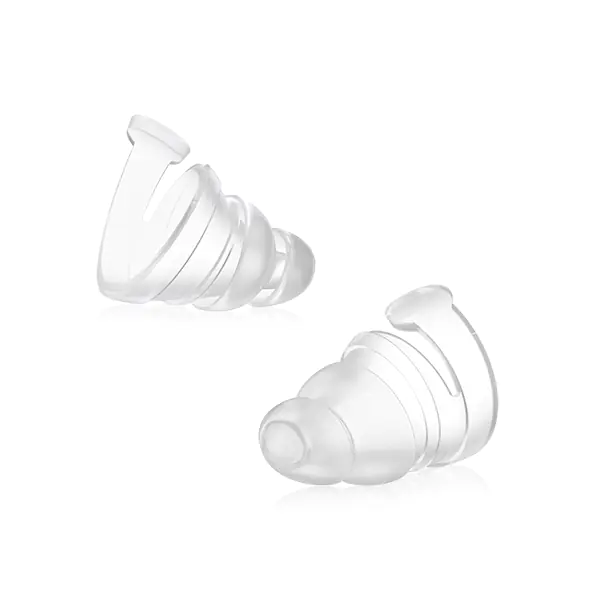
Music SoundPRO uses the same medical-grade, 2-lamella silicone body as the rest of our range, independently certified by PZT GmbH in Germany. The transparent design sits flush in the ear canal so it stays comfortable through a long set and is practically invisible, which answers a real complaint we hear about bulkier ring-style plugs that some people find uncomfortable over several hours.
At £26.95 for a pair that lasts up to 100 uses, that works out at about £0.02 per gig, and every set ships with an aluminium case so they survive the bottom of a festival bag. They are German-tested and independently certified at 24 dB, backed by a 40-day money-back guarantee, and trusted by over 1,000,000 people including techno DJ UMEK.
For dependable passive protection that turns loud stages down to a safer level, you can shop the Music SoundPRO earplugs for concerts and try them risk-free across a full season of gigs and festivals.
If you want help getting the right fit before a big run of shows, our AR KI TECH ear measurement service uses two photos of your ears to match your size and bring returns down to 3%. For the full picture across festivals, clubs and rehearsals, browse our earplugs for music hub before you decide.


Are high-fidelity reusable earplugs worth it versus foam?
For concerts, reusable silicone plugs are worth it over disposable foam because foam tends to muffle music heavily and unevenly, while reusable plugs like Music SoundPRO lower the volume more cleanly and last far longer. Foam is rated high, often NRR 30–33 dB, but at the cost of a flat, blocked-up sound that buries vocals.
The cost-per-use gap is just as real. A single pair of reusable plugs at £26.95 over 100 uses is about £0.02 a night, while binning foam after every gig adds up across a festival season. The table below lays the two options side by side.
| Factor | Reusable silicone (Music SoundPRO) | Disposable foam |
|---|---|---|
| Rating | SNR 24 dB | NRR 30–33 dB |
| Sound quality | Volume down, music still clear | Heavy, uneven muffle |
| Lifespan | Up to 100 uses | 1–2 uses |
| Cost per gig | ~£0.02 | Adds up per night |
| Comfort over hours | Flush silicone fit | Expands, can feel blocked |
| Waste | Reusable, plastic-free | Single-use landfill |
Foam still has a place as an emergency backup if you forget your plugs. For anyone going to gigs regularly, a reusable pair pays for itself fast and sounds better doing it.
There is a sustainability angle too. A pair you keep for around 100 nights replaces dozens of foam plugs headed for landfill, and our silicone is plastic-free and reusable by design. Protecting your ears does not have to mean a bin full of single-use foam by the end of the summer.
Can one loud night really cause tinnitus?
Yes, one loud concert can trigger tinnitus, the ringing or buzzing that sometimes lingers long after the music stops. It happens because sustained high volume damages the tiny hair cells in the cochlea, and those cells do not grow back.
The worry people carry home, whether the ringing will ever stop, is common and understandable. The reassuring part is that this is largely preventable. The WHO guidance on safe listening estimates that over a billion young people are at risk of hearing loss from recreational noise, much of it avoidable with simple protection.
Wearing concert earplugs from the first support act onward is the most direct way to lower that risk. If you already live with ringing, our earplugs for tinnitus protect against the loud exposure that can make symptoms worse.
How do you wear concert earplugs correctly?
To wear concert earplugs correctly, gently pull your outer ear up and back, slide the plug into the ear canal until it sits flush, then let your ear settle so the seal forms. A proper seal is what delivers the full SNR 24 dB of protection, and a loose fit can lose several decibels.
Put them in before the music starts rather than waiting until your ears already hurt. Keep them in for the full set, including the support acts, since the cumulative exposure over an evening is what does the damage. If a plug ever feels like it is working loose during an energetic set, reseat it quickly between songs.
Fit also affects how clean the music sounds. A plug sitting too shallow can feel hollow, while a properly seated one settles into the canal and disappears. If you find sizing fiddly, getting the right size first time is the single biggest improvement you can make to both comfort and protection.
How do you look after reusable concert earplugs?
Reusable silicone concert earplugs last up to 100 uses when you rinse them with water and mild soap after a sweaty gig and let them dry before storing. Keeping them in their aluminium case stops them collecting fluff and grit in a bag, which is what shortens the life of cheaper plugs.
Check the silicone every so often for splits or a loss of springiness, since a worn plug seals less well and protects less. Looked after properly, a single pair comfortably covers a full year of regular gig-going, which is where the cost-per-use maths comes from.
What about festivals and multi-day events?
Festivals stack the risk because you are exposed to loud stages across many hours and several days, not just one set. A reusable pair rated SNR 24 dB handles back-to-back stages and survives in a pocket or bag between acts, which is where a sturdy case earns its keep.
The same principle applies whether you are at the barrier or watching from the field, just adjust how close you stand to the speaker stacks. The right plugs let you stay near the action without paying for it the next morning.
Choosing the best earplugs for concerts in the UK comes down to three things. Match the protection to your venue, aim for around SNR 24 dB, and pick a reusable pair so you actually carry them every time. Get those right and you protect your hearing for decades while still hearing the music you came for. Find your fit and try them risk-free with our 40-day guarantee.

His connection to hearing protection stems from personal experience with sound sensitivity during live events and work in noisy environments, an issue that made him more aware of the long-term risks of unmanaged noise exposure. Today, as both a communicator and a user of BOLLSEN products, he is passionate about raising awareness around the importance of proactive hearing care.
At BOLLSEN, he develops data-driven marketing campaigns, writes SEO-focused articles, and manages communication channels that connect customers with practical knowledge about hearing protection. His work ensures that BOLLSEN’s message—prioritizing health, performance, and sustainability reaches a global audience in an engaging and trustworthy way.
Passionate about writing since childhood, Timotej combines creativity with a strong analytical approach, continuously testing new ideas in digital marketing, performance advertising, and social media. He believes in learning through innovation and collaboration, balancing leadership with openness to new perspectives.
Beyond his professional role, Timotej is committed to a healthy lifestyle and finds inspiration in fitness, sports, and quality time with friends. His personal passion for well-being aligns with BOLLSEN’s core values, making his work not only a career but also a cause he deeply believes in.