
⏱️ Estimated reading time: 11 min

Key Takeaways
The choice of music earplugs vs foam earplugs comes down to one honest trade-off, and it is not the one most articles sell you. Most gig-goers who try cheap foam describe the same muffled, underwater sound, with vocals, snare and guitar buried while only boomy bass pushes through.
At Bollsen we make medical-grade reusable earplugs trusted by over 1,000,000 people, independently tested and certified in Germany, so we have no reason to pretend foam is useless. It is not. Foam genuinely protects, and for some situations it is the right call.
But for a live show the decision turns on more than a single dB number. It turns on how the plug actually sounds, whether you keep it in for the whole set, and what happens to your hearing the moment you pull it out early. So let us compare the two the way they behave at a real gig, not the way the lab sheet reads.
Do foam earplugs block more noise than music earplugs?
On paper foam looks stronger, because foam earplugs carry a lab rating of NRR 30–33 dB against the SNR 24 dB of reusable music earplugs, yet that lab number rarely survives contact with a real ear. The rating assumes a perfect, deep insertion that most people never achieve under festival conditions.
This is why NIOSH applies a real-world derating of 50% to slow-recovery foam plugs, compared with 30% for other plugs and 25% for earmuffs. So a 33 dB foam plug can behave more like a 16 dB plug once it is rolled, inserted in a rush and half-expanded. Protection still matters more than the exact figure, since every 3 dB increase halves your safe listening time, and at a 100 dB set you reach the limit in roughly 15 minutes.
The honest read from the NIOSH guidance on noise and hearing loss is that a plug you wear correctly for the whole night beats a higher-rated plug you take out after three songs.
Why do foam earplugs make music sound muffled?
Foam muffles music because a deep, compressed foam seal over-attenuates the high frequencies and triggers the occlusion effect, the booming of your own voice and chewing that a tight seal traps inside the ear canal. The treble carrying vocals, cymbals and guitar detail drops away first, while low bass leaks through, so the mix sounds underwater.
The research on the occlusion effect with earplugs shows how a deep seal amplifies your own low-frequency body sounds by 20 dB or more, which is the booming most people notice when they talk with foam in. Combine that with uneven attenuation and the result is the muffled wall of sound gig-goers complain about.
There is a second, sharper problem. Foam is uncomfortable over a full gig because it expands with constant outward pressure, so you won’t want them in for long. People pull them out mid-set to hear properly, and that is exactly when the damage happens, in front of a stack running at 110 dB or more.
Do music earplugs really let you hear the gig?
Music earplugs let you stay at the gig because they bring the volume down, not off, so the music stays clear and just quieter, and speech stays understandable with a correct fit. Our Music SoundPRO is a passive medical-grade silicone plug rated SNR 24 dB, which brings a 110 dB set down to around a safer 86 dB.
To be straight about it, this is not a flat studio filter that leaves every note untouched. It is a passive plug that lowers the overall level, so the show is quieter and protected rather than acoustically perfect, and that honest trade is what keeps the plug in your ears all night. The evidence that any well-worn plug works is strong: in a festival study at 100 dBA over 4.5 hours, temporary hearing shift appeared in 8% of protected ears versus 42% of unprotected ears, with tinnitus at 12% versus 40%.

You can read that JAMA Otolaryngology festival earplug trial in full, and it mirrors what gig-goers report: one wore high-fidelity plugs through a five-hour front-row EDM set and left with no ringing at all, still able to talk to the person beside them.


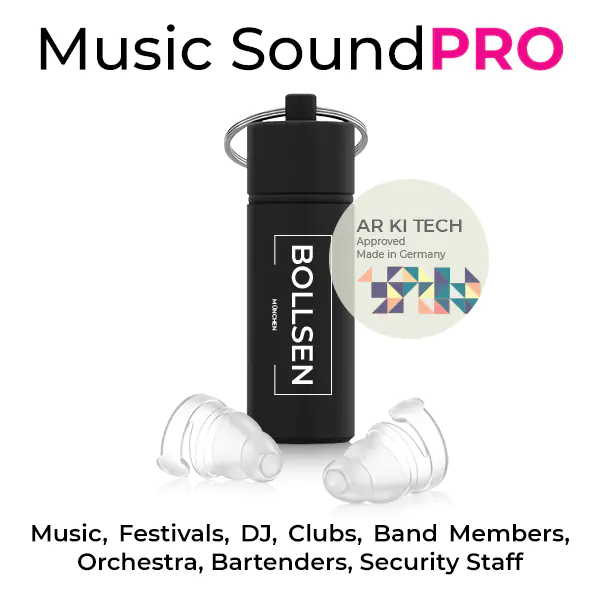
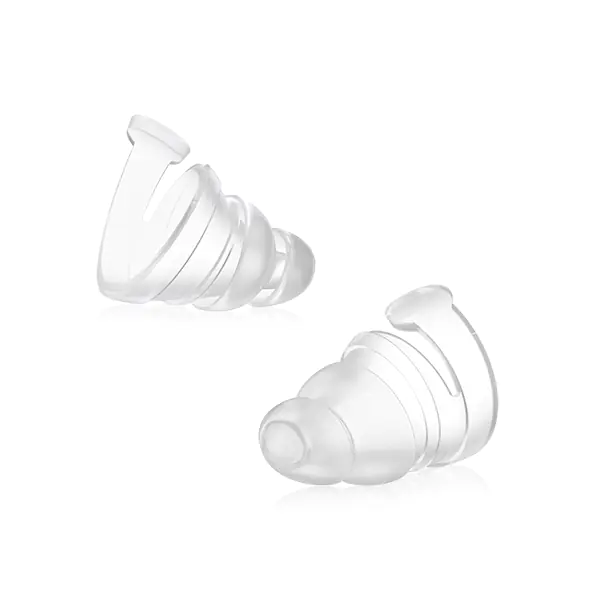
Fit is the whole game here, because the seal decides both the protection and how natural speech sounds, which is why our AR KI TECH ear measurement service matches you to the correct size and cuts returns to 3%. Bollsen is German-tested and independently certified at 24 dB, backed by a 40-day money-back guarantee and trusted by artists including DJ UMEK.
How do foam and music earplugs compare side by side?
Side by side, foam earplugs win on raw cheap attenuation and lose on sound quality, comfort and waste, while reusable music earplugs trade a few dB for a clear mix you can sit with all night. The table below compares the two on the things that actually decide a gig.
| What matters at a gig | Foam earplugs | Music earplugs (silicone) |
|---|---|---|
| Lab rating | NRR 30–33 dB | SNR 24 dB |
| Real-world rating | Often near half, after NIOSH 50% derating | Consistent with a correct seal |
| Occlusion effect | Strong, own voice booms | Lower with a flush fit |
| How the music sounds | Muffled, underwater, bass-heavy | Quieter but clear, music stays present |
| Talking between songs | Hard, voices sound blocked | Speech stays understandable |
| Comfort over a full set | Expands and pushes out, often removed early | Flush, low-profile, stays in all night |
| Reuse | 1–2 uses, then binned | Up to 100 uses, washable |
| Cost and waste | ~20p a pair, up to 100 pairs a year to landfill | £26.95 once, roughly one pair a year |
When are foam earplugs actually the right choice?
Foam earplugs are the right choice when you need maximum cheap attenuation and sound quality does not matter, which mainly means sleep, very loud industrial or firearms noise, and last-minute backup. A disposable NRR 33 dB foam plug is hard to beat for a £0.20 pair you can grab anywhere.
Nobody really defends foam as the nice option, only the available one, the thing you grab at the bar or keep in the glovebox. For nightly sleep, a softer reusable silicone plug usually wins on comfort, and our wider buyer guide to the best earplugs for sleeping compares those options for blocking snoring and street noise. For one-off emergencies, foam still earns its place in your pocket.
Under UK Control of Noise at Work Regulations, hearing protection is required above the 85 dB daily action level, and for many industrial tasks foam’s higher raw rating is genuinely useful. The point is to match the plug to the job, not to crown one type for everything.
Which earplugs should you choose for concerts and festivals?
For concerts and festivals, choose reusable silicone music earplugs, because a clear 24 dB plug you wear from the first song to the last protects you better than a muffled foam plug you remove mid-set. Typical gigs run 95–115 dB, with front-of-stage peaks above 120 dB, so staying protected for the whole show is what counts.
If you want help picking a specific pair across different venues and budgets, our roundup of the best earplugs for concerts ranks the options for gigs, clubs and festivals. Players and performers facing rehearsal and stage volumes night after night should also read our guide to earplugs for musicians for fit and on-stage monitoring.
Whatever brand you land on, the underlying lesson holds across every type of plug for live sound, which our hub on earplugs for music lays out for concerts, clubs and rehearsal rooms.
So the music earplugs vs foam earplugs question is less about which number is bigger and more about which plug you will actually keep in. Foam wins on cheap, maximum attenuation for sleep, industry and emergencies. For music, reusable silicone keeps the show clear, stays comfortable for a full set, and lasts up to 100 nights instead of one.
Protect the hearing you need to enjoy the next gig, and pick the plug you will wear all night. As seen in BBC Science Focus, Which? and Mixmag, our reusable earplugs are built to do exactly that. Find your fit and try them risk-free for 40 days.

His connection to hearing protection stems from personal experience with sound sensitivity during live events and work in noisy environments, an issue that made him more aware of the long-term risks of unmanaged noise exposure. Today, as both a communicator and a user of BOLLSEN products, he is passionate about raising awareness around the importance of proactive hearing care.
At BOLLSEN, he develops data-driven marketing campaigns, writes SEO-focused articles, and manages communication channels that connect customers with practical knowledge about hearing protection. His work ensures that BOLLSEN’s message—prioritizing health, performance, and sustainability reaches a global audience in an engaging and trustworthy way.
Passionate about writing since childhood, Timotej combines creativity with a strong analytical approach, continuously testing new ideas in digital marketing, performance advertising, and social media. He believes in learning through innovation and collaboration, balancing leadership with openness to new perspectives.
Beyond his professional role, Timotej is committed to a healthy lifestyle and finds inspiration in fitness, sports, and quality time with friends. His personal passion for well-being aligns with BOLLSEN’s core values, making his work not only a career but also a cause he deeply believes in.