⏱️ Estimated reading time: 12 min

Key Takeaways
Choosing earplugs for concert and venue staff is not the same problem a gig-goer solves, because a worker cannot step outside when it gets too loud. If you pour pints, load in a band, run the door or steward a festival crowd, your ears clock the same 100 dB the audience does, except you are rostered in front of the PA for the whole shift.
What staff actually describe is rarely “hearing damage”. It is ears that feel exhausted and fried by the end of the night, sometimes with a ring that lingers into the next day. Around 568,000 people work in UK bars, pubs and clubs where music is loud enough to put their hearing at risk, and the resentment is real: it is not a night out they chose, it is a shift.
At Bollsen, we are a hearing protection specialist whose earplugs are independently tested and certified in Germany, and this guide covers what the law requires, how loud each role really is, and how to pick protection that works across a full shift. It sits within our wider resources on earplugs for music for anyone building a safer setup around live sound.
Do venue staff legally need hearing protection in the UK?
Under the Control of Noise at Work Regulations 2005, UK employers have a legal duty to protect workers from hearing damage, and the music and entertainment sector has been explicitly in scope since 6 April 2008. That means a venue owner, promoter or production company must treat a bartender or roadie the same way a factory treats its floor staff.
The Health and Safety Executive sets this out in its guidance, and its “Sound Advice” package (HSG260) was written specifically for live music and events. The duty is not triggered by the job title but by the noise, and amplified venues cross the threshold routinely. You can read the framework directly in the HSE guidance on the Control of Noise at Work Regulations, which sets the duty to assess exposure and provide protection.
This is where staff differ sharply from the crowd. A gig-goer can walk to the bar or step into the smoking area, but a worker is stationed by the speakers for hours, so exposure accumulates in a way a single support set never does.
How loud is it working front-of-stage and behind the bar?
A typical amplified venue runs at around 100 dB, and festival main stages reach 100 to 115 dB, loud enough to cause damage in as little as 15 minutes of unprotected exposure. Stage crew and performers sit even higher during a set, with measured performance levels of roughly 91 to 100 dB(A) depending on the role and position.
Research on musicians found that 52% exceed the NIOSH 85 dB(A) recommended exposure limit over an eight-hour period, and crew working the same rooms are exposed alongside them. The NIOSH occupational noise exposure limits explain why sustained levels at this range drive permanent hearing loss.
| Role / location | Typical exposure | Sits above 85 dB action value? |
|---|---|---|
| Bar and door staff, amplified venue | ~100 dB | Yes |
| Security / stewards, front-of-stage | 100–110 dB | Yes |
| Roadies and stage crew during a set | 91–100 dB(A) | Yes |
| Festival main-stage area | 100–115 dB | Yes |
| Foyer / cloakroom, doors open | 80–90 dB | Often |
What do the 80, 85 and 87 dB action values mean for a venue?
The Regulations set three thresholds measured as daily personal noise exposure, or LEP,d. The lower exposure action value is 80 dB(A), the upper exposure action value is 85 dB(A), and the exposure limit value is 87 dB(A) measured at the ear once the protection is accounted for.
At 80 dB(A) the employer must assess the risk and offer information, training and hearing protection on request. At 85 dB(A) protection becomes mandatory, hearing protection zones must be designated and signed, and use is no longer optional. The 87 dB(A) limit must never be exceeded at the ear, which is why the spec of the earplug matters as much as the decision to wear one.
Repeated exposure has a specific cost. A temporary threshold shift, the dullness and ringing after a shift, usually resolves in 16 to 48 hours, but repeated shifts turn that into permanent noise-induced hearing loss and tinnitus. The plain-English worker view is set out by the RNID summary of noise at work risks, which covers audiometry and the duty in accessible terms.
What SNR rating do venue staff and roadies need?
For most venue roles an earplug rated around SNR 24 dB is the sensible target, because it brings a typical 105 dB exposure down to roughly 81 dB at the ear, clearing the 85 dB action value with a small margin. Treat that as a working figure rather than a lab guarantee, since real-world attenuation depends heavily on how well the plug seals.

It also helps to know what a passive silicone earplug actually does. The attenuation is not flat across the spectrum. These plugs bring the whole level down and cut the highest frequencies most, so the honest way to put it is that they make everything quieter, not that they keep the sound “unchanged”. For venue work that is exactly what you want, protection first, with enough of the mix and speech left through to do the job.
Because that residual figure depends on a proper seal, fit accuracy is part of the spec, not an afterthought. Our AR KI TECH ear measurement service uses two photos to size the plug correctly, which reduces the fit variability that erodes real-world protection.
Which earplugs work for a full shift at a live venue?
For staff working repeated shifts, reusable medical-grade silicone earplugs at SNR 24 dB are the practical choice, because they seal consistently, wash clean between shifts and last up to 100 uses rather than being binned each night. Our Music SoundPRO earplugs use a transparent 2-lamella silicone body that sits flush in the ear canal and stays discreet on the floor.
They bring the volume down by around 24 dB so you are protected but can still hear customers and crew instructions, rather than being sealed off the way over-blocking foam can feel. They ship with an aluminium case on a keyring, which matters when the alternative is losing them between the till and the load-out.


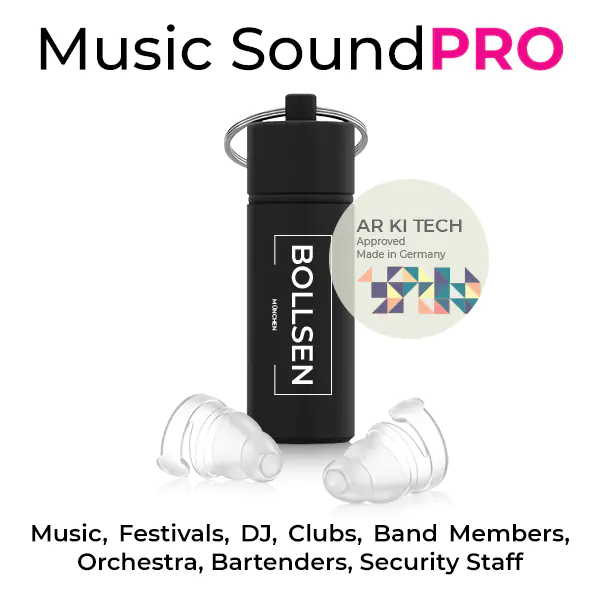
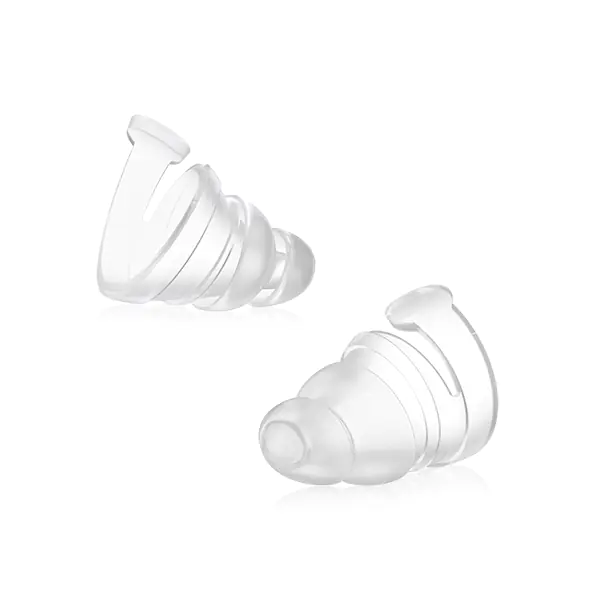
To match the right pair to your role and shift length, see our Music SoundPRO earplugs for concert and venue staff, sized for whole-shift wear in front of a live PA. They are German-tested and independently certified at 24 dB and covered by a 40-day money-back guarantee.
Are reusable silicone earplugs better than foam for staff?
For occupational use across many shifts, reusable silicone generally beats disposable foam on consistency and communication, even where a single foam plug shows a higher lab number. Foam over-blocks and muffles speech, which pushes staff to leave it out or wear it half-in, and a plug that is not worn protects nobody.
| Factor | Disposable foam | Reusable silicone (SNR 24 dB) |
|---|---|---|
| Speech and cue clarity | Muffled, over-blocks | Brings volume down, speech stays usable |
| Consistency shift to shift | Varies with each roll-and-insert | Consistent once fitted |
| Lifespan | Single or few uses | Up to 100 uses, washable |
| Hygiene across shifts | Traps debris, binned | Wash with mild soap between shifts |
| Cost over time | Recurring | One pair replaces dozens of disposables |
The same logic is why performers on the other side of the barrier protect their hearing this way. If you want to see how it plays out for the acts you work alongside, our guide to the earplugs used by musicians working the same venues covers on-stage use and monitor compatibility for the people you share the room with.
Can venue or bar staff claim compensation for hearing damage at work?
Where an employer failed to provide suitable hearing protection and a worker developed noise-induced hearing loss or tinnitus as a result, a civil claim is generally possible within 3 years of diagnosis or of the point the worker reasonably became aware of the damage. The duty to prevent the harm sits with the venue, not the individual.
That is the practical reason provision matters to both sides. For the worker it is their hearing, and for the venue it is a documented, low-cost duty that is far cheaper to meet than to defend. The World Health Organization’s work on safe listening in music venues underlines how manageable venue sound exposure is once it is taken seriously.
Delayed onset is what makes people underestimate it. Tinnitus does not always announce itself the night of the event, and it can surface weeks later and never fully leave, which is exactly why protection during the shift is worth more than any remedy afterwards.
If you work live music for a living, your hearing is a tool you cannot replace, and the maths is simple: a 100 dB shift and a plug rated around SNR 24 dB puts you back under the action value with room to talk to people. Reusable silicone lasts the season, seals the same way every night, and keeps enough of the room open that you can still do the job. Protect it now, because the ring that shows up later does not come with a returns policy. Find your fit and try it risk-free with our 40-day money-back guarantee.

His connection to hearing protection stems from personal experience with sound sensitivity during live events and work in noisy environments, an issue that made him more aware of the long-term risks of unmanaged noise exposure. Today, as both a communicator and a user of BOLLSEN products, he is passionate about raising awareness around the importance of proactive hearing care.
At BOLLSEN, he develops data-driven marketing campaigns, writes SEO-focused articles, and manages communication channels that connect customers with practical knowledge about hearing protection. His work ensures that BOLLSEN’s message—prioritizing health, performance, and sustainability reaches a global audience in an engaging and trustworthy way.
Passionate about writing since childhood, Timotej combines creativity with a strong analytical approach, continuously testing new ideas in digital marketing, performance advertising, and social media. He believes in learning through innovation and collaboration, balancing leadership with openness to new perspectives.
Beyond his professional role, Timotej is committed to a healthy lifestyle and finds inspiration in fitness, sports, and quality time with friends. His personal passion for well-being aligns with BOLLSEN’s core values, making his work not only a career but also a cause he deeply believes in.