
⏱️ Estimated reading time: 10 min

Key Takeaways
If you have ever searched how loud are concerts in decibels, here is the blunt answer: most sit between 90 and 120 dB. A normal conversation runs at about 60 dB, so a gig is not a little louder than daily life, it is thousands of times more intense in sound energy.
That ringing the morning after a show, or the muffled hearing that lingers for a day, is not a badge of honour. It is your ears telling you the volume crossed a line. Plenty of gig-goers now pull out a phone decibel meter mid-set and are shocked to see 105 or 110 dB staring back at them.
This guide breaks down how loud different venues actually get, how long you can safely stay at each level, and what those numbers mean for your hearing tonight. We use the UK HSE safety framework throughout, because it is the standard that governs noise here.
How loud are concerts in decibels?
Most concerts measure between 90 and 120 dB, with a typical rock or pop gig sitting around 100 to 110 dB. That is roughly the same as a car horn heard at close range, and far above the 85 dB level where noise-induced hearing damage begins.
The decibel scale is logarithmic, not linear, so every 10 dB rise represents a tenfold jump in sound intensity. A 110 dB metal gig is not a fraction louder than an 80 dB restaurant, it carries around 1,000 times the sound energy. The World Health Organization treats 85 dB as the safe reference level, and concerts sail well past it.
| Setting | Typical level | Everyday comparison |
|---|---|---|
| Everyday conversation | ~60 dB | Two people talking |
| Jazz club / acoustic set | 80–95 dB | Busy restaurant to heavy traffic |
| Indoor pop / small venue | 95–105 dB | Petrol lawnmower |
| Rock arena concert | 100–115 dB | Car horn at close range |
| Metal concert | 110–120+ dB | Chainsaw or ambulance siren |
| EDM / electronic festival | 100–120 dB | Sustained rock band volume |
| Outdoor festival main stage | 100–115 dB | Jet aircraft taxiing nearby |
| Front-of-stage at a festival | 110–120 dB | Threshold of physical pain |
How loud is a festival compared to a club?
A small jazz club or acoustic set runs about 80 to 95 dB, an indoor club or pop show climbs to 95 to 105 dB, and an outdoor festival main stage reaches 100 to 115 dB, with the front rows pushing past 115 dB. Bigger space does not mean safer sound.
People assume an open field is gentler than a sweaty club, but festival rigs are built to throw sound across huge crowds. Measured research on sound exposure at outdoor music festivals has recorded sustained main-stage levels above 100 dB across full sets. That is why the phone-meter reality check surprises so many people.
Genre matters too. Acoustic and jazz sets tend to stay lower, while metal and EDM shows are among the loudest, regularly touching 115 to 120 dB near the stage. The more amplification and bass a show runs, the higher the reading.
How long is it safe to stay at a concert?
At 85 dB you can listen safely for about 8 hours, but every 3 dB increase halves that safe time. So at a 100 dB concert your entire daily dose is used up in roughly 15 minutes, and at 110 dB it takes about two minutes.
This is the 3 dB exchange rule used by the UK Control of Noise at Work Regulations 2005, which sets 85 dB as the upper action level for daily exposure. The US NIOSH recommended exposure limit uses the same 3 dB doubling and the same 85 dB reference.
| Sound level | Safe listening time |
|---|---|
| 85 dB | 8 hours |
| 88 dB | 4 hours |
| 91 dB | 2 hours |
| 94 dB | 1 hour |
| 97 dB | 30 minutes |
| 100 dB | ~15 minutes |
| 103 dB | ~8 minutes |
| 106 dB | ~4 minutes |
| 110 dB | ~2 minutes |
| 115 dB | ~30 seconds |
In real terms, a two-hour gig at 100 dB delivers around 15 times a full day’s safe noise dose in a single evening. Your ears do not reset between songs, exposure accumulates across the whole set.
Can one concert cause hearing loss or tinnitus?
Yes. A single loud concert can trigger tinnitus and a temporary threshold shift, and repeated exposure can cause permanent noise-induced hearing loss by destroying the tiny hair cells (stereocilia) inside your cochlea, which never grow back.
According to the US NIDCD guidance on noise-induced hearing loss, both a one-off loud event and long-term exposure can harm the inner ear. Once those hair cells die, the damage is irreversible, which is why prevention is the only real fix.
The ringing so many people notice on the walk home has a name: temporary threshold shift. Hearing usually recovers within a day or two, but each episode chips away at the margin, and the fatigue that lingers is a signal, not a souvenir.
Does standing near the speakers make it louder?
Where you stand changes your exposure dramatically. Sound pressure rises sharply as you approach the PA stack, so the front rail of a festival can read 110 to 120 dB while the back of the field sits 10 to 15 dB lower, a genuine difference in risk.
The common debate over whether it is the whole crowd or just the speakers has a clear answer. Proximity to the rig is the single biggest factor you control. Stepping back a few rows, or taking a break away from the front, cuts your exposure far more than most people expect.
How can you protect your hearing without missing the music?
The simplest fix is a pair of reusable earplugs rated at SNR 24 dB, which lowers a 105 dB gig to around 81 dB at your eardrum, safely under the 85 dB line, while you still hear the music at a lower volume. Good concert earplugs protect your hearing without shutting you out of the show.

At Bollsen, we are a family-run hearing protection company founded in 2016, independently certified to 24 dB in Germany, that has helped more than 1,000,000 people keep their hearing intact at gigs and festivals. Our Music SoundPRO earplugs use passive medical-grade silicone rated SNR 24 dB to bring the overall volume down, so a loud gig drops to a safer level while you still hear the music and the people around you.


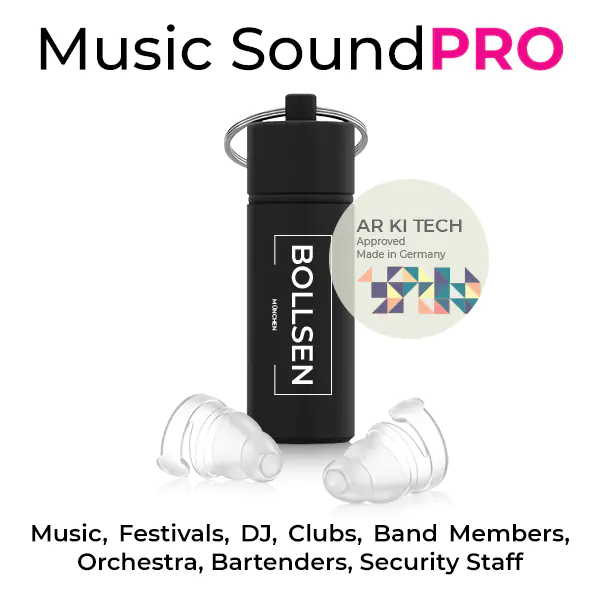
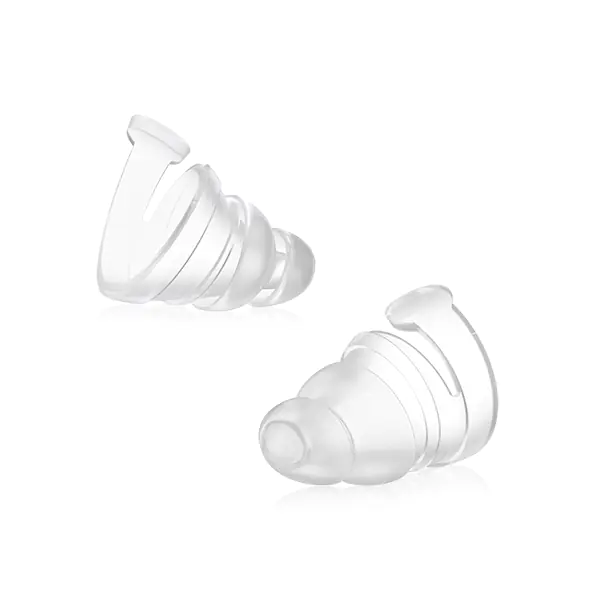
A snug seal is what actually delivers the rated protection, so fit matters as much as the number on the box. If you want help getting the right size first time, our AR KI TECH fit measurement uses two photos of your ears to match you to the correct size.
If you want to compare options before a big show, we put together a full rundown of the best earplugs for concerts that weighs attenuation and comfort so you can pick a pair that suits how you listen. For regular gig-goers, our guide to earplugs for music covers the choices across festivals, clubs and rehearsals in more detail.
Children need this even more than adults, because their ear canals are smaller and sound pressure builds faster in them. If you bring little ones along, hearing protection for children at concerts should never be an afterthought, and our range for hearing protection for children at concerts is sized for young ears from age three.
Concerts are worth going to, and you do not have to trade your hearing for a good night. The numbers are clear: most gigs run 90 to 120 dB, safe time at 100 dB is measured in minutes, and once inner-ear hair cells are gone they stay gone.
Three habits cover you. Know how loud your venue really is, step back from the speakers when you can, and wear a properly fitted pair of earplugs. Do that, and you can keep going to shows for decades without the ringing that used to feel normal.

His connection to hearing protection stems from personal experience with sound sensitivity during live events and work in noisy environments, an issue that made him more aware of the long-term risks of unmanaged noise exposure. Today, as both a communicator and a user of BOLLSEN products, he is passionate about raising awareness around the importance of proactive hearing care.
At BOLLSEN, he develops data-driven marketing campaigns, writes SEO-focused articles, and manages communication channels that connect customers with practical knowledge about hearing protection. His work ensures that BOLLSEN’s message—prioritizing health, performance, and sustainability reaches a global audience in an engaging and trustworthy way.
Passionate about writing since childhood, Timotej combines creativity with a strong analytical approach, continuously testing new ideas in digital marketing, performance advertising, and social media. He believes in learning through innovation and collaboration, balancing leadership with openness to new perspectives.
Beyond his professional role, Timotej is committed to a healthy lifestyle and finds inspiration in fitness, sports, and quality time with friends. His personal passion for well-being aligns with BOLLSEN’s core values, making his work not only a career but also a cause he deeply believes in.