
⏱️ Estimated reading time: 10 min

Key Takeaways
Noise-induced hearing loss in musicians is one of the quietest career risks in the business, and it rarely announces itself until the damage is already done. Chris Martin of Coldplay has spoken openly about the tinnitus he built up over years on stage, and he sits alongside Neil Young, Dave Grohl and countless session players who wish they had protected their ears sooner. On tinnitus forums the same worry surfaces after every loud night: people fixate on a single gig and a small ringing spike, unsure whether it will fade or stay.
The answer usually comes down to the years, not the one night. Bollsen is a family-run hearing protection company, German-tested and independently certified, and we have spent years helping players stay in the music without wrecking their hearing. We make reusable earplugs for music that bring stage and rehearsal volume down to a safer level while keeping the sound intact.
What is noise-induced hearing loss in musicians?
Noise-induced hearing loss is permanent sensorineural hearing loss caused when loud sound destroys the tiny hair cells, or stereocilia, inside the cochlea of the inner ear. These cells convert sound vibration into the nerve signals your brain reads as music, and once they die they do not grow back.
For musicians the problem is exposure that repeats day after day. According to the CDC and NIOSH, both the loudness and the duration of sound determine the harm, which is why a working player racks up far more risk than someone who hears a loud noise once. The damage is silent and gradual, so most musicians only notice it when speech in a noisy room becomes hard to follow.
Do musicians get hearing loss more than other people?
Yes, and the gap is stark. Professional musicians carry roughly four times the risk of noise-induced hearing loss compared with the general public, and a higher hazard of tinnitus on top of that.
A study of professional musicians published in the National Library of Medicine found an audiometric-notch prevalence of 42.4%, the tell-tale dip that marks noise damage. Broader meta-analysis puts hearing loss at 25.7% of musicians versus 11.6% of controls, and tinnitus at 42.6% versus 13.2%. Pop and rock players fare worst, with some reviews finding hearing loss in 63.5% at the 3 to 6 kHz range against 32.8% of classical players.
What makes those numbers worse is the awareness gap. Only around a third of at-risk musicians have ever had a hearing test, so the loss usually goes unmeasured until it is well established.
At what decibel level does hearing damage start?
Sustained exposure at 85 dB across an eight-hour day is the recognised point where harm begins, and the risk climbs steeply from there. The HSE Control of Noise at Work Regulations 2005 set 80 dB(A) as the lower action value, 85 dB(A) as the upper, and 87 dB(A) as the exposure limit you must not exceed.
The catch for musicians is the 3 dB doubling rule. Every extra 3 dB halves the safe exposure time, so 88 dB is safe for half as long as 85 dB, and 91 dB for a quarter as long. A rehearsal room sitting at 85 to 95 dB for two to four hours daily is already at or beyond the daily limit before a single gig is counted.
Live sound is louder again. If you want the full picture of the decibel levels that trigger hearing damage at concerts, we have measured the common venues so you can see where your own gigs land on the scale.
Can noise-induced hearing loss be reversed?
No. Once the hair cells in the cochlea are destroyed they cannot regenerate, so noise-induced hearing loss is permanent and irreversible. This is the single most important fact for any musician to accept early.
There is a temporary version that fools people. A temporary threshold shift, the muffled, ringing feeling after a loud show, can recover within 24 to 48 hours if the ears are rested. The trouble is that repeated temporary shifts stack up, and the World Health Organization frames hearing damage as cumulative for exactly this reason. On the forums people describe it bluntly, that their head-banging days are over, and the regret is almost always about protection they skipped years earlier.
Is tinnitus an early warning sign of hearing loss?
Frequently, yes. That ringing, hissing or spike after a gig is your inner ear signalling that loud sound has stressed the hair cells, and many people treat tinnitus as an early warning sign of hearing loss rather than a harmless quirk. Recurring spikes suggest some damage has already been done.
The scale is easy to underestimate. In one survey, 85% of a rock audience reported transient tinnitus after a show, yet only around 20% had worn any protection. UK charity guidance from Tinnitus UK is clear that musicians accept tinnitus far too passively as an occupational hazard.
If you are wondering whether live music can cause tinnitus, both hearing loss and tinnitus trace back to the same cause, so protection is the only reliable prevention. Managing an existing case is a separate topic, and dedicated earplugs for tinnitus can help reduce the daily sound triggers.
How can musicians protect their hearing without ruining the music?
You lower the overall volume with a well-fitted passive earplug instead of blocking the sound with foam. Foam plugs kill the top end and leave the music dull and boxy, which is exactly why so many players leave them out and take the risk instead.
There is a lot of interest in how high-fidelity earplugs protect against noise-induced hearing loss, and with any passive plug the attenuation is never perfectly even. Under EN 352-2 testing, silicone plugs reduce the high frequencies most, so the sound is quieter and slightly softer at the top, not a flawless studio copy. What matters for your ears is that the overall level drops below the danger zone while the music stays clear and musical.
Our Music SoundPRO is a passive two-lamella silicone earplug rated at SNR 24 dB that brings a 100 dB rehearsal down to roughly 76 dB, comfortably below the 85 dB limit. It lowers the volume rather than filtering it flat, so you still hear the mix clearly, just quieter and far less muffled than disposable foam.


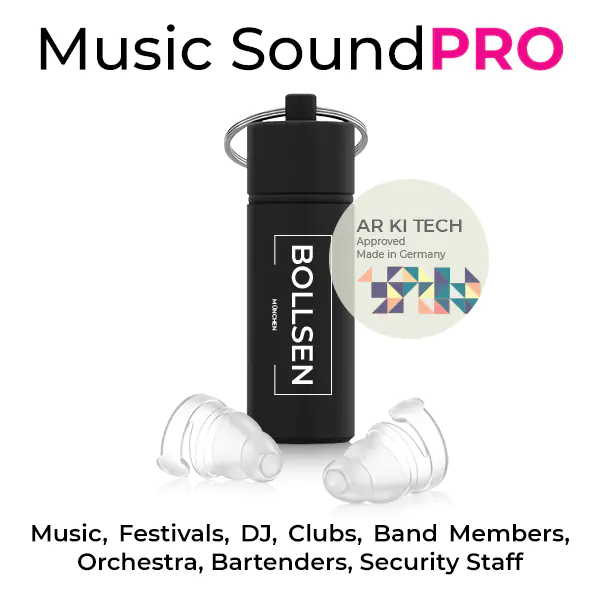
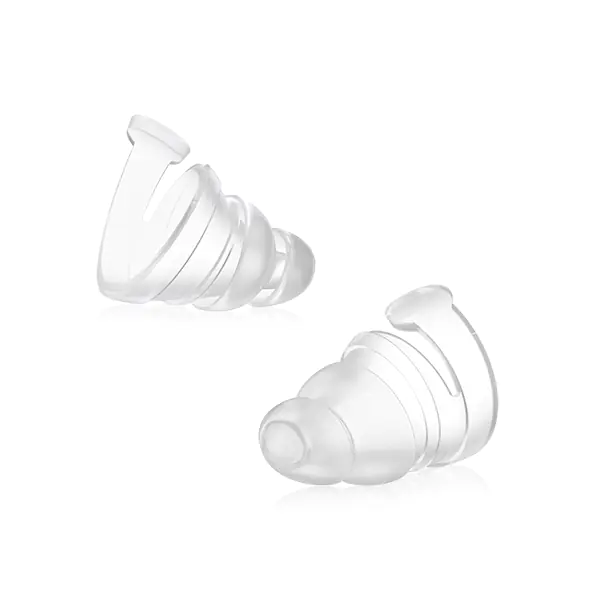
Fit is what makes or breaks the seal, which is why we developed AR KI TECH, an AI ear-measurement service that photographs your ears and ships the correct size to get the attenuation the plug is rated for. You can read how the AR KI TECH fit measurement works if a reliable seal has been the sticking point for you before.
How do you protect your hearing across a whole career?
Think in decades, not in single nights. A 20 to 30 year career is thousands of hours of exposure, and the players who keep their hearing are the ones who made protection a habit early, the same way they carry spare strings or sticks.
Get a baseline hearing test, keep a pair of plugs in every gig bag, and treat any lasting ringing as a reason to rest your ears rather than push through. If you are ready to compare options, our guide to the best earplugs for musicians walks through fit, attenuation and use case so you can match protection to how you actually play.
Protecting your hearing is not about giving up loud music. It is about staying in it. The damage is permanent and cumulative, the decibel maths is unforgiving, and the fix is a pair of well-fitted plugs you barely notice. Wear them tonight, and you keep playing for the years that matter most.

His connection to hearing protection stems from personal experience with sound sensitivity during live events and work in noisy environments, an issue that made him more aware of the long-term risks of unmanaged noise exposure. Today, as both a communicator and a user of BOLLSEN products, he is passionate about raising awareness around the importance of proactive hearing care.
At BOLLSEN, he develops data-driven marketing campaigns, writes SEO-focused articles, and manages communication channels that connect customers with practical knowledge about hearing protection. His work ensures that BOLLSEN’s message—prioritizing health, performance, and sustainability reaches a global audience in an engaging and trustworthy way.
Passionate about writing since childhood, Timotej combines creativity with a strong analytical approach, continuously testing new ideas in digital marketing, performance advertising, and social media. He believes in learning through innovation and collaboration, balancing leadership with openness to new perspectives.
Beyond his professional role, Timotej is committed to a healthy lifestyle and finds inspiration in fitness, sports, and quality time with friends. His personal passion for well-being aligns with BOLLSEN’s core values, making his work not only a career but also a cause he deeply believes in.