
⏱️ Estimated reading time: 13 min

Key Takeaways
If you are trying to work out which hearing protection audiologists trust, you have probably noticed the advice online contradicts itself. One source swears by cheap foam, the next insists you need custom moulds costing over £100, and the reviews rarely tell you what a hearing professional actually weighs up before putting something in an ear.
We are Bollsen, a family-run hearing protection company founded in 2016 and trusted by over 1,000,000 people, with every earplug independently tested and certified in Germany. We manufacture reusable hearing protection, and recently a certified German hearing specialist chose our protector to carry under her own brand, with her own box, her own logo and our certified protection inside.
Her name is Rita Zeuner, founder of Ohrginal in Bielefeld and recognised among Germany’s TOP 100 hearing specialists. You can verify her practice at her Bielefeld hearing centre. This article explains what a hearing professional like Rita actually looks for, and why those criteria matter far more than the marketing on the box.
Why should you trust what a hearing professional puts in their patients’ ears?
A hearing professional stakes their reputation on what goes into their patients’ ears, so their choice of protection is a stronger signal than any advert. When someone who fits ears for a living selects one manufacturer’s earplug to sell under her own name, she is vouching for its certification, its fit and its comfort with her own livelihood.
Rita Zeuner runs Ohrginal, a hearing care practice with locations in Bielefeld and Werther in Germany, and a third Bielefeld centre opening in 2026. A hearing specialist at her level is trained to measure hearing, fit hearing aids and make custom ear protection, the German equivalent of a hearing aid audiologist. Ohrginal is recognised among the country’s TOP 100 practices in that field.
We built her a reusable hearing protector under the Ohrginal brand. The certificate, the quality control, the production and the shipping come from Bollsen. The box, the logo and the name on the capsule are hers. For a clinician whose patients judge her by what she puts in their ears, choosing which protector to attach her name to is not a decision taken lightly, and that is exactly why it is worth paying attention to what she chose.
What does a hearing professional actually look for in an earplug?
A hearing professional judges an earplug on four things that rarely make the marketing copy: independent certification to a recognised standard, a seal that fits the individual ear canal, comfort across a full day, and honest sound that lowers volume without turning every voice to mush.
Certification comes first, because a protection figure only means something if an independent laboratory measured it. Bollsen earplugs are tested and certified in Germany to EN 352-2, so the SNR 24 dB rating is a checked number rather than a claim. After that comes the seal, since protection lives or dies on fit, and then comfort, because a plug that hurts after twenty minutes is a plug that ends up in a drawer.
The fourth criterion is the one most buyers overlook. A good protector does not simply muffle everything by a flat amount, it takes the sharp, damaging edge off loud sound while leaving speech intelligible. That balance between protection and communication is what separates something a professional will recommend from something people abandon after a week.
Does the number on the box tell you how protected you are?
No, the SNR or NRR number on the box is a laboratory ceiling, not the protection you actually get. Real-world research finds people achieve only around half of the labelled rating once you account for imperfect insertion, so a high figure on the packaging can be badly misleading if the plug does not seal.
This is the single fact a hearing professional wishes more people understood. The CDC and NIOSH guidance on hearing protection notes that without fit training, real-world attenuation drops to roughly 50% of the label, which is why NIOSH derates ordinary earplugs to just 30% of their rated number when estimating protection.
Put plainly, an earplug advertised at a headline 33 dB but seated poorly protects less than a 24 dB plug fitted correctly. That is why fit testing has become the gold standard in workplace hearing programmes, and why a professional cares more about how a plug seals in your ear than about the largest number printed on the packet. Chase the seal, not the number.
Do audiologists recommend foam or reusable silicone earplugs?
Both foam and reusable silicone earplugs protect your hearing when inserted correctly, but hearing professionals tend to steer regular users towards silicone. Foam has to be rolled down and seated perfectly every single time, and in practice it is often fitted poorly, which quietly throws away the high-frequency protection you most need.
Foam also expands and warms in the canal, so it tends to feel intrusive across a long day, and it is single-use, which means a constant stream of waste and cost. A reusable silicone plug keeps a consistent shape and seal each time you insert it, wipes clean, and lasts up to 100 uses. There is a quieter truth behind the professional preference too, which is that the best hearing protection is simply the one you will actually keep in, and comfort is what drives that.
| Protection type | Typical protection | Reusable | Fit consistency | Rough cost |
|---|---|---|---|---|
| Disposable foam plugs | Up to ~30 dB if seated perfectly | Single use | Varies every insertion | Pennies per pair, replaced constantly |
| Reusable silicone (Bollsen Life+) | SNR 24 dB, rising in the highs | Up to 100 uses | Same seal each time | £26.95 per pair |
| Custom-moulded earplugs | High, tailored to the ear | Several years | Best possible | £100+ and a clinic appointment |
Are expensive custom-moulded earplugs worth it?
For someone wearing protection all day, every day, custom-moulded earplugs fit best and are worth considering, but they cost upwards of £100 and need a clinic appointment and an ear impression. For most people, that expense buys a fit advantage a well-made reusable silicone plug already comes close to matching.
Scroll any concert or hearing forum and the same argument repeats: is it worth paying for custom moulds, or is a bag of foam plugs fine? The honest answer sits between the two. Research measuring individual attenuation against the rated figure keeps finding that a badly fitted premium plug loses to a well-fitted mid-range one, so the money is best spent on getting the seal right rather than on the highest number or the fanciest name.
Getting the size right is where a reusable plug either succeeds or fails, because a loose fit leaks exactly the high frequencies you are trying to block. Bollsen’s AR KI TECH ear measurement uses two photos to match you to the correct size in about two minutes, roughly 55% cheaper than an audiologist custom earmold and with a return rate of just 3%. It is the closest a non-custom plug gets to a bespoke fit without an appointment.
What hearing protection did a TOP-100 hearing specialist choose to put her name on?
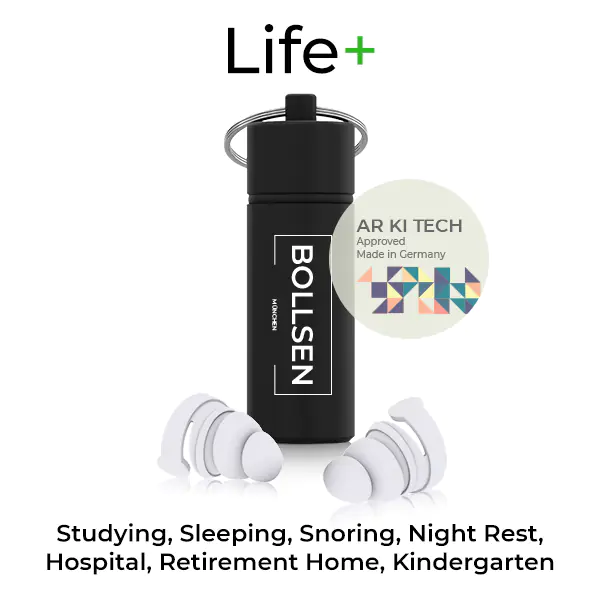
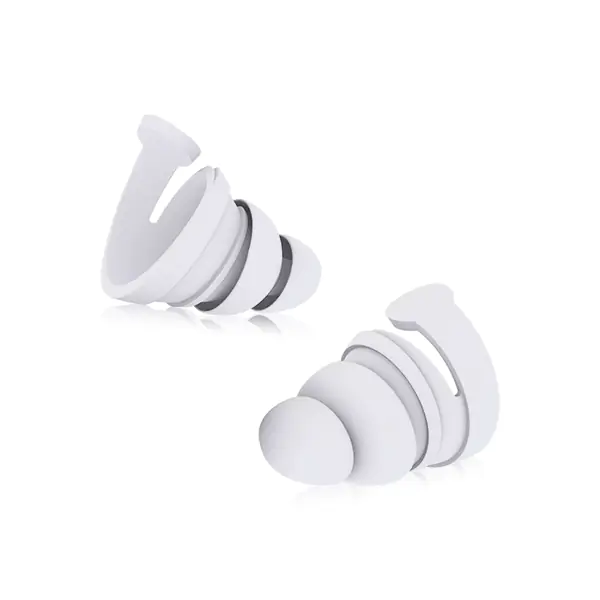
Rita Zeuner chose a reusable medical-grade silicone earplug certified to SNR 24 dB under EN 352-2, the same protector Bollsen sells to the public as Life+. It sits low and flush in the ear canal with no protruding stem, seals consistently on every insertion, and is washable and reusable up to 100 times.
The reason this style of protector earns a professional’s trust comes down to its attenuation curve and its comfort. A passive silicone plug like Life+ attenuates high frequencies most, rising from around 22 dB in the low frequencies to roughly 35 dB at 8 kHz, so it works hardest against the piercing, high-pitched sounds that do the most damage to the inner ear. It is made from hypoallergenic medical-grade silicone, lasts up to 100 uses, and costs £26.95 per pair, which works out at roughly 27p per use.


Will earplugs stop you hearing conversation and alarms?
No. A passive earplug at SNR 24 dB turns the whole room down by roughly 24 dB, so a conversation half a metre away and a smoke or equipment alarm stay clearly audible, simply quieter and less tiring to listen to.
Because a passive plug reduces the whole soundscape together rather than picking and choosing, alarms still cut through, just as a phone ringing in the next room is quieter but unmistakable. There is no electronics deciding what to let in and nothing to switch on, fail or run out of battery. What you lose is the punishing edge of the loudest sound, not your awareness of the room.
Because so much noise damage first shows up as ringing rather than lost volume, many people only start protecting their hearing after the sound arrives. If a persistent ring has already started for you, our guide to earplugs for tinnitus covers how the right protection helps once the ringing has begun and how to keep it from getting worse.
Who needs hearing protection a professional would approve of?
Anyone with regular exposure above 85 dB needs protection a professional would sign off on, from musicians and motorcyclists to trades and clinical staff. A dentist beside a drill, a factory worker on a line and a nurse near an ultrasonic scaler all take a daily dose that adds up silently over a career.
The daily dose is what counts, and for many jobs it sits at or above the level where the law treats noise as a workplace hazard. Our overview of earplugs for work covers occupational noise across trades where exposure climbs past 85 dB, and for one clinical example, a Munich dentist explains in our piece on earplugs for dentists why daily drill noise puts dental staff at real risk of hearing loss.
It matters because the damage is permanent. The World Health Organization on noise and hearing loss is blunt that noise-induced hearing loss cannot be reversed and is almost entirely preventable, and it estimates that more than a billion young people are already at risk from unsafe sound levels. That is the whole case for protecting the ears you have while they still work.
What hearing protection should you actually buy?
Protecting your hearing is one of the few health decisions you cannot reverse later, so it is worth getting right the first time. What a hearing professional looks for is not a headline number but a protector that is independently certified, seals the same way every time, stays comfortable enough to actually wear, and lowers the harmful sound most. A reusable silicone earplug at SNR 24 dB meets that brief, which is why a TOP-100 hearing specialist was willing to put her own name on one.
If you want the same German-tested, independently certified protection the public version carries, Bollsen Life+ reusable hearing protection is SNR 24 dB, made from medical-grade silicone, reusable up to 100 times at £26.95 per pair, and comes with a 40-day money-back guarantee so you can try it risk-free. Protect the hearing you rely on every single day.

His connection to hearing protection stems from personal experience with sound sensitivity during live events and work in noisy environments, an issue that made him more aware of the long-term risks of unmanaged noise exposure. Today, as both a communicator and a user of BOLLSEN products, he is passionate about raising awareness around the importance of proactive hearing care.
At BOLLSEN, he develops data-driven marketing campaigns, writes SEO-focused articles, and manages communication channels that connect customers with practical knowledge about hearing protection. His work ensures that BOLLSEN’s message—prioritizing health, performance, and sustainability reaches a global audience in an engaging and trustworthy way.
Passionate about writing since childhood, Timotej combines creativity with a strong analytical approach, continuously testing new ideas in digital marketing, performance advertising, and social media. He believes in learning through innovation and collaboration, balancing leadership with openness to new perspectives.
Beyond his professional role, Timotej is committed to a healthy lifestyle and finds inspiration in fitness, sports, and quality time with friends. His personal passion for well-being aligns with BOLLSEN’s core values, making his work not only a career but also a cause he deeply believes in.