
⏱️ Estimated reading time: 16 min

Key Takeaways
Dosimetry carried out across four UK music venues found that 70% of staff exceeded the daily exposure limit value in a single shift, and fewer than 30% wore any hearing protection at all. UK noise regulations for music venues have applied in full since 6 April 2008. There is no exemption for live music and no grace period left to run.
Part of the trouble is that “noise regulations” points at two completely separate bodies of law, and almost every page you will find quietly picks one lane without telling you which. Ask around on a UK venue workers’ forum and the confusion sits right out in the open, with people asking plainly: “What is the actual law / act called? (Name number date etc)”. It is called the Control of Noise at Work Regulations 2005, and it is not the same thing as the licence conditions that keep your neighbours happy.
At Bollsen we are a family-owned hearing protection brand founded in 2016, and our earplugs are German-tested and independently certified at 24 dB. The regulations name hearing protectors, not brands, so the choice of certified earplugs for music work sits with the venue and its own risk assessment. Our hub page on earplugs for music sets out which attenuation level suits which role on a live music floor.
Which UK noise laws actually apply to a music venue?
Two separate regimes apply, and they are routinely mistaken for each other. The Control of Noise at Work Regulations 2005 protect staff and performers from the noise inside the room, while the Environmental Protection Act 1990 and the Licensing Act 2003 protect neighbours from the noise escaping outside.
They have different triggers, different enforcers, and different remedies. A venue can hold a spotless premises licence, sit well inside its sound limiter settings, and still be in breach of the occupational regulations on every shift it opens.
| Occupational regime | Environmental and licensing regime | |
|---|---|---|
| Who it protects | Staff, performers and contractors at work | Neighbours and the public outside |
| Main law | Control of Noise at Work Regulations 2005 (SI 2005/1643) | Environmental Protection Act 1990, Licensing Act 2003 |
| What it limits | Personal noise exposure at the ear, averaged across the working day | Noise leaving the building, usually via premises licence conditions |
| Trigger | Daily exposure of 80 dB(A) LEP,d and above | Statutory nuisance, licence conditions, sound limiter settings |
| Who enforces | HSE and local authority health and safety inspectors | Local authority environmental health and the licensing committee |
| Typical remedy | Improvement notice, prosecution, civil claim for hearing loss | Noise abatement notice, licence review, closure order |
Workers conflate the two themselves. On that same forum, a mobile DJ asked whether the noise-at-work law would be amended to stop the practice of “bypassing AVLs by plugging in outside the function room”. An automatic volume limiter is a licensing control fitted to protect the street. It has nothing to say about the person standing behind the decks, and switching it off does not breach the occupational regulations any more than leaving it on satisfies them.
What is the Control of Noise at Work Regulations 2005?
It is SI 2005/1643, the statutory instrument that requires every UK employer to assess and control the noise their workers are exposed to. It came into force for most industry on 6 April 2006, and for the music and entertainment sectors on 6 April 2008 after a two-year deferral.
The scope is broad and explicitly named. Concert halls, theatres, amplified live music venues, pubs, clubs, nightclubs, studios, cinemas, discos, restaurants, fairgrounds and theme parks are all in. You can read the Control of Noise at Work Regulations 2005 in full on legislation.gov.uk, though the statute itself offers no interpretation.
For interpretation there are two documents, and they are often mixed up. HSG260 “Sound advice” (2008) is the sector guidance written specifically for music and entertainment, and it is the one a venue should reach for first. L108 “Controlling noise at work” (3rd edition, 2021) is the general guidance on the regulations, and despite what a lot of consultancy blogs claim, it is not an Approved Code of Practice. HSE publishes HSG260 Sound advice for music and entertainment free of charge.
What does the law require a venue to do at each action value?
Regulation 4 sets three thresholds, each with a daily or weekly A-weighted average and a C-weighted peak: the lower exposure action value at 80 dB(A) and 135 dB(C), the upper exposure action value at 85 dB(A) and 137 dB(C), and the exposure limit value at 87 dB(A) and 140 dB(C).
Each threshold switches on a different set of duties, and they stack. Once a shift puts someone past 85 dB(A), providing hearing protection for venue staff is no longer a courtesy, it is a duty you have to police. The same applies to hearing protection for sound engineers working the room night after night.
| Threshold | Daily or weekly average | Peak | What the venue must legally do |
|---|---|---|---|
| Lower exposure action value | 80 dB(A) | 135 dB(C) | Assess the risk (Reg 5). Provide information, instruction and training (Reg 10). Make hearing protection available on request (Reg 7). |
| Upper exposure action value | 85 dB(A) | 137 dB(C) | Reduce exposure by means other than hearing protection so far as reasonably practicable (Reg 6). Provide hearing protection and ensure it is worn (Reg 7). Designate and sign hearing protection zones. Provide health surveillance (Reg 9). |
| Exposure limit value | 87 dB(A) | 140 dB(C) | Must never be exceeded. Assessed with hearing protection taken into account. |
HSE sets out the noise exposure action values and employer duties alongside a free exposure calculator. A venue that has never run the numbers has already failed Regulation 5, which is the duty everything else hangs off.
Why is the 87 dB limit value assessed with hearing protection on?
Because the two kinds of threshold answer different questions. The 80 and 85 dB(A) action values are assessed without any hearing protection, since they measure how noisy the job is. The 87 dB(A) exposure limit value is assessed with hearing protection taken into account, since it measures what actually reaches the ear.
Most articles on this subject get it backwards, and the mistake matters. A club floor running at 100 dB(A) will trip both action values no matter what you hand out, so the training, the signage, the zones and the health surveillance are all still owed. What the earplugs do is keep you under the 87 dB(A) ceiling.
That single asymmetry is why a certified attenuation figure is the load-bearing number in the whole compliance chain. Without it, the ceiling is simply unmeasurable.
Do UK noise regulations protect the audience or only the staff?
Only the staff. The Control of Noise at Work Regulations 2005 attach to people at work, so a paying customer at the barrier has no protection under them. Audience noise is handled instead by HSE event safety guidance, which is a recommendation rather than legislation.
UK workers spotted this gap long before the SERP did. “I would guess theres enthusiastic clubbers out there getting as much exposure as some DJs and staff,” one DJ wrote on a venue forum. Another answered it precisely: “But isnt the salient point that punters are not at work?” That is the whole distinction, in one line.
The guidance still sets clear numbers. HSE recommends the Event LAeq in any part of the audience area should not exceed 107 dB, that the C-weighted peak should not exceed 140 dB, and that where the Event LAeq is likely to exceed 96 dB the organiser should warn the audience in advance on tickets, advertising or notices at the entrance. Audiences should not be within 3 metres of any loudspeaker, and 1 metre is the absolute floor. HSE’s event safety guidance on audience noise levels covers pyrotechnics on the same basis.
Are self-employed musicians, freelance DJs and session players covered?
Yes, and this is the question the rest of the internet leaves hanging. Regulation 3 applies the duties to a self-employed person in respect of themselves, and extends an employer’s duties to other people at work on the premises so far as is reasonably practicable, whether or not they are on the payroll.
“Would the regulations apply to self employed people?” is asked verbatim on UK venue forums, and it goes unanswered more often than not. The short version for a venue: a hired-in FOH engineer, a session player and a guest DJ are all people at work in your building, and your duties reach them.
Two duties behave differently for non-employees. Health surveillance under Regulation 9 does not extend to people who are not your employees, while information and training under Regulation 10 does. A freelancer gets the briefing and the protection, and arranges their own audiometry.
Is music above 85 decibels illegal in UK bars and restaurants?
No, and it never has been. The claim that “music louder than 85 decibels is now illegal in UK bars and restaurants” circulates widely, but it is a garbled memory of a temporary 2020 hospitality restriction brought in to reduce raised voices during the pandemic, and it was revoked long ago.
The 85 dB(A) upper exposure action value is not a volume cap. It describes a worker’s exposure averaged across a whole shift, not the sound pressure level in the room at any one moment. A venue can legally run at 100 dB(A) all night, provided the people working in it are protected properly and no one crosses 87 dB(A) at the ear.
Which roles in a music venue are most exposed to noise?
Anyone standing still in the loud part of the room for a full shift. A nightclub or amplified venue typically runs at 95 to 105 dB(A), and at 100 dB(A) an unprotected worker reaches the 85 dB(A) upper action value in roughly 15 minutes, and the 87 dB(A) limit value in under half an hour. A six-hour shift is not a close call.
The front of house mixing position sits at 95 to 105 dB, and the monitor engineer carries the highest exposure of any crew role, since the wedges are pointed more or less at them. Bar staff, door staff, stage crew and cleaners working during load-out all accumulate their own doses.
Our guide to hearing protection for venue staff under UK law works through the bar, door and touring roles and what attenuation each one needs across a full shift. For the mix position specifically, our guide to hearing protection for sound engineers covers how to protect your ears without losing the reference you mix against.
What counts as adequate hearing protection under the regulations?
Protection that is CE or UKCA marked, tested to EN 352-2, and rated high enough to bring the wearer below the 87 dB(A) exposure limit value without overprotecting them into isolation. Regulation 7 asks for suitability, not for a brand, and Regulation 8 asks you to check it is actually being used.
The arithmetic is simpler than the regulations make it sound. Take the measured level, subtract the certified SNR figure, and check the result against 87 dB(A). A 105 dB(A) club floor with SNR 24 dB earplugs lands at roughly 81 dB(A) at the ear, under the limit value and under the 85 dB(A) upper action value too. HSE also warns against going too far the other way, since anything below about 70 dB(A) at the ear leaves a worker unable to hear warnings. If you want the detail on how SNR ratings map to UK regulatory compliance levels, the ratings themselves are worth understanding before you buy anything.

Our Music SoundPRO is a passive 2-lamella medical-grade silicone earplug rated at SNR 24 dB (H24 / M21 / L19), tested to EN 352-2 and independently certified by a notified body in Germany. Attenuation rises with frequency, so it brings the room’s volume down and you still hear the music, just quieter. That 24 dB is the number that does the compliance work, which is the only reason it belongs in an article about the law.


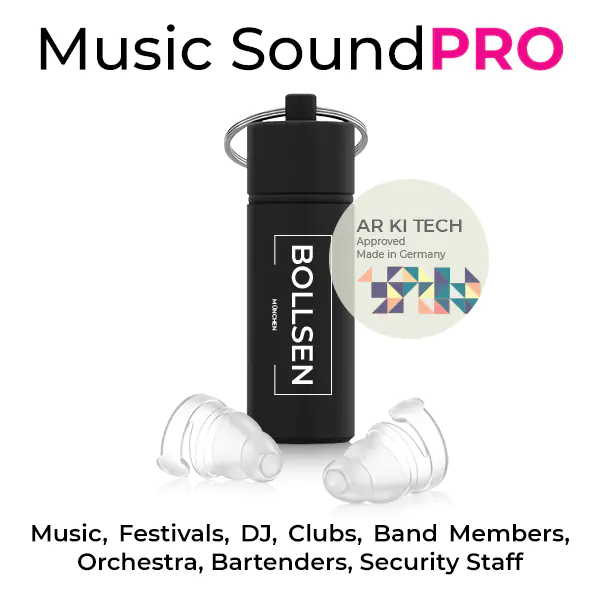
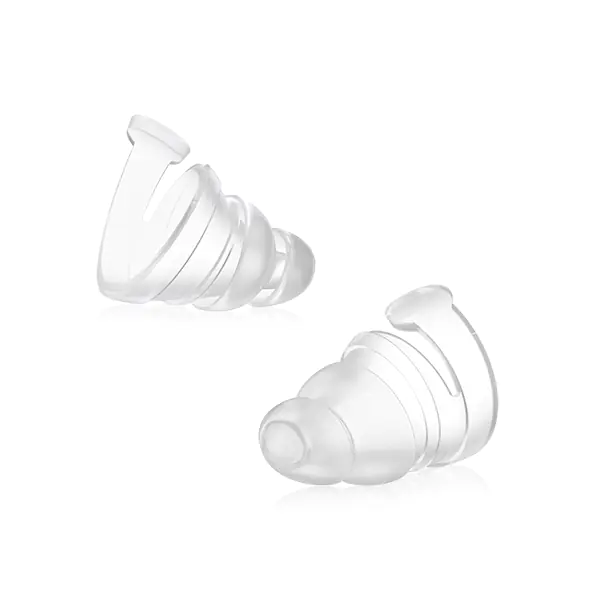
Because the rated figure only holds if the seal does, fit accuracy is a compliance question rather than a comfort one, and our AR KI TECH ear measurement service sizes the ear canal from two photographs before anything ships. On the certification side, Music SoundPRO as HSE-compliant hearing protection carries the EN 352-2 test data a venue needs to file against its Regulation 5 risk assessment.
Can a music venue be exempt from providing hearing protection?
There is no music venue exemption. Regulation 11 lets HSE grant a written exemption certificate from hearing protection only where the full and proper use of protectors “would be likely to cause greater risk to health or safety than not using such protectors”, and it must require increased health surveillance in exchange.
That bar is set for genuine edge cases, not for a venue that finds the paperwork tedious. Nobody writing about this subject seems to mention Regulation 11 exists, which is unfortunate, because knowing the exemption route is narrow is more useful than assuming there isn’t one.
Enforcement is real, and workers notice when it lands. “The club where i DJ (Oceana) has brought this into seriously into action and i have to wear ear plugs when i am not using the headphones,” one UK DJ reported. Set against the dosimetry finding that 70% of UK music venue staff exceeded the daily exposure limit value, published in Noise & Health in 2012, the authors’ conclusion that the industry is failing to meet regulatory requirements still reads as fair.
Two laws, two different jobs. The Control of Noise at Work Regulations 2005 protect the people working in the room, and the licensing regime protects the people living next to it. If you run a venue, the occupational one is the one with the 80, 85 and 87 dB(A) numbers in it, and it has applied to live music since April 2008.
Start with a noise risk assessment under Regulation 5, because every other duty follows from what it finds. If it puts anyone above 85 dB(A) across their shift, hearing protection stops being optional and becomes something you provide, sign for, and check is being worn. Certified earplugs rated at SNR 24 dB take a 105 dB(A) room down to roughly 81 dB(A) at the ear, which is what compliance looks like in practice rather than on paper.

His connection to hearing protection stems from personal experience with sound sensitivity during live events and work in noisy environments, an issue that made him more aware of the long-term risks of unmanaged noise exposure. Today, as both a communicator and a user of BOLLSEN products, he is passionate about raising awareness around the importance of proactive hearing care.
At BOLLSEN, he develops data-driven marketing campaigns, writes SEO-focused articles, and manages communication channels that connect customers with practical knowledge about hearing protection. His work ensures that BOLLSEN’s message—prioritizing health, performance, and sustainability reaches a global audience in an engaging and trustworthy way.
Passionate about writing since childhood, Timotej combines creativity with a strong analytical approach, continuously testing new ideas in digital marketing, performance advertising, and social media. He believes in learning through innovation and collaboration, balancing leadership with openness to new perspectives.
Beyond his professional role, Timotej is committed to a healthy lifestyle and finds inspiration in fitness, sports, and quality time with friends. His personal passion for well-being aligns with BOLLSEN’s core values, making his work not only a career but also a cause he deeply believes in.