
⏱️ Estimated reading time: 21 min

Key Takeaways
Wind noise, not the engine, is what damages a rider’s hearing, and the best motorcycle earplugs for wind noise are the ones that cut the airflow roar without cutting out the road. Wind tunnel measurements taken at the ear under standard helmets recorded 97 to 104 dB(A) at 70 mph, a level at which hearing damage begins in six to thirty minutes. Tinnitus UK estimates that 994,000 riders in the UK are putting their hearing at risk, and that fewer than a third use protection regularly.
At Bollsen we make medical-grade silicone hearing protection, and our Moto+ plug was built around this exact problem, so we have spent a lot of time with the research on where helmet noise actually comes from. Ask riders rather than manufacturers, though, and the reason they keep wearing plugs is not the one you would expect: in the most upvoted r/motorcycles thread on hearing protection, the argument that persuaded the most people was fatigue, not tinnitus.
This guide compares filtered silicone, disposable foam, custom moulds and noise-cancelling earbuds on the attributes that actually decide the purchase: certified attenuation, behaviour inside a helmet, reuse count and price. If you want the wider category first, our hub page on earplugs for motorcycle riding covers fit, law and use cases across every scenario, from commuting to track days.
Why does wind noise damage a rider’s hearing faster than the engine?
Above roughly 40 mph, wind noise turbulence around the helmet overtakes the engine as the loudest sound reaching a rider’s ear, and it keeps climbing with speed, which is why a quiet exhaust and a well-baffled silencer do nothing to protect hearing on a motorway run. Research carried out by ISVR Consulting at the University of Southampton, commissioned by the Home Office, established that aerodynamic noise dominates the engine above 60 to 70 km/h.
The measurement that matters is not how loud your bike sounds to a bystander but how loud the air is at your ear inside the helmet. Those two figures move independently. A rider can drop two exhaust systems and gain nothing, because the noise source is the turbulent air shearing past the helmet shell and visor.
There is a second reason wind noise is so damaging: it is constant. A loud overtake lasts a few seconds, but airflow noise runs for the entire journey at a steady level. Cumulative dose, not peak volume, is what drives noise-induced hearing loss and tinnitus. Tinnitus UK describes noise exposure as the single biggest preventable cause of tinnitus, and rider surveys show only 29% use hearing protection regularly or sometimes.
How loud is wind noise inside a motorcycle helmet?
Wind tunnel measurements taken at the ear under a standard motorcycle helmet recorded 90 to 99 dB(A) at 50 mph, rising to 97 to 104 dB(A) at 70 mph, which means wind noise at legal UK motorway speed sits 12 to 19 dB above the 85 dB level at which hearing protection becomes necessary. Road recordings at higher speeds run higher still.
Applying the CDC and NIOSH exposure limits, which halve the safe duration for every 3 dB increase, turns those numbers into riding time rather than abstract decibels.
| Riding speed | Level at the ear under a helmet | Safe exposure time before risk |
|---|---|---|
| Up to 35 mph | 85 to 95 dB(A) | 48 minutes to 8 hours |
| 50 mph | 90 to 99 dB(A) | 19 minutes to 2 hours 30 minutes |
| 70 mph | 97 to 104 dB(A) | 6 to 30 minutes |
| 100 mph and above | 110 to 116 dB(A) | 22 to 90 seconds |
Published figures for rider noise vary widely, and the reason is worth knowing before you shop. The Southampton study found that noise at the ear depends on the helmet and the motorcycle together, not the helmet alone. One helmet in the test was the quietest of four with no windscreen fitted and the noisiest of the same four with a tall screen, purely because the rider’s head sat in a different part of the airflow.
A single-number quietness rating for a helmet is therefore unreliable when you change bikes, and earplugs remain the only variable a rider fully controls. The frequency content is the other detail that gets misreported. Most buying guides describe wind noise as a high-frequency hiss, but the A-weighted spectra measured under helmets peak around 300 to 400 Hz, with very little contribution below 100 Hz. That mid-range dominance is precisely where a filtered silicone plug does its work.
What SNR rating do motorcycle earplugs need for riding?
A SNR rating between 20 and 26 dB is the working range for road riding, because it brings a 97 to 104 dB(A) airflow level down to roughly 73 to 84 dB at the ear while leaving enough acoustic information for traffic awareness, which is what separates motorcycle earplugs from general-purpose industrial plugs.
SNR, the Single Number Rating used under EN 352-2 in the UK and Europe, is subtracted from the measured noise level to estimate what reaches the eardrum. At the 98 dB typical of a 70 mph motorway cruise, a 24 dB SNR plug leaves about 74 dB, which is roughly the level of a busy office. If the ratings themselves are new to you, our explainer on what NRR and SNR ratings mean sets out how the two standards are measured and why they are not interchangeable when comparing products across markets.
Certification is the part to check. An SNR figure only means something if it comes from EN 352-2 testing at an accredited laboratory. Numbers quoted without a standard behind them, which is common on marketplace listings, are marketing estimates rather than measured attenuation.
Can too much attenuation make riding less safe?
Yes. Excess attenuation pushes the level at the ear below roughly 70 dB, and UK guidance specifically advises against that because a rider who cannot hear sirens, horns or their own engine loses information that riding safely depends on, which is why the highest-rated plug on the shelf is rarely the right one.
The arithmetic is straightforward. At a 98 dB wind noise level, disposable foam rated 33 to 37 dB SNR leaves 61 to 65 dB at the ear. That is quieter than a normal conversation, and it removes not only the wind but the engine note that tells you when to change gear and the tyre roar that tells you the surface has changed.

The Health and Safety Executive sets 80 dB(A) as the lower action value and 85 dB(A) as the upper, with 87 dB(A) as the absolute limit at the ear, and its guidance on selecting protection warns against over-protection for exactly this reason. Around 74 dB at the ear, the target a 24 dB SNR plug hits at motorway speed, sits comfortably under the 80 dB action value while still passing enough sound through to keep a rider connected to the road.
Which earplug type handles helmet wind noise best?
The filtered medical-grade silicone earplug type handles helmet wind noise best on the road, because it is the only one that combines certified 24 dB SNR attenuation, a profile low enough to sit under a helmet, reuse across 100 rides and a level at the ear that stays inside the safe band.
| Earplug type | Certified SNR | Level at the ear at 98 dB | Reuse | Cost per pair |
|---|---|---|---|---|
| Filtered medical-grade silicone (Moto+) | 24 dB, EN 352-2 | About 74 dB | Up to 100 uses | £29.95 |
| Disposable foam | 33 to 37 dB | 61 to 65 dB | Single use | About £0.20 |
| Custom moulded from an audiologist | 22 to 31 dB | 67 to 76 dB | 2 to 5 years | £60 to £120 |
| Noise-cancelling earbuds | Not rated to EN 352-2 | Unverified | Rechargeable | £80 to £250 |
Foam wins on price and loses on almost everything else that matters at 70 mph. It over-attenuates, it compresses and re-expands unevenly so the seal drifts during a long ride, and it has to be rolled and inserted with clean hands at the roadside, which is awkward in gloves.
Riders who have used both describe the difference in terms no datasheet captures. The recurring complaint about foam is that everything arrives as though heard through a wall, which some find genuinely claustrophobic inside a full-face helmet, while silicone plugs are consistently described as sounding closer to normal, just quieter. That is the attenuation curve showing up as an experience rather than a number.
Noise-cancelling earbuds are the option riders most often ask about and the one that fits riding worst. Active cancellation works on steady low-frequency tones, while helmet wind noise is broadband turbulence centred around 300 to 400 Hz, so the cancellation has little to grip. They also carry no EN 352-2 rating, which means there is no verified attenuation figure to plan around, and riders themselves are blunt about it: consumer earbuds are not hearing protection.
What are the best motorcycle earplugs for wind noise?
The best motorcycle earplugs for wind noise on the UK market for everyday road riding are filtered silicone plugs certified at 24 dB SNR, and we built Moto+ specifically for this job: a flat profile that disappears inside any helmet, medical-grade silicone, and a pair that lasts up to 100 rides rather than one.
Two attributes separate a riding plug from a sleeping or work plug. The first is profile height: anything with a stem or a protruding filter housing becomes a pressure point once a helmet’s cheek pads clamp down, and 40 minutes later that pressure point is all you can think about. The second is moisture tolerance, because a helmet interior on a summer ride is warm and humid. Silicone handles both, while foam absorbs moisture and loses its seal.
Bollsen is German-tested and independently certified at 24 dB, and our hearing protection has been covered by BBC Science Focus. Every pair is backed by a 40-day money-back guarantee.



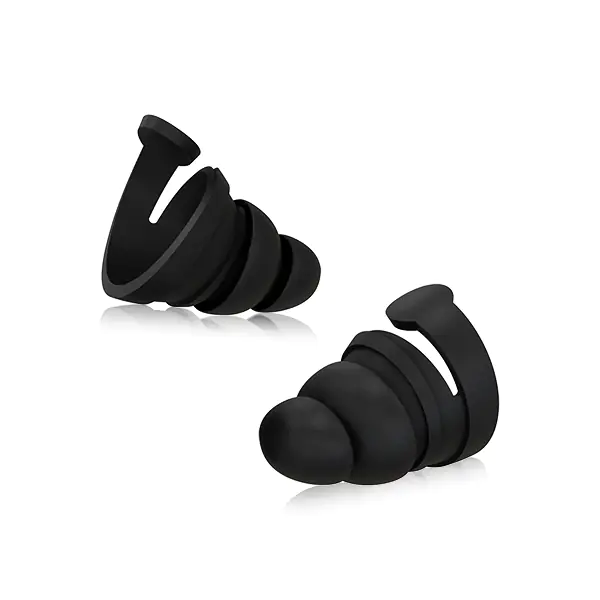
If you want the full specification, the current price and the size options side by side, the BOLLSEN Moto+ earplugs for motorcycle page lists the certified 24 dB SNR rating, the aluminium keychain case and the guarantee terms in one place.
Do motorcycle earplugs fit under a helmet without pressure points?
Correctly sized motorcycle earplugs fit under a helmet without pressure points, because the cheek pads press against the outer ear rather than the canal, so profile height instead of plug diameter decides whether a two hour ride stays comfortable. This is where most riders go wrong on a first purchase.
The insertion sequence matters as much as the product. Plugs go in before the helmet, not after, and the ear should be pulled gently up and back to straighten the canal first. Getting this right on the first attempt prevents the seal breaking halfway through a ride, which is the single most common reason riders abandon hearing protection.
Sizing is the other half of the problem. Ear canals vary enough that a single size fails a meaningful share of riders, and a plug that is too small falls out while a plug that is too large hurts within the hour. Our AR KI TECH measuring service reads ear canal geometry from two photographs in the browser in about two minutes with no app or account, and it has brought our return rate down to 3%.
Riders who already know standard sizes do not suit them can order Moto+ with AR KI TECH measuring at £44.95 and get a canal-matched fit without an audiologist appointment, which is roughly 55% cheaper than a custom earmould.
Are custom moulded motorcycle earplugs worth the extra cost?
Custom moulded motorcycle earplugs justify their cost for a narrow group of riders: those whose ear canals fall outside standard sizes, and those riding professionally for six or more hours a day. For everyone else, £60 to £120 plus two appointments buys a fit improvement that a photo-measured silicone plug at £44.95 delivers for around a third of the price.
Custom moulds carry real advantages. Attenuation across the range runs 22 to 31 dB SNR, the seal is exact, and a well-made pair lasts two to five years. They also carry drawbacks the sales pitch tends to skip: they cannot be replaced quickly if one is lost at a fuel stop, ear canal shape changes with weight and age so the fit degrades, and the higher-attenuation versions run into the over-protection problem described above.
The practical middle ground is a canal-matched universal plug. It solves the fit problem that sends most riders towards custom moulds in the first place, costs substantially less, and can be replaced the same week if one goes missing.
Can you still hear traffic, sirens and your intercom with earplugs in?
Yes, and most riders report hearing traffic and sirens more clearly with plugs in, not less, because wind roar masks quieter sounds and removing 24 dB of it lifts the signal-to-noise ratio for everything else, including intercom audio and engine feedback.
Masking is a well-documented effect: a loud broadband noise raises the threshold at which the ear can detect a quieter sound in the same frequency region. At 98 dB, wind noise is masking a siren, a horn and the note of your own engine. Attenuating everything by 24 dB does not change the relationship between those sounds, but it moves the whole picture out of the region where the ear is overloaded, and detail that was buried becomes audible again.
One rider’s comparison in a long r/motorcycles thread on hearing protection puts it better than any specification sheet: riding without plugs is the equivalent of driving a car down the motorway with the windows wound down, and riding with them is the same journey with the windows up. Nothing is removed, the roar just stops dominating.
Intercom audio behaves the same way. Riders routinely find they can drop headset volume by several notches with plugs in, which is a useful indicator that the wind, not the speaker, was the limiting factor. The one genuine trade-off is that a plug rated above about 30 dB SNR does start to cut into the sounds you want.
Do motorcycle earplugs reduce riding fatigue?
Motorcycle earplugs reduce riding fatigue measurably on long runs, and among riders who wear them every day this is the benefit ranked first, ahead of hearing protection. Sustained noise at 97 to 104 dB(A) is a continuous load on attention, and taking 24 dB off it frees capacity for the road.
Ask riders rather than manufacturers and the emphasis shifts noticeably. In the most upvoted r/motorcycles discussion on hearing protection, the argument that persuaded the most people was not tinnitus but concentration: riders describe motorway stints above 55 mph as feeling markedly less intense with plugs in, report holding focus for longer stretches, and several use the phrase highway hypnosis for what constant noise does over a few hours. One rider makes the practical version of the point, noting he covers 300 to 500 mile days while unprotected riding companions want to stop every hour.
That maps onto what the acoustics predict. Noise at 100 dB does not simply risk hearing damage at the four hour mark, it raises stress load and drains attention from the first mile, which is why the fatigue benefit shows up on a two hour ride long before any hearing risk is measurable. For a commuter, that is the benefit felt on day one.
Riders also argue about the opposite end of the speed range, and formal buying guides tend to skip it. At 35 mph the level at the ear is roughly 80 to 85 dB(A), which the exposure tables put at eight hours of safe listening, so a 20 minute errand across town carries little real risk. Cross 50 mph and the safe window collapses to under two and a half hours, which is where the habit becomes worth building.
How do you stop motorcycle earplugs falling out on a long ride?
Motorcycle earplugs stop falling out on a long ride once you fix the three things that cause it: the wrong canal size, insertion after the helmet is already on, and jaw movement from talking or chewing that slowly breaks the seal. None of the fixes involves buying a more expensive plug.
Size first. A plug that needs force to insert is too large and will push itself back out as the canal relaxes, while one that slides in with no resistance is too small and will not hold a seal at speed. Correct sizing feels like light, even contact around the canal with no pinching.
Insertion second: helmet off, ear pulled up and back, plug rotated gently into place, then wait a few seconds for the silicone to settle before the helmet goes on. The third fix is a habit rather than a technique. Reseat the plugs at the first fuel stop of a long day, because canal shape shifts slightly as the jaw moves and the body warms up.
This is not a minor detail. Riders describing long motorway commutes report the same pattern: a plug works loose in the final stretch, they are too tired to stop for it, and they finish the journey with one ear effectively unprotected. Over a five day working week that adds up to hours of one-sided exposure, and it is entirely preventable with a thirty second stop.
What else reduces wind noise besides earplugs?
Riding position and windscreen height reduce wind noise at the ear by more than most riders expect, and unlike earplugs they cost nothing. Southampton’s wind tunnel work measured a 4 to 5 dB reduction when the rider sat more upright than normal, and 8 to 9 dB when the rider tucked so the head sat in the lee of the windscreen.
Nine decibels is a substantial change, roughly equivalent to cutting the sound energy at the ear by seven eighths, and it explains why the same rider on the same bike can find one journey punishing and another tolerable. It also explains why tall riders on bikes with mid-height screens tend to suffer most: their heads sit in the narrow band of highly turbulent flow at the edge of the screen’s wake, which the study mapped directly.
Sealing helps too, but where you seal depends on the screen. With a low screen or none, most of the noise enters around the base of the helmet at the neck, and improving the neck seal produced about 5 dB. With a standard screen fitted, the neck gap stops mattering and the visor becomes the path, where sealing the visor to the shell produced 4 to 7 dB.
None of these substitute for hearing protection at motorway speed, since even a 9 dB reduction leaves 88 to 95 dB at the ear, but stacked with a 24 dB plug they turn a marginal ride into a comfortable one. Spectators face the same arithmetic from the other side of the barrier, which is why we looked at how loud an F1 race gets for trackside spectators and what protection makes sense for a full race weekend.
The verdict by rider type
| Rider type | Typical exposure | Priority | Recommendation |
|---|---|---|---|
| Urban commuter, under 40 mph | 85 to 95 dB, 20 to 40 minutes per trip | Traffic and pedestrian awareness | Filtered silicone, 20 to 24 dB SNR |
| Motorway commuter, 60 to 70 mph | 97 to 104 dB, 45 to 90 minutes daily | Comfort under a helmet, sat-nav clarity | Moto+, 24 dB SNR |
| Tourer, 4 to 8 hours a day | 97 to 104 dB sustained | All-day comfort, reuse, intercom | Moto+, or AR KI TECH sized |
| Track day rider | 105 to 116 dB, no public traffic | Maximum attenuation | Higher-rated plug acceptable here |
| Working rider, courier or police | 90 dB(A) or more daily average | Certified attenuation, all-day reuse | EN 352-2 certified 24 dB SNR |
Wind noise is the loudest thing most riders will ever be exposed to regularly, it arrives at 97 to 104 dB(A) at motorway speed, and six minutes is enough to start doing damage. The fix is not the highest number on the shelf. It is a certified 24 dB SNR filtered plug that lands the level at the ear around 74 dB, sits flat enough to be forgotten inside a helmet, and lasts 100 rides rather than one.
The hearing you protect is the long game. What you notice on the first ride is arriving less drained, and that is the reason riders who start wearing plugs rarely stop. Riders who have lived with the consequences put it more simply: the best earplug is the one you will actually put in. Find your fit before the next ride, not after the ringing starts.

His connection to hearing protection stems from personal experience with sound sensitivity during live events and work in noisy environments, an issue that made him more aware of the long-term risks of unmanaged noise exposure. Today, as both a communicator and a user of BOLLSEN products, he is passionate about raising awareness around the importance of proactive hearing care.
At BOLLSEN, he develops data-driven marketing campaigns, writes SEO-focused articles, and manages communication channels that connect customers with practical knowledge about hearing protection. His work ensures that BOLLSEN’s message—prioritizing health, performance, and sustainability reaches a global audience in an engaging and trustworthy way.
Passionate about writing since childhood, Timotej combines creativity with a strong analytical approach, continuously testing new ideas in digital marketing, performance advertising, and social media. He believes in learning through innovation and collaboration, balancing leadership with openness to new perspectives.
Beyond his professional role, Timotej is committed to a healthy lifestyle and finds inspiration in fitness, sports, and quality time with friends. His personal passion for well-being aligns with BOLLSEN’s core values, making his work not only a career but also a cause he deeply believes in.