
⏱️ Estimated reading time: 10 min

Key Takeaways
Ask ten riders about hearing protection and you will get ten confident answers, most of them inherited from someone else. Most of what riders believe about earplugs for motorcycle use comes from the paddock and the pub rather than from a lab. These motorcycle earplug myths are worth taking apart properly, because the acoustics under a helmet are genuinely counter-intuitive.
At Bollsen we have made reusable medical-grade silicone hearing protection since 2016, and the questions that reach our inbox from riders are always the same five. The finding that surprises people most is that a helmet attenuates almost nothing below 250 Hz, while the wind noise the helmet itself generates concentrates at 300 to 400 Hz. Your helmet protects you where the noise is not.
Riders who already wear plugs rarely argue the point on audiology. They talk about finishing a 300 mile day still sharp instead of wanting to stop every hour because the drone has worn them down. Everything below sits alongside our wider guidance on earplugs for motorcycle riding, and each myth here gets the measured answer rather than the received one.
Myth 1: Is a motorcycle helmet enough to protect your hearing?
No helmet sold is hearing protection. Laboratory measurement of three motorcycle helmets found essentially no attenuation below 250 Hz, a rise of 8 to 9 dB per octave above 500 Hz, and only around 30 dB at 8 kHz. The protection arrives in the frequencies that were never the problem.
That matters because the A-weighted energy of helmet wind noise sits at 300 to 400 Hz, inside the band the helmet barely touches. The authors of the helmet attenuation study also point out that their figures exclude the wind noise a helmet generates around itself at speed, so real-world protection is lower still. Treat a helmet as roughly 5 to 10 dB of usable broadband reduction and nothing more.
A quieter helmet is still a loud helmet, and quieter models buy you comfort rather than safety. The full octave-band picture of whether a helmet protects your hearing, and what the SHARP ratings do and do not tell you, runs longer than one myth can hold.
Myth 2: Is it illegal or unsafe to ride with earplugs in the UK?
It is legal, and the position is not ambiguous. No UK statute prohibits riding with earplugs, and Highway Code Rule 84 goes past mere permission by advising riders to “Consider wearing ear protection”. The mandatory rule in that same section is Rule 83, which covers helmets.
You can read Rules for motorcyclists 83 to 88 on gov.uk in under a minute, and it is worth the minute, because the UK law on riding with earplugs is smaller and plainer than the pub version of it. The safety half of this myth is the more interesting half, and it has a real basis. HSE warns about over-protection, advising that hearing protection should not reduce the level at the ear below about 70 dB, because people who feel cut off miss warning signals and end up removing the plugs entirely.
An emergency siren produces 110 to 120 dB at source. It stays audible through a 24 dB earplug because it is loud, not because any earplug passes sirens selectively, and our own EN 352-2 curve actually attenuates the highs most. The question of hearing sirens and traffic with earplugs in gets more complicated on a busy road, but the short answer is that the level reaching your ear decides it.
Myth 3: Is it the engine or the wind that damages your hearing?
The wind, by a wide margin. Aerodynamic turbulence around the helmet overtakes engine noise somewhere between 35 and 45 mph, and ISVR wind tunnel measurements (Lower et al., 1994) put the level at the rider’s ear at 90 to 99 dB(A) at 50 mph, rising to 97 to 104 dB(A) at 70 mph. A quiet exhaust changes none of that.
Those levels are enough to do measurable harm inside a single ride. A 1995 study of 18 riders at a steady 80 mph recorded a mean temporary threshold shift of 10.3 dB at 1 kHz after one hour, and an earlier study by the same group found hearing loss in 20 of 44 Grand Prix racers, at a median age of 28, with the deficit growing alongside racing experience.
Riders describe the difference better than the data does. Without plugs it is a motorway drive with the windows down, and with them it is the same drive with the windows up. That wind turbulence, not the engine, causes the damage is the fact most riders have backwards, and the speed curve behind it rewards a closer look.
Myth 4: Are foam earplugs good enough for riding?
Foam is not a neutral default, it is simply more attenuation. Disposable foam is typically rated SNR 33 to 37 dB, and under a helmet running at 97 to 104 dB(A) that pushes the level at your ear under HSE’s 70 dB floor, which is the definition of over-protection rather than better protection.
| Option | Rated SNR | Level at the ear under a 97–104 dB(A) helmet, on rated figures | Against HSE’s 70 dB over-protection floor |
|---|---|---|---|
| Disposable foam | 33–37 dB | 60–71 dB | At or below the floor |
| Reusable silicone filter earplugs | 24 dB | 73–80 dB | Above the floor |
| Custom moulded | 22–31 dB | 66–82 dB | Depends on the mould |
Our Moto+ earplugs are rated SNR 24 dB (H 24 / M 21 / L 19) to EN 352-2, German-tested and independently certified, which lands a 97 to 104 dB(A) helmet at roughly 73 to 80 dB at the ear. Twenty-four decibels off the top does not shut the road out, it brings the whole of it down. You still hear the traffic, just quieter.



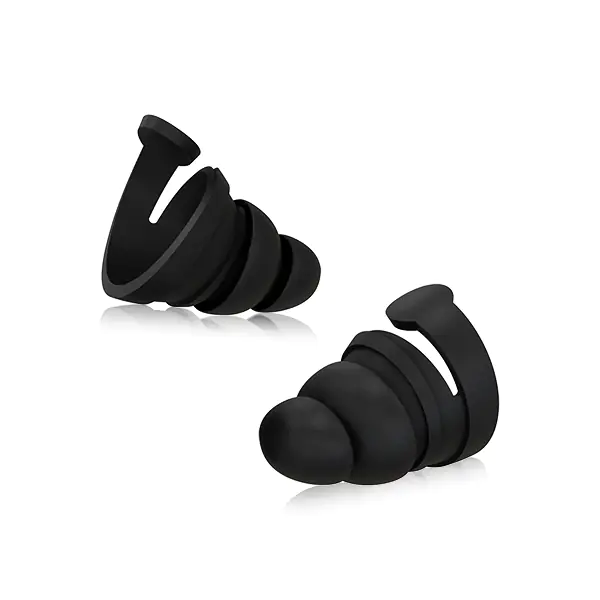
Riders put it plainly on the forums. Foam makes them feel like they are hearing the road through a wall, and it turns claustrophobic inside a full-face helmet, while silicone is described as normal but quieter. The numbers behind that feeling come down to foam vs filtered attenuation profiles, which diverge by more than the single figure on the packet suggests.
Myth 5: Is it too late to start if your ears already ring?
No, and this is the myth that costs riders the most. Noise-induced hearing loss and tinnitus are cumulative, so the damage already done stays done, while every protected ride from here limits what gets added to it.
The scale of the problem in Britain is not small. Tinnitus UK puts 994,000 riders at risk, because only 29% of British motorcyclists use hearing protection regularly or even sometimes. The rest are riding on one of the four myths above.

Riders who already have ringing usually report the same first change, and it is not audiological. The drone stops accumulating over the hours, so the fatigue at the end of a long day arrives later. Earplugs will not undo damage that is already done, and persistent ringing is a conversation for your GP or an audiologist, but cutting the exposure on every ride from here is the part that is still in your hands.
So what should a rider actually do?
Five beliefs, five measurements, and none of them favour riding unprotected. The helmet works in the wrong frequencies, the Highway Code recommends protection rather than forbidding it, the wind does the damage well before the engine does, and more attenuation is not automatically safer. Our Moto+ riding earplugs sit at SNR 24 dB for exactly that reason, low-profile enough to stay put under any helmet.
Which pair to ride with is a buying decision rather than a myth, and it deserves its own space. If you want ratings, fit and rider type compared properly before you choose, our guide to the best motorcycle earplugs for wind noise takes each option apart for touring, commuting and track use. Start on the next ride, not the next season.

His connection to hearing protection stems from personal experience with sound sensitivity during live events and work in noisy environments, an issue that made him more aware of the long-term risks of unmanaged noise exposure. Today, as both a communicator and a user of BOLLSEN products, he is passionate about raising awareness around the importance of proactive hearing care.
At BOLLSEN, he develops data-driven marketing campaigns, writes SEO-focused articles, and manages communication channels that connect customers with practical knowledge about hearing protection. His work ensures that BOLLSEN’s message—prioritizing health, performance, and sustainability reaches a global audience in an engaging and trustworthy way.
Passionate about writing since childhood, Timotej combines creativity with a strong analytical approach, continuously testing new ideas in digital marketing, performance advertising, and social media. He believes in learning through innovation and collaboration, balancing leadership with openness to new perspectives.
Beyond his professional role, Timotej is committed to a healthy lifestyle and finds inspiration in fitness, sports, and quality time with friends. His personal passion for well-being aligns with BOLLSEN’s core values, making his work not only a career but also a cause he deeply believes in.