
⏱️ Estimated reading time: 15 min

Key Takeaways
Book a motorcycle or car track day and the checklist runs to tyre pressures, brake fluid, taped lights and a noise test. Earplugs for track days almost never make that list, and they are the only item on it protecting something you cannot replace. Measured on helmeted riders and published in the British Journal of Audiology, a rider at a sustained 100 mph is sitting in 112 dB(A). At that level the Health and Safety Executive’s daily allowance runs out in roughly a minute.
Riders push back on this, and they are blunt about it. One track rider on a stock exhaust said that with plugs in “I can’t hear the damn bike”, and pulled them out after the first session. That reaction is real, but it answers a road question on a closed circuit. We build our road advice around traffic awareness and junction hazards, which is why choosing earplugs for motorcycle riding on the public road works differently from kitting up for a circuit session.
At Bollsen we have been making reusable medical-grade silicone hearing protection since 2016, and our work has been covered in BBC Science Focus and Which? magazine. Track days are a different exposure problem from commuting, so this article deals with the participant inside the helmet rather than anyone watching from the fence.
Do you actually need earplugs for a track day?
Yes, because a track day concentrates exposure in a way road riding never does, packing five or six 20-minute sessions at sustained speed inside six to eight hours in a paddock with thirty other engines running. The HSE upper exposure action value of 85 dB(A) covers a whole eight-hour day, and one session can spend it several times over.
Road riding is intermittent by nature. You slow for junctions, sit in queues, filter and stop for fuel, and each of those is a rest your ears take without you noticing. A circuit removes every one of them, which is why a track day deserves its own answer rather than a borrowed one.
How loud is a track day for the rider or driver?
Loud enough to be measured in triple digits, with helmeted riders recorded at 112 dB(A) at 100 mph by Binnington and colleagues on the acoustic environment of the motorcyclist, and at 114 to 116 dB(A) at 120 mph in open-road measurements by the Institute of Sound and Vibration Research at the University of Southampton. Those are ordinary track-day speeds on most UK circuits.
The noise is not mostly your engine. ISVR traced the dominant source to the turbulent wake coming off the screen and the helmet, with the largest contribution to the A-weighted level sitting between 300 and 400 Hz. Above roughly 40 mph that aerodynamic roar exceeds the exhaust, so a quiet bike is not a quiet ride.
Wind noise scales with speed rather than with your exhaust, and it keeps climbing for as long as you hold the throttle open. Our hub article on wind noise dB by speed maps the full range from town speeds upwards for road riders.
Drivers get a slightly better deal, and not by as much as they hope. A helmet, an open visor, a stripped interior and an uncorked exhaust give back most of what the bodywork takes away. The primary measurements are worth reading yourself in the ISVR study on noise under motorcyclists’ helmets, which remains the most cited work on the subject.
Is the 105 dB track noise limit about protecting your hearing?
No, because the 105 dB(A) static limit used by Motorsport UK and most circuits is measured 0.5 m from the exhaust outlet at 45 degrees with the engine held near three-quarters of redline, and it exists to satisfy planning conditions rather than to protect the person riding. It is the most misread number in UK track-day culture.
Nothing in that test describes what reaches your ear. It is a snapshot of one stationary machine at half a metre, not a measure of accumulated exposure inside a helmet across six sessions. Single-seaters are allowed 108 dB(A), Castle Combe holds a stricter 100 dB(A) static limit with an 87 dB(A) drive-by test on top, and 11 of the 19 UK circuits in one industry guide also run a drive-by test.
Pass the noise test and you have proved your bike or car is a good neighbour. You have proved nothing about your ears. The circuit operators publish their own limits and testing protocols, and this guide to UK track day noise limits sets out how each venue runs it before you book. Readings are taken from different distances at different circuits, so the numbers are not directly comparable between venues.
How much noise do you take across a six-session track day?
More than a full working day in a factory, because noise dose runs on an exchange rate of 3 dB, which means every 3 dB above the 85 dB(A) action value halves the time your ears can safely take it. That arithmetic turns a 20-minute session from a short blast into the dominant event of your day.
| Level at your ear | Time to a full daily noise dose | What one 20-minute session costs |
|---|---|---|
| 85 dB(A) | 8 hours | 4% of the day’s dose |
| 90 dB(A) | 2 hours 30 minutes | 13% of the day’s dose |
| 95 dB(A) | 47 minutes | 42% of the day’s dose |
| 100 dB(A) | 15 minutes | 1.3 times the day’s dose |
| 105 dB(A) | Under 5 minutes | 4.2 times the day’s dose |
| 112 dB(A) | About 1 minute | 21 times the day’s dose |
Read the bottom rows again. Five sessions at the levels those studies record is not a marginal overshoot of the HSE Control of Noise at Work exposure action values, it is a multiple of them, and that is before the paddock, the pit lane and the sighting laps are counted.
The consequence is measurable rather than theoretical. McCombe and colleagues on hearing loss in motorcyclists put 18 riders through one hour at a steady 80 mph and found a mean temporary threshold shift of 10.3 dB at 1 kHz. Riders describe the same thing in their own words, and one wrote that forgetting his plugs once “resulted in partial hearing loss, self reversible by next day, I would NEVER want to repeat this experiment again”. Across 246 riders the same team measured permanent shifts of 3.7 dB at 0.5 kHz against national population norms, so the temporary version does not stay temporary forever.
What SNR should track-day earplugs be, and is it different from road riding?
On a closed circuit, take the most attenuation you can comfortably wear all day, which is a different answer from road riding, where a 20 to 26 dB range leaves you room to place sirens, horns and traffic behind you. The road-riding SNR sweet spot vs track needs question splits cleanly, because every reason for holding attenuation down disappears the moment the circuit is closed.
There are no junctions, no oncoming traffic and no emergency vehicles arriving unannounced. Marshals communicate with flags you look for rather than sounds you listen for. What remains is a wall of aerodynamic noise for 20 minutes at a time, repeated, and under those conditions more attenuation is better up to the point where the plug stops being comfortable under a helmet lining.
One thing worth being straight about is that no passive earplug is a flat filter. Under EN 352-2 testing our silicone body attenuates around 21.9 dB at 63 Hz and rises to 35.3 dB at 8 kHz, so the higher frequencies are cut hardest and nothing is preserved selectively. You still hear the track, just quieter.

Can you wear earplugs under a full-face helmet all day?
You can, provided the earplug has no protruding stem, because a full-face helmet lining presses directly on anything sitting proud of the ear canal and turns it into a hot spot by session four. That is the point where foam and track days part company.
Foam has to be rolled, held and given time to expand, which is awkward in the assembly area with gloves on and a two-minute call. It also absorbs sweat across a six-session day and cannot be washed and put back in. Reusable medical-grade silicone seats immediately, resists moisture, and washes for reuse up to 100 times, which matters when you are refitting between every session.



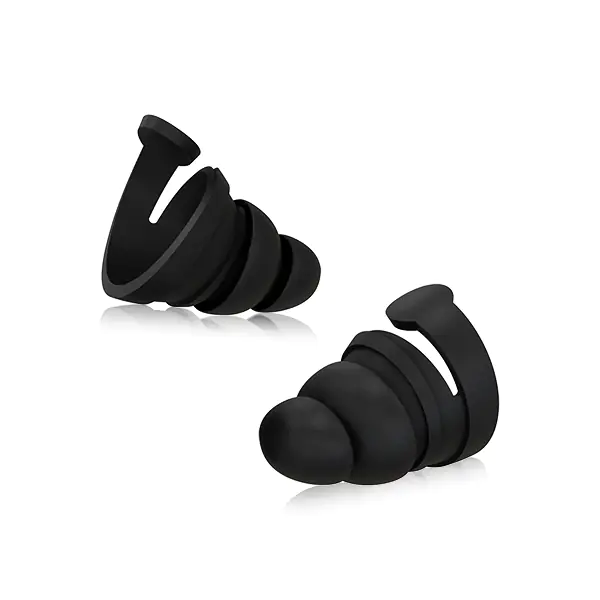
We designed our two-lamella low-profile body to sit flush inside the canal with nothing for a helmet to press against. Moto+ (SNR 24 dB) is German-tested, independently certified 24 dB, rated H24 / M21 / L19 under EN 352-2 by PZT GmbH, Notified Body No. 1974, for riders who want the detail behind the single number.
Will earplugs stop you hearing the engine and your shift points?
No, and most riders find the opposite once they adapt, because wind noise is broadband and relentless and it is the thing masking your engine at speed, so dropping the overall level makes the motor easier to pick out of what is left. The objection tends to reverse within a day or two of riding.
Riders say it plainly on the forums. “You will find that eventually you can hear your motorcycle better with the plugs in.” Another put it this way: “As I got used to wearing plugs I couldn’t figure out how I ever rode without them.”
What you genuinely do lose is speed feel. One rider described how “the sounds of the motor and the wind noise are decreased enough that the visceral speed clues are mostly gone”, and compensated by relying more on the tacho. On a circuit you are already riding to reference points and reading the tacho for shift lights, so the cue you lose is one you were not using.
Do you need to hear anything on a closed circuit?
Barely anything, because circuit signalling is deliberately visual, with flags, marshal posts, light panels and the pit board all designed to be seen rather than heard by someone travelling at 100 mph. Nobody can hear a shout at that speed, so nothing important is transmitted by sound.
The awareness argument that dominates road riding has no equivalent here. There is no traffic, no cross traffic, no sirens and no horn behind you at a roundabout. A track day is the one place you can take maximum attenuation without giving anything up.
There is a performance case too, and riders raise it unprompted. “Extended noise exposure wears me out, it’s very fatiguing”, one wrote, and on track another found it “easier to relax and concentrate without all that wind noise filling my head”. Instructors recommend plugs on exactly that basis, for concentration across a long day rather than for safety.
Do MotoGP riders and racing drivers wear earplugs?
Every rider on the MotoGP grid wears them under the helmet, using moulded silicone rather than foam because foam shifts and swells, and MotoGP states the plugs cut 20 to 30 dB from machines producing up to 130 dB. Nobody at that level treats hearing protection as optional kit.
Car racing tells the same story with a bigger engine note. F1 cars are among the loudest machines on any circuit, and if you have ever wondered how loud an F1 car really is from the grandstands, the driver sits far closer to the source than any spectator does.
Professional teams are a different brief from a hobbyist track day, whether that is a motocross squad or a rally crew, with intercom systems, full race weekends and repeat exposure across a season. We set out the specification and volume requirements for motocross teams and professionals separately, and cover the same ground for rally teams and professionals who need protection across multi-day stages.
Do car track days and karting need hearing protection too?
Both do, and karting is the one people underestimate, because a kart puts an unsilenced high-revving engine roughly a metre behind your head with no bodywork, no glass and often an open-face helmet between you and it. Sessions are shorter, but the dose arithmetic does not care how you arrived at the level.
Car track days add something the paddock tends to forget. A stripped car with a roll cage, no carpet and no headlining is a hard, reflective box, and the exhaust drone that was tolerable on a road trip becomes a different proposition across six 20-minute sessions with a helmet on.
What to take to your next track day
Two numbers are worth carrying away from this. The circuit’s 105 dB(A) test is about the village down the road, and your own dose at 105 dB(A) at the ear is spent in under five minutes. Six sessions of that is not a marginal call.
Fit your plugs in the assembly area before the helmet goes on, and leave them in between sessions while you are stood at the fence watching the next group out. If you also ride on the road, choosing motorcycle earplugs there is a different calculation, and our guide to the best motorcycle earplugs for wind noise works through those trade-offs for riders who spend most of their miles in traffic.
Hearing damage does not announce itself on the day. It turns up years later as a ringing that will not switch off, and nothing reverses it once it is there. Protection cannot undo what is already done, but it decides how much more you add, and a track day is where you add the most in the shortest time.

His connection to hearing protection stems from personal experience with sound sensitivity during live events and work in noisy environments, an issue that made him more aware of the long-term risks of unmanaged noise exposure. Today, as both a communicator and a user of BOLLSEN products, he is passionate about raising awareness around the importance of proactive hearing care.
At BOLLSEN, he develops data-driven marketing campaigns, writes SEO-focused articles, and manages communication channels that connect customers with practical knowledge about hearing protection. His work ensures that BOLLSEN’s message—prioritizing health, performance, and sustainability reaches a global audience in an engaging and trustworthy way.
Passionate about writing since childhood, Timotej combines creativity with a strong analytical approach, continuously testing new ideas in digital marketing, performance advertising, and social media. He believes in learning through innovation and collaboration, balancing leadership with openness to new perspectives.
Beyond his professional role, Timotej is committed to a healthy lifestyle and finds inspiration in fitness, sports, and quality time with friends. His personal passion for well-being aligns with BOLLSEN’s core values, making his work not only a career but also a cause he deeply believes in.