
⏱️ Estimated reading time: 15 min

Key Takeaways
Ask what motorcycle earplugs SNR rating you need and every rider you know will give you a different number. One UK rider on r/motorcycle settled on 39 dB SNR foam plugs for the road. Another, in an 85-comment thread, admitted the outside world felt “too quiet” with plugs in and hated not hearing what was going on around him. Both were reacting to the same mistake, which is treating the rating as a score to maximise.
The measured answer for road riding is 20 to 26 dB, and the rest of this guide is about which end of that band belongs to your riding and how to read the label that proves it. At BOLLSEN we have made reusable medical-grade silicone hearing protection since 2016, trusted by 1,000,000+ people, and our own Moto+ earplugs for motorcycle use are rated SNR 24 dB for the reasons set out below. If you want the fitting, helmet and sizing side, our hub on earplugs for motorcycle riding covers helmet compatibility, sizing and rated attenuation before you commit to a pair.
What SNR rating do I need for motorcycle riding?
Road riding needs an SNR of 20 to 26 dB. Wind noise under a full-face helmet measured 90 to 99 dB(A) at 50 mph and 97 to 104 dB(A) at 70 mph in the ISVR wind-tunnel study by Lower and colleagues (1994), and a rating in that band brings the level at the ear below the 85 dB HSE target without dropping under the 70 dB point where HSE says over-protection begins.
Which end of the band you need depends on how fast and how long you ride. Commuting at town speeds sits at the bottom of it, sustained motorway and touring sit at the top, and a rider who is paid to be on the bike all day is covered by the Control of Noise at Work Regulations 2005 rather than by preference.
| Riding type | Typical level under the helmet | Recommended SNR | Why |
|---|---|---|---|
| Urban commute, mostly under 40 mph | Below 90 dB(A); wind reaches 90 dB(A) at about 40 mph (Binnington 1993) | 20–22 dB, or none at 30 mph and below | Helmet alone improves warning-signal detection in town |
| A-road and motorway, 50–70 mph | 90–99 dB(A) at 50 mph, 97–104 dB(A) at 70 mph (Lower 1994) | 24 dB | 98 dB(A) minus 24 dB leaves 74 dB at the ear, inside the HSE 70–85 dB window |
| Touring, all day at motorway speed | 97–104 dB(A) sustained for hours | 24–26 dB | Hours of exposure add up; at 97 to 104 dB(A) the top of the band still leaves 71 to 78 dB at the ear |
| Occupational: courier, instructor, police | Daily exposure regularly above 90 dB(A) (ISVR) | Certified 24 dB as a minimum | 85 dB(A) upper action value: protection must be provided and worn |
| Track day | Sustained high speed, no oncoming traffic | Not a road decision | See our guide to earplugs for track days |
The track-day row deserves its own guide because a circuit removes the traffic-awareness trade-off entirely. For sustained high-speed sessions with no oncoming traffic, our guide to earplugs for track days explains why maximum attenuation is the right call there and the wrong one on the road.
Why is 20 to 26 dB the road-riding sweet spot?
Because wind noise on a road bike sits between 90 and 104 dB(A) at legal speeds, and the HSE window for a protected ear runs from 70 dB to 85 dB. Subtract 20 to 26 dB from a 98 dB(A) motorway level and the result lands inside that window; subtract 33 dB or more and it falls out of the bottom.
Three studies fix the input side. Lower and colleagues measured 90 to 99 dB(A) at 50 mph and 97 to 104 dB(A) at 70 mph in the wind tunnel for the Home Office, and the reports still sit on the ISVR motorcycle noise project page. Binnington and colleagues (1993) put wind noise at 90 dB(A) from 40 mph, rising log-linearly to 112 dB(A) at 100 mph, and Jordan and colleagues (2003) recorded 83.6 to 109.4 dB(A) on the road, with even the best helmet above 90 dB(A) at speeds over 90 km/h.
The at-ear arithmetic for the ends of the band is short. At a 98 dB(A) motorway reference, SNR 20 leaves 78 dB at the ear, SNR 24 leaves 74 dB and SNR 26 leaves 72 dB, all inside the HSE window. At 50 mph, where the wind runs 90 to 99 dB(A), a 24 dB plug lands between 66 and 75 dB, which is why the lower end of the band suits a commuter and the upper end suits sustained motorway riding.

Every line of that arithmetic starts from the wind noise dB levels by speed, which climb faster than most riders expect. For the full speed-by-speed table, fairing and helmet variables, see our measured guide to wind noise dB levels by speed, which also marks the point where wind overtakes engine noise above 40 mph.
What do SNR, H, M and L mean on an EN 352-2 label?
SNR (Single Number Rating) is the attenuation figure an earplug earns under EN 352-2, the European standard for earplugs, and the H, M and L values printed beside it are the attenuation for high, medium and low-frequency noise. A rating without a BS EN 352-2 test behind it is a marketing number, which is why forum threads keep repeating “never trust their claims”. Most of the confusion about what NRR and SNR ratings mean comes from American packaging, which prints NRR instead.
The two ratings are earned under different test methods and do not convert cleanly, but that is not a riding question. For the derating rules, the two test methods and a full explanation of what NRR and SNR ratings mean, our sleep-earplug guide covers the standards in more depth than a riding decision needs.
How to read the Moto+ H, M and L values for wind noise
Wind noise under a helmet peaks around 250 to 500 Hz, which makes the M and L figures the honest ones for riding. Our Moto+ earplugs are rated SNR 24 dB with H 24 / M 21 / L 19, German-tested, independently certified 24 dB, and the frequency curve below shows why the headline number and the wind number differ.
| Frequency | 63 Hz | 125 Hz | 250 Hz | 500 Hz | 1 kHz | 2 kHz | 4 kHz | 8 kHz |
|---|---|---|---|---|---|---|---|---|
| Moto+ mean attenuation (EN 352-2) | 21.9 dB | 23.1 dB | 21.8 dB | 22.1 dB | 23.2 dB | 28.4 dB | 29.3 dB | 35.3 dB |
Read across the curve and the shape is plain. Attenuation rises with frequency, sitting around 22 dB through the lows and mids where wind energy lives and climbing to 35 dB at 8 kHz. That is a standard passive earplug profile rather than a flat one, and it means a siren stays audible through Moto+ because a siren is 110 to 120 dB loud, not because the earplug favours it.
How does the HSE SNR selection table apply to riding levels?
The HSE publishes a selection table that matches a measured A-weighted noise level to an SNR range: 85 to 90 dB(A) needs SNR 20 or less, 90 to 95 needs 20 to 30, 95 to 100 needs 25 to 35 and 100 to 105 needs 30 or more. Lay the measured riding levels over it and 50 mph, at 90 to 99 dB(A), spans the 20 to 30 and 25 to 35 rows, while 70 mph, at 97 to 104 dB(A), spans the 25 to 35 and 30-plus rows.
Now cap that with the 70 dB floor. At a typical 98 dB(A) motorway level anything above 28 dB drops the ear below 70 dB, and at a 90 dB(A) A-road pace 20 to 22 dB is already enough. Trim both ends and the usable road band is 20 to 26 dB, the lower half for slower riding and the upper half for sustained motorway speed. HSE’s own wording is that you should “aim at least to get below 85 dB at the ear”, and that protectors “that reduce the level at the ear to below 70 dB should be avoided”, because over-protection causes difficulties with communication and hearing warning signals and wearers tend to remove the protection. That guidance sits on the HSE hearing protection page and was written for factories, but a motorway at 70 mph is a louder workplace than most of them.
For riders who are paid to be on the bike, the table is not advice. The Control of Noise at Work Regulations 2005 set a lower exposure action value of 80 dB(A), an upper action value of 85 dB(A) at which hearing protection must be provided and worn, and an exposure limit of 87 dB(A) at the ear. The ISVR found working riders’ daily exposure regularly above 90 dB(A), and Jordan’s on-road study put every occupational rider above the 90 dB(A) action level in force at the time, so a courier, instructor or police rider needs a certified 24 dB rather than the bottom of the band.
Does the helmet count towards the protection?
No, not in the frequencies that matter. A helmet attenuates about 5 to 8 dB above 500 Hz and, according to Kennedy and colleagues (2014, Acta Acustica), amplifies noise below 500 Hz, which is exactly where helmet wind noise peaks, so the earplug is doing the work in the band that matters and its SNR cannot be topped up with helmet figures.
The same 2014 study measured a temporary threshold shift of more than 15 dB after a 30-minute ride, and McCombe, Binnington, Davis and Spencer (1995) recorded a mean shift of 10.3 dB at 1 kHz after one hour at a steady 80 mph. A threshold shift is hearing that has temporarily dulled, and it is the measured reason riders describe feeling worn out after a long motorway stint even in a quiet helmet. Choose the SNR for the wind noise you actually ride in, and let the helmet’s 5 to 8 dB above 500 Hz be a bonus rather than a figure in your sum.
Is a higher SNR always safer on the road?
No. Above about 26 dB on a public road the extra attenuation starts costing traffic awareness rather than buying protection, because disposable foam rated 33 to 37 dB SNR brings a 98 dB(A) motorway level down to 61 to 65 dB at the ear, below the 70 dB point at which HSE says warning signals become harder to hear.
Riders discover this by feel before they read it. The r/motorcycle rider who found the outside world “too quiet” was describing exactly that floor, and another in the same thread said he could not wear foam plugs that block everything. The “more is better” instinct comes from foam, where 29, 33 and 39 dB are the numbers on the shelf, and it is the most common attenuation mistake on the road.
None of this means a 24 dB earplug hides a siren, because a siren at 110 to 120 dB loses the same 24 dB as the wind and stays well clear of it. The measured evidence on hearing sirens and traffic with earplugs in, including the 1993 finding that detection improved above 40 mph, is the subject of our guide to hearing sirens and traffic with earplugs in, which also carries the full at-ear table for every earplug type you might fit.
Which earplugs deliver 24 dB under a helmet?
A reusable silicone earplug rated SNR 24 dB under EN 352-2, with a low-profile body that sits inside the canal without a protruding stem, delivers the middle of the road-riding band in a form that a full-face helmet does not unseat. That pairing of certified rating and helmet-safe shape is what separates the best motorcycle earplugs for wind noise from a high number on a foam packet.
Fit decides whether the rating you paid for is the rating you get. One rider put it precisely, saying that if he shifted his head or jaw one plug ended up slightly unseated mid-trip, annoying and useless. A seal that breaks under the helmet cheek pad turns 24 dB into a fraction of that, so the shape of the plug is part of the attenuation decision.



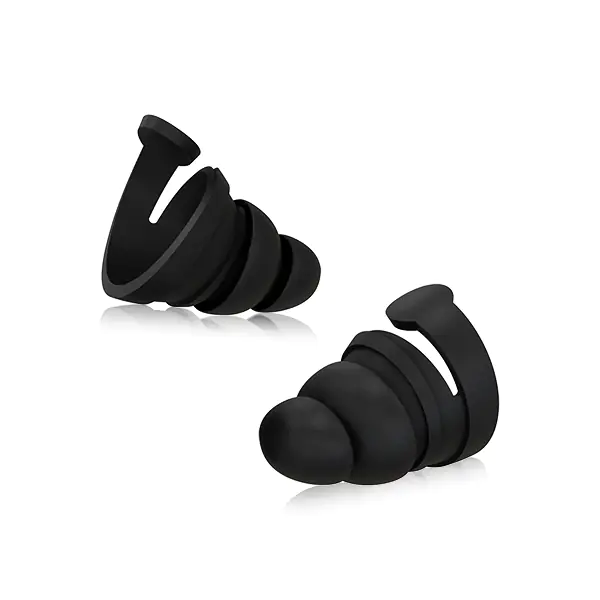
For the middle of the band in a shape built for the helmet cheek pad, our Moto+ (SNR 24 dB) earplugs are German-tested, independently certified 24 dB and made from medical-grade natural silicone. They are BPA, PVC and latex-free, washable and moisture-resistant for up to 100 uses, and come in an aluminium case at £26.95 a pair, which works out at roughly 27p per ride. Every pair carries our 40-day money-back guarantee. If your ears run small or large, AR KI TECH sizes the plug from two photos of your ears so the seal you measured at home is the seal you ride with.
So which SNR should you ride with?
Ride with 20 to 26 dB on the road, and pick the end of the band by speed and duration rather than by the biggest number you can find. Town commuting sits at 20 to 22 dB, or no plug at all at 30 mph and below, A-road and motorway riding sits at 24 dB, and touring or working days sit at 24 to 26 dB. Read the M and L values rather than the SNR alone, because wind lives at 250 to 500 Hz, and never let foam take you under the 70 dB floor.
The rating is one of three things that decide whether a pair works on a bike, alongside helmet fit and how the plug survives a season of sweat and rain. For the full comparison of foam, moulded and reusable silicone, our hub guide to the best motorcycle earplugs for wind noise puts every option side by side with its rating, its helmet fit and its price. Pick the band, check the certificate, and ride the same roads with less of the roar. Try Risk-Free for 40 days.

His connection to hearing protection stems from personal experience with sound sensitivity during live events and work in noisy environments, an issue that made him more aware of the long-term risks of unmanaged noise exposure. Today, as both a communicator and a user of BOLLSEN products, he is passionate about raising awareness around the importance of proactive hearing care.
At BOLLSEN, he develops data-driven marketing campaigns, writes SEO-focused articles, and manages communication channels that connect customers with practical knowledge about hearing protection. His work ensures that BOLLSEN’s message—prioritizing health, performance, and sustainability reaches a global audience in an engaging and trustworthy way.
Passionate about writing since childhood, Timotej combines creativity with a strong analytical approach, continuously testing new ideas in digital marketing, performance advertising, and social media. He believes in learning through innovation and collaboration, balancing leadership with openness to new perspectives.
Beyond his professional role, Timotej is committed to a healthy lifestyle and finds inspiration in fitness, sports, and quality time with friends. His personal passion for well-being aligns with BOLLSEN’s core values, making his work not only a career but also a cause he deeply believes in.