⏱️ Estimated reading time: 14 min

Key Takeaways
For most workers, no. A well-fitted universal or sized earplug gives comparable protection for a fraction of the typical £100–200+ custom price and without weeks of lead time. Custom plugs suit a narrow group, such as very small or unusually shaped ear canals, or years of daily high-noise work with the employer paying.
Not on the evidence. In HSE research report RR727, five CE-marked custom-moulded earplug models all delivered less protection than their makers claimed, and the study found no evidence that custom plugs protect better than other types. Correct fit and insertion matter more than the price.
Typically £100–200 or more per pair, plus an ear impression appointment before the wait begins. A universal WorkPRO pair costs £29.95.
Suppliers typically quote an impression appointment followed by around 3–4 weeks of manufacture. Your employer must still provide suitable hearing protection from your first noisy shift, so you wear a universal or foam plug while you wait.
Suppliers typically quote four to five years, but the material rarely decides it. Ear canals change shape over time, and when a custom plug starts to loosen or leak sound it needs a new impression, not just a clean.
Your employer must provide suitable hearing protection free of charge under the Control of Noise at Work Regulations 2005, but nothing requires it to be custom-moulded. Many employers fund custom plugs only where nothing else fits.
Custom earplugs for work promise a seal moulded to your own ears, and they carry a price to match, usually £100–200 or more a pair. On one UK motorcycling forum, a rider who had paid for a set called them “very slightly better but as easy to lose as the cheap ones”. On a carpenters’ forum, another worker described his custom pair as “extremely comfy” over long days on the tools. Both can be right, depending on the job, the shift and who pays.
HSE estimates that 15,000 workers have hearing problems caused or made worse by work (Labour Force Survey average, 2022/23 to 2024/25), so the plug you choose has to be worn properly every shift, not admired in its case. At Bollsen, we make hearing protection trusted by 1,000,000+ people, including WorkPRO, a German-tested, independently certified 24 dB reusable earplug for noisy jobs. We do not make custom-moulded plugs, and we still think they are the right call for some workers. For every job, noise level and UK rule in one place, our hub for earplugs for work is the place to start before you compare plug types.
Are custom moulded earplugs worth it for work?
Custom-moulded earplugs are worth it for work only for a narrow group of people, namely those with very small or unusually shaped ear canals that no universal plug seals, and those facing years of daily high-noise exposure whose employer funds the typical £100–200+ cost and the 3–4 week wait. For everyone else, a well-fitted universal or sized earplug gives comparable protection sooner and for far less.
That verdict comes from how the three options behave on a real shift. A custom plug is moulded from an impression of your ear, a universal plug such as WorkPRO uses a flexible 2-lamella silicone body to seal a wide range of canals, and a sized plug matches a small or medium body to your canal from photos. Price is the most visible difference between them, and on protection it is the least important.
Do custom earplugs protect better on shift than universal earplugs?
There is no evidence that custom-moulded earplugs protect better on shift than other hearing protectors, and in HSE research report RR727, a market surveillance study of five CE-marked custom-moulded models, every model tested delivered less attenuation than its manufacturer claimed. A custom plug is only as good as its fit on the day, the same as any other earplug.
The same caution applies to every rating. HSE’s hearing protection guidance advises subtracting 4 dB from the rated SNR to allow for real-world fit, and suggests SNR 20 or less for 85–90 dB(A), 20–30 for 90–95 dB(A), 25–35 for 95–100 dB(A) and 30 or more for 100–105 dB(A). A universal SNR 24 plug sits in the 90–95 dB(A) band, just below the 95–100 dB(A) range.
Working out how much hearing protection your job needs starts with a daily exposure figure in dB(A). Our guide how much hearing protection do I need converts a measured noise level into a target SNR band for your workplace.
How do custom-moulded, universal and sized earplugs compare for work?
Custom-moulded earplugs typically cost £100–200+ and take weeks to arrive, the universal WorkPRO costs £29.95 and is available off the shelf, and the sized WorkPRO sits between them, chosen small or medium from two phone photos. All three are reusable in-ear protectors, so the real differences show up in fit, re-fit and replacement on a working site.
| Factor | Custom-moulded earplugs | Universal WorkPRO (2-lamella) | Sized WorkPRO (S/M, AI ear measurement) |
|---|---|---|---|
| Cost | Typically £100–200+ per pair, impression usually included | £29.95 per pair | See product page |
| Lead time | Impression appointment, then typically 3–4 weeks of manufacture | Off the shelf | Size chosen from two phone photos, then shipped |
| Fit consistency | Repeatable once the impression is right; still depends on correct insertion | Flexible flanges seal a wide range of canals; insertion technique matters | Small or medium body matched to your canal; insertion technique matters |
| Re-fit when the canal changes | New impression and a new pair | Nothing to re-make; replace the pair if it stops sealing | Re-measure and switch size if the fit changes |
| Replacement if lost on site | Re-order at full price; weeks without that pair | Replace a £29.95 pair | Re-order the same size |
| PPE compatibility | Sits in the canal; most fit under ear defenders | Low-profile; ear defenders fit over the top | Low-profile; ear defenders fit over the top |
What does the custom lead time mean for workers on site?
A custom pair starts with an ear impression appointment, and suppliers typically quote 3–4 weeks of manufacture after that, so a new starter, an agency worker or anyone who has lost a pair needs other hearing protection for the whole wait.
Under regulation 7 of the Control of Noise at Work Regulations 2005, employers must make hearing protection available from 80 dB(A) or a 135 dB(C) peak, and must provide it and enforce its use from 85 dB(A) or 137 dB(C). Exposure at the ear must also stay below the 87 dB(A) limit and the 140 dB(C) peak. In practice that means a universal or foam plug from the first noisy shift.
Interim protection is the employer’s job, not the worker’s. Our guide to employer responsibilities for noise at work sets out who supplies, pays for and checks hearing protection under UK law, including the free-of-charge rule.
How consistent is the fit across a full working shift?
A custom-moulded earplug goes in the same way every time once the impression is right, which is its strongest argument, while a universal 2-lamella earplug relies on the wearer inserting it to the same depth each time and taking a moment to check the fit. Carpenters who rate custom plugs mostly praise comfort, not extra decibels. One said the choice “is very personal”, and co-workers on the same site preferred opposite types.
Fit can be measured rather than guessed. Individual fit testing, covered by the standard BS EN 17479:2021, measures how much protection a plug actually delivers in your ear, and HSE expects employers to train workers to fit their protection correctly.
Correct insertion matters as much for a custom plug as for a universal one. Our step-by-step guide on how to put earplugs in and check the fit shows the pull-up-and-back technique and a quick seal check you can repeat at the start of every shift.
When does a custom work earplug need re-making?
A custom-moulded earplug needs re-making when your ear canal changes shape, which happens gradually over the years, and suppliers typically quote a working life of four to five years before a new impression is due. When the canal changes, a pair that once sealed well can loosen or leak sound, and the answer is a new impression and a new pair.
A universal or sized plug handles small changes differently, because the flexible flanges work across a range of canals and a pair that stops sealing is simply replaced or swapped for the other size. If you notice wax build-up, itching or soreness where any plug sits, pause that pair and speak to your GP, pharmacist or occupational health team before carrying on. The NHS page on earwax build-up explains when to get help.
Where does a sized WorkPRO fit between custom and universal earplugs?
The sized WorkPRO is the middle option for workers whose ears sit outside the universal fit, with the size, small (S) or medium (M), chosen by AI ear measurement from two phone photos rather than moulded from an impression. It is the same WorkPRO design in two sizes, so there is no appointment and no weeks-long wait, and our photo sizing has a brand-wide return rate of 3%.
WorkPRO is a passive earplug rated SNR 24 dB (H 24 / M 21 / L 19), tested to EN 352-2 in Germany, in yellow hypoallergenic silicone with a low profile so ear defenders fit over the top. Attenuation rises with frequency, so higher-pitched noise is reduced most, and it is neither electronic nor noise cancelling. A loud warning stays audible because it is loud, not because a filter passes it through.


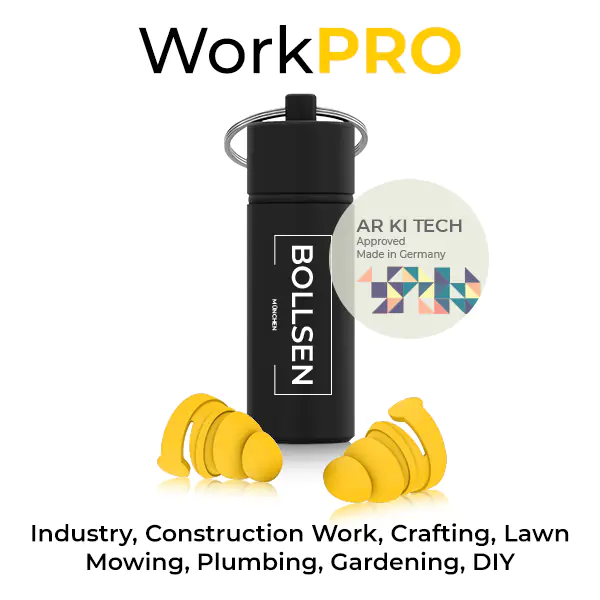

If a universal fit has worked for you before, our WorkPRO earplugs (SNR 24 dB, £29.95) are the reusable, washable default for most noisy shifts and come with our 40-day money-back guarantee. If earplugs have always felt loose or sore in your ears, WorkPRO with AR KI TECH sizing (S/M) matches a small or medium body to your ear canal before you buy, with no impression appointment.
What does losing a plug on site cost the employer?
Losing one custom-moulded earplug on site usually means re-ordering the pair at the typical £100–200+ price, sometimes from the impression on file, with weeks of lead time, while losing a universal plug means replacing a £29.95 pair from stock. One forum rider’s complaint that custom plugs are “as easy to lose as the cheap ones” is really a complaint about this bill.
Kitting out ten workers with custom plugs typically costs £1,000–2,000 or more before any losses, against £299.50 for ten WorkPRO pairs at the single-pair price, and some employers fund custom only for named roles with the heaviest exposure. Suppliers’ own payback calculations usually compare custom plugs with disposable foam, not with a reusable universal pair, so check which baseline a quote uses.

Disposable foam, reusable silicone and banded plugs each carry a different cost per shift. Our comparison of reusable vs foam vs banded earplugs for work works out that cost for one worker and a team of 50, including the break-even point against foam.
Do custom earplugs work with a hard hat, safety glasses and a respirator?
Custom-moulded, universal and sized earplugs all sit inside the ear canal, so none of them competes for space with a hard hat, the arms of safety glasses or the straps of a respirator the way ear defender cushions can, where a glasses arm can lift the cushion seal. HSE asks employers to check that hearing protection is compatible with the other PPE a worker wears before issuing it.
Under ear defenders, a low-profile plug matters more than a moulded one, because anything sticking out of the ear can press on the cushion. Wearing earplugs with a hard hat, glasses and respirator mostly comes down to the order you put the kit on. Our guide to earplugs vs ear defenders at work compares the two by noise level, PPE and shift length.
Which workers should choose custom-moulded earplugs?
Custom-moulded earplugs make sense for workers with very small or irregular ear canals that neither a universal nor a sized plug seals, and for long-term roles with daily exposure above 85 dB(A) where the employer pays, accepts the 3–4 week wait and keeps interim protection in stock. For occasional noise, one woodworker found cheap plugs worked “well enough that the additional expense of custom fitted is not warranted”.
Most UK workers are better served by a universal plug first, a sized plug if the universal one does not seal, and custom only after both. Our ranked guide to the best earplugs for work sets out every type by job and noise level, from disposable foam to electronic and banded options.
If you are weighing custom plugs for night-time use rather than the workplace, our guide to custom-moulded earplugs for sleep covers overnight comfort and fit for bedroom noise.
Custom earplugs for work are a good product sold to more people than need one. Start with a universal WorkPRO, move to the S or M size if the fit is wrong, and keep custom for the ears nothing else seals. Whatever you choose, check the seal every shift, because a leaking plug delivers less than its rating, however much it cost. Try WorkPRO risk-free with our 40-day money-back guarantee.

His connection to hearing protection stems from personal experience with sound sensitivity during live events and work in noisy environments, an issue that made him more aware of the long-term risks of unmanaged noise exposure. Today, as both a communicator and a user of BOLLSEN products, he is passionate about raising awareness around the importance of proactive hearing care.
At BOLLSEN, he develops data-driven marketing campaigns, writes SEO-focused articles, and manages communication channels that connect customers with practical knowledge about hearing protection. His work ensures that BOLLSEN’s message—prioritizing health, performance, and sustainability reaches a global audience in an engaging and trustworthy way.
Passionate about writing since childhood, Timotej combines creativity with a strong analytical approach, continuously testing new ideas in digital marketing, performance advertising, and social media. He believes in learning through innovation and collaboration, balancing leadership with openness to new perspectives.
Beyond his professional role, Timotej is committed to a healthy lifestyle and finds inspiration in fitness, sports, and quality time with friends. His personal passion for well-being aligns with BOLLSEN’s core values, making his work not only a career but also a cause he deeply believes in.