
 Sleeping
 Concerts
 Motorcycle
 Swimming
 Work
Work Kids
Kids


⏱️ Estimated reading time: 8 min

Key Takeaways
A festival weekend can mean many hours of loud music across several days, and that exposure adds up. Hearing risk depends on both how loud the sound is and how long you are exposed, so a long day near the stage can matter more than a single loud song.
Further from the speaker stacks is better, because sound is loudest close to the speakers. Standing off to the side or towards the back, and stepping away from the front for regular quiet breaks, lowers how much loud sound reaches your ears over a long day.
From the first set, not after your ears already feel tired. Because exposure builds across the day and across the weekend, the sensible habit is to wear them while the music is loud and take them out only in quiet moments, such as at the campsite.
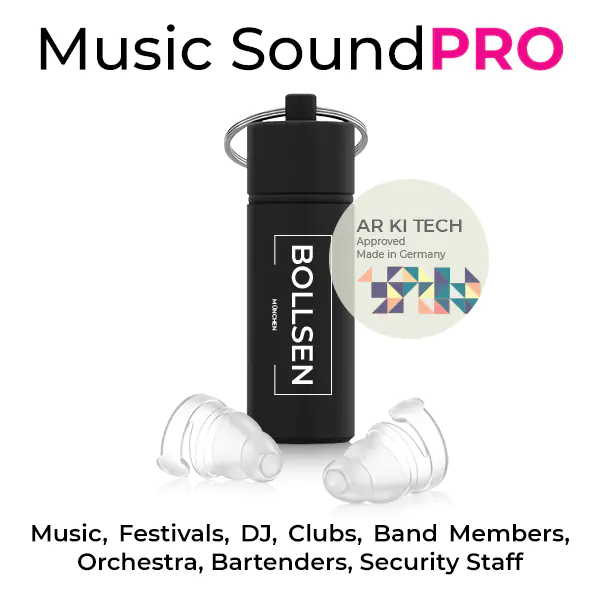
Yes. Music SoundPRO is a passive hypoallergenic silicone earplug with an SNR of 24 dB. You still hear the music, just quieter. It is transparent, so it is hard to spot, and it is not electronic or noise cancelling.
Mild ringing can follow a loud night, but it is a sign your ears have had a lot to deal with. If the ringing lasts or keeps coming back, speak to your GP or an audiologist rather than waiting for it to settle on its own.
BOLLSEN works with Roxy Nox as a partner; their Instagram post is a paid partnership. Roxy is a DJ (tech house and techno), a music producer and a label owner, and in her own post she talks about what festival season means for her ears. This article takes her point and turns it into practical, sourced advice for anyone heading to a festival this summer.
Roxy Nox on looking after her ears
Roxy shared her thoughts on Instagram in June 2026. She opens with the idea that care for your hearing now belongs to festival season as much as the music does: “Taking good care of my ears has become just as much a part of festival season as the music itself.”
She is also clear about why it matters in her line of work: “As a professional DJ, I spend a lot of my time in seriously loud environments.” And as someone who produces and runs a label, she adds: “As a music producer and label owner, my hearing is my most important tool.”
Her closing line is the simplest summary of the whole topic: “Look after your ears – they’re with you for life.”
Why festival season adds up
A single loud night is one thing. A festival is usually several long days, often with music from the afternoon until late. Your ears do not get a full reset in between, so the exposure builds. That cumulative effect is the reason a plan for the whole weekend works better than reacting once your ears feel tired.
The World Health Organization points out that over 1 billion young adults are at risk of permanent, avoidable hearing loss due to unsafe listening practices (see the WHO fact sheet linked below). It also lists safe listening strategies for recreational settings as part of its recommended approach. We cover typical levels in our guide to how loud concerts really are, and answer the obvious question in do earplugs at concerts work.
Where you stand makes a difference
Sound is loudest closest to the speakers, so position is one of the easiest ways to lower your exposure without spending anything. A few habits help:
- Keep clear of the speaker stacks. The front barrier is the most dramatic spot, but it is also where the sound is strongest.
- Choose the sides or the back for the long sets. You can usually still feel the energy of the crowd from there.
- Behind the booth is not automatically quiet. Monitors and nearby stacks can be loud, so the same advice applies on the other side of the decks.
- Build in quiet breaks. Step away from the stage for ten minutes or so between sets, ideally somewhere you can hear each other talk.
Earplugs in from the first set
The most reliable habit is to put your earplugs in at the start rather than waiting until you notice a problem. By the time your ears feel tired, you have already had the exposure. Wearing them from the first set also means you do not have to think about it again until the music stops. If you are still choosing a pair, our guide to festival earplugs compares the options.
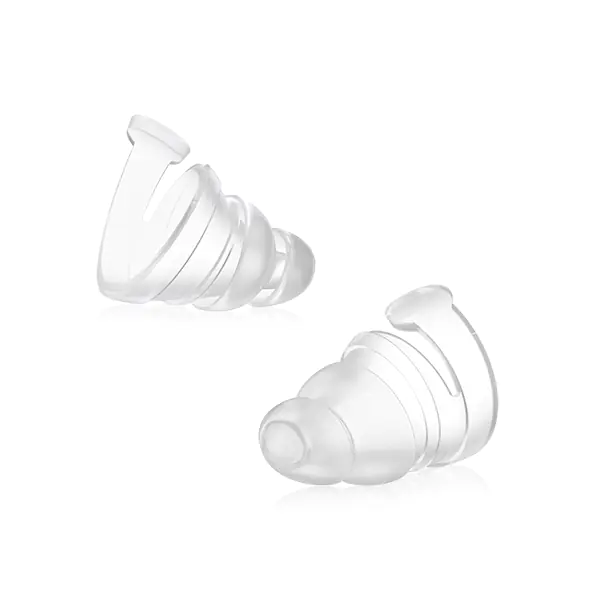
Roxy mentions another reason people skip protection: “They’re practically invisible – nothing in the way while you’re playing, no awkward looks on the dancefloor, just comfortable and reliable protection.” Music SoundPRO is a transparent earplug that fits flush in the ear, so it is hard to see when worn.
To be precise about what it does: it is a passive earplug made from hypoallergenic silicone with an SNR of 24 dB (H 24, M 21, L 19). It lowers the volume rather than switching the music off, so you still hear the music, just quieter. Its attenuation is not identical at every pitch; it is higher in the highs than in the lows. It is not electronic and it is not noise cancelling. If you want a hand with the choice, see how to choose music earplugs.
Each pair comes with an aluminium case with a keyring, and the plugs are reusable up to 100 times. Clip the case to your bag or belt so the plugs are always to hand, and keep them in the case when they are not in your ears so they stay clean and do not get lost in a tent.
A simple festival routine
- Before you go: pack your earplugs and case, and check the plugs are clean.
- On arrival: decide where you will stand for the main sets, away from the stacks.
- From the first set: plugs in, and leave them in while the music is loud.
- Between sets: take a quiet break away from the stage.
- At the campsite and at night: give your ears as much quiet as you can.
- Afterwards: if ringing lasts or keeps coming back, speak to your GP or an audiologist.
See how other professionals approach the same question: see every expert who trusts BOLLSEN, or read how a Balkan band thinks about it in our Dubioza Kolektiv expert review.


Sources and further reading
- World Health Organization: Deafness and hearing loss fact sheet
- Roxy Nox on Instagram (paid partnership with BOLLSEN)

His connection to hearing protection stems from personal experience with sound sensitivity during live events and work in noisy environments, an issue that made him more aware of the long-term risks of unmanaged noise exposure. Today, as both a communicator and a user of BOLLSEN products, he is passionate about raising awareness around the importance of proactive hearing care.
At BOLLSEN, he develops data-driven marketing campaigns, writes SEO-focused articles, and manages communication channels that connect customers with practical knowledge about hearing protection. His work ensures that BOLLSEN’s message—prioritizing health, performance, and sustainability reaches a global audience in an engaging and trustworthy way.
Passionate about writing since childhood, Timotej combines creativity with a strong analytical approach, continuously testing new ideas in digital marketing, performance advertising, and social media. He believes in learning through innovation and collaboration, balancing leadership with openness to new perspectives.
Beyond his professional role, Timotej is committed to a healthy lifestyle and finds inspiration in fitness, sports, and quality time with friends. His personal passion for well-being aligns with BOLLSEN’s core values, making his work not only a career but also a cause he deeply believes in.