
 Sleeping
 Concerts
 Motorcycle
 Swimming
 Work
Work Kids
Kids


⏱️ Estimated reading time: 9 min

Key Takeaways
Rehearsals combine high levels with long duration. Exposure builds with both loudness and time, so a session of several hours at full volume adds up even if no single moment feels extreme. Small rooms and reflective walls can make levels feel louder than they are on stage.
A muffled or dull feeling after loud music can be a temporary change in hearing, often with ringing. The US National Institute on Deafness (NIDCD) says some temporary loss fades within 16 to 48 hours. If ringing or dullness lasts or keeps returning, speak to your GP or an audiologist.
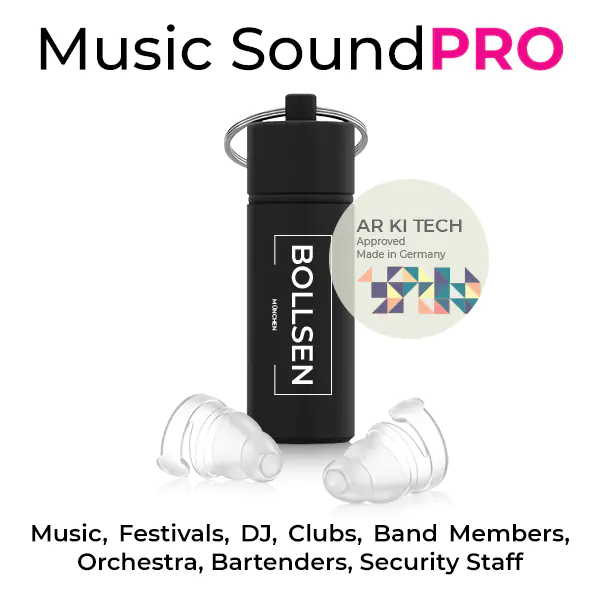
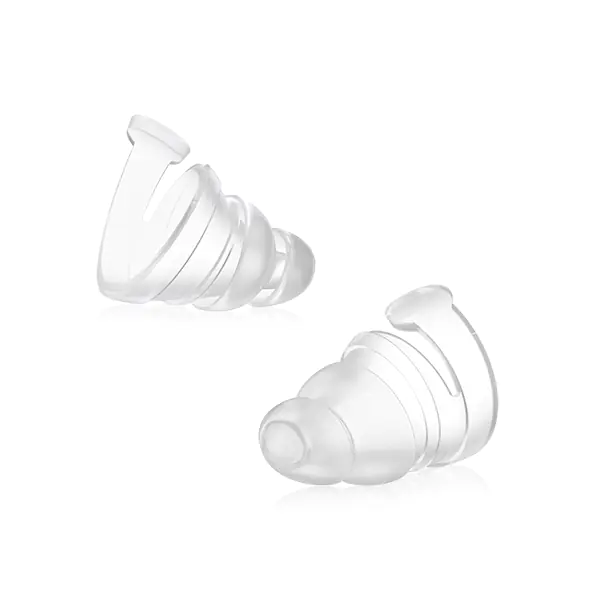
Music SoundPRO lowers the whole level so you still hear the music, just quieter. It is a passive silicone earplug rated SNR 24 dB. Attenuation rises with frequency, so the highs are reduced more than the lows. Expect it to sound different at first, then adjust your amp or monitor levels.
Put earplugs in before the first song, not after your ears feel tired. Keep amps and monitors no louder than needed, take short breaks between songs, and give drummers some distance from the guitar stacks. Lower exposure is the aim, and plugs plus lower levels work best together.
Wash your hands, hold the plug by its stem, gently pull your ear up and back, and insert it with a slight twist until it sits snugly. It should feel comfortable and seal without pain. Try the sizes, and check the seal by humming. It is reusable up to 100 times.
Post-punk, industrial and EBM band XPQ-21 posted about their BOLLSEN earplugs on Instagram on 10 June 2026. BOLLSEN works with XPQ-21 as a partner; their Instagram post is a paid partnership. They said: “Folks, these little things saved my ears.” They also wrote that they use them for “rehearsal room, full volume, hours-long sessions”, and added: “Would recommend them even without this being a partnership.” We have limited detail beyond that post, so this article sticks to what they said and to what the independent sources below support. If you want the wider picture, you can see every expert who trusts BOLLSEN.
What XPQ-21 said about rehearsals
In their caption, the band describe walking out of long, loud sessions with tinnitus and a “cotton in the head” feeling, and say that is no longer the case for them. That is their own experience, and it is not something we can promise for anyone else. Earplugs lower how much sound reaches your ear. They do not treat or prevent tinnitus, and they are not a substitute for medical advice.
What they say about the sound is more useful to compare with your own experience: “It still sounds like music, just quieter.” That matches how we describe Music SoundPRO. It is a passive plug made of hypoallergenic silicone with an SNR of 24 dB, so you hear the music at a lower level. Attenuation is not flat. It rises with frequency, from roughly 22 dB in the low end to about 35 dB at 8 kHz, so the highs are reduced more than the lows.
Why hours-long sessions add up
Hearing risk depends on how loud a sound is and for how long you hear it. The NIDCD says that long or repeated exposure to sounds at or above 85 dBA can cause hearing loss, and that the louder the sound, the shorter the time it takes. It lists playing in a band among the recreational activities that can put you at risk (NIDCD, noise-induced hearing loss).
In the UK, the Control of Noise at Work Regulations set action levels of 80 and 85 dB(A) for daily or weekly average exposure, with an exposure limit of 87 dB(A) (HSE). Those rules cover work, and HSE states they do not apply to people who choose to go to noisy places in their free time. A hobby band is not covered, but the numbers are a sensible yardstick. HSE also offers a noise exposure calculator if you know your levels. We do not know the level of any particular rehearsal room, so measure rather than guess if you can. For more on the musician-specific picture, read our guide to noise-induced hearing loss in musicians.
What a muffled, “cotton in the head” feeling can mean
After a loud session, sounds can seem dull or muffled, sometimes with ringing. The NIDCD notes that loud noise can sometimes cause a temporary hearing loss that disappears 16 to 48 hours later, and that recent research suggests there may be residual long-term damage even when hearing seems to recover (NIDCD). Treat that feeling as a signal that the session was too much for your ears, not as something to push through.
The NHS says tinnitus is not usually a sign of anything serious and may get better by itself, but advises seeing a GP if you have it regularly or constantly, if it is getting worse or if it bothers you (NHS, tinnitus). If ringing lasts or keeps coming back, speak to your GP or an audiologist. Ringing with sudden hearing loss needs urgent medical attention, as the NHS page explains.
Practical habits for a loud rehearsal room
- Plugs in before the first song. Exposure counts from the first loud note, so do not wait until your ears feel tired.
- Turn amps and monitors down to what the room needs. If everyone raises their level to hear themselves, the whole room climbs together. Agree a ceiling.
- Take breaks. A few quiet minutes between songs or sets lowers the total dose over a long session.
- Mind the drummer’s position. Drums and cymbals are loud on their own, and a drummer sitting right beside a guitar stack hears both. Space and angled amps help. Our guide to ear protection for drummers covers this.
- Keep a pair in your gear bag. The aluminium case with a keyring makes it easy to carry them to every rehearsal.
Fitting Music SoundPRO for rehearsals
Music SoundPRO is a reusable, hypoallergenic silicone earplug, good for up to 100 uses, and it comes with an aluminium case. For a good seal, wash your hands, hold the plug by its stem, gently pull the top of your ear up and back, and insert it with a slight twist until it sits snugly. It should be comfortable. If it hurts or feels loose, remove it and try again. Because sound is lowered rather than blocked, you can still talk to bandmates, although it helps to agree on hand signals for loud sections. There is also a version with AR KI TECH, which helps you find your size. See our guide to choosing music earplugs for more detail.
You may notice the sound changes at first, because the highs are reduced more than the lows. Give it a few rehearsals and adjust your levels, rather than turning everything up to compensate. Another band that works with us is covered in our Dubioza Kolektiv expert review, and acousticians share their view in the Camino Akustik review.


Sources
- NIDCD: Noise-induced hearing loss
- HSE: Control of Noise at Work Regulations 2005
- NHS: Tinnitus
- WHO: Making listening safe
WHO states that more than 1 billion young people (12 to 35 years old) are at risk of hearing loss due to recreational exposure to loud sound.

His connection to hearing protection stems from personal experience with sound sensitivity during live events and work in noisy environments, an issue that made him more aware of the long-term risks of unmanaged noise exposure. Today, as both a communicator and a user of BOLLSEN products, he is passionate about raising awareness around the importance of proactive hearing care.
At BOLLSEN, he develops data-driven marketing campaigns, writes SEO-focused articles, and manages communication channels that connect customers with practical knowledge about hearing protection. His work ensures that BOLLSEN’s message—prioritizing health, performance, and sustainability reaches a global audience in an engaging and trustworthy way.
Passionate about writing since childhood, Timotej combines creativity with a strong analytical approach, continuously testing new ideas in digital marketing, performance advertising, and social media. He believes in learning through innovation and collaboration, balancing leadership with openness to new perspectives.
Beyond his professional role, Timotej is committed to a healthy lifestyle and finds inspiration in fitness, sports, and quality time with friends. His personal passion for well-being aligns with BOLLSEN’s core values, making his work not only a career but also a cause he deeply believes in.