
⏱️ Estimated reading time: 20 min

Key Takeaways
The best earplugs for work are rarely the ones with the biggest number on the packet. One UK forum user summed up the search well: “I use earplugs for 8 hours a day at work, and I’ve tried every different type that we’ve had at work.” Most people asking this question have already been handed foam by their employer and want to know whether something else would suit their shift better.
This guide compares earplug types, not brands, against UK noise law and HSE’s selection guidance. Ear defenders (called ear muffs in the US) appear as the main alternative. Ratings are given as SNR, the European figure; the US NRR for the same plug usually reads roughly 3–5 dB lower.
If you are comparing a US packet with a UK one, our NRR vs SNR explained page shows how the two test methods produce different numbers for one plug. US readers working to American rules can read what OSHA standards are for background, but every limit in this guide is the UK’s.
At Bollsen, we are a family-owned hearing protection company founded in 2016 and trusted by 1,000,000+ people, and we make a reusable work earplug called WorkPRO. We say below where it fits and where another type does the job better. For our full range of earplugs for work, including job-specific guides and UK regulations, start at our workplace hub.
What makes an earplug the best choice for work?
The best choice of work earplugs brings your noise level below 85 dB(A) at the ear without dropping it under 70 dB, stays comfortable for an 8–12 hour shift, and works with the hard hat, safety glasses or respirator your job already requires. Those three tests rule out more options than any brand comparison does.
HSE lists the same factors in its brief guide to noise at work (INDG362): a suitable protection factor, comfort and hygiene for the work being done, and compatibility with hard hats, masks and eye protection. It also asks employers to consult workers on the types provided. That matters because protection only counts while it is in the ear, and HSE notes that removing it for even a few minutes considerably reduces the protection over a day.
Two more criteria decide daily use. Hygiene matters when plugs are handled with dusty or oily hands several times a shift, and cost per wear matters when a team goes through hundreds of pairs a month. Ear canal size is the quiet one: a plug that is too large presses, and one that is too small never seals.
Hearing specialists judge hearing protection on the same basis. Our interview on what an audiologist looks for in hearing protection explains why seal, comfort and real wear time rank above the headline attenuation number. If you want the basics first, start with what earplugs are and how each design blocks sound.
What does UK law say about hearing protection at work?
Under the Control of Noise at Work Regulations 2005, employers must act at a lower exposure action value of 80 dB(A) (peak 135 dB(C)) and an upper exposure action value of 85 dB(A) (peak 137 dB(C)), and must never let exposure at the ear pass the limit of 87 dB(A) (peak 140 dB(C)). The exact values are set out in regulation 4 of the 2005 Regulations.
Between 80 and 85 dB(A), the employer must provide hearing protection to anyone who asks for it. Above 85 dB(A), the employer must provide it, make sure it is used and mark hearing protection zones. HSE is clear that hearing protection is not an alternative to controlling noise at source, so earplugs are the last layer of an employer’s plan, not the plan itself.
HSE’s rule of thumb is simple. If people have to raise their voices to talk when they are about 2 m apart, the noise probably needs action, and using noisy powered tools for more than half an hour a day is another trigger. Our Control of Noise at Work Regulations 2005 explained guide covers each duty in more detail.
The stakes are measurable. HSE’s noise-induced hearing loss statistics estimate that 15,000 workers had hearing problems caused or made worse by work (average for 2022/23 to 2024/25), and 50 new cases of occupational deafness were assessed for Industrial Injuries Disablement Benefit in 2024.
How do the main types of work earplugs compare?
Across the main types, disposable foam has the highest typical SNR (roughly 28–37 dB), reusable silicone sits around 20–30 dB with the lowest running cost for daily wear, and ear defenders reach 25–35 dB but compete with hard hats and glasses for space. The table below compares each type on the factors HSE asks employers to weigh.
| Type | Typical SNR range | Cost per wear | PPE compatibility | Hygiene | Best for |
|---|---|---|---|---|---|
| Disposable roll-down foam | 28–37 dB | Lowest upfront; a fresh pair every shift and after most removals | Fits under hard hats, glasses and respirator straps | Rolled between the fingers, so needs clean hands; single use | Short, very loud tasks, visitors, very dirty work |
| Reusable pre-moulded silicone | 20–30 dB | One-off cost that falls with every shift worn | Low-profile; fits under hard hats and ear defenders | Washable with mild soap and water | Daily 8–12 hour shifts at 90–100 dB(A) |
| Banded / canal-cap | 20–26 dB | Medium; band kept, pods replaced | Band can clash with a hard-hat harness or visor | Pods touch surfaces when the band is put down | Walking in and out of noisy areas many times a shift |
| Corded (foam or reusable) | Same as the plug on the cord | Slightly above the uncorded version | Cord can snag on equipment | Cord picks up dust and sweat | Jobs where a dropped plug is easily lost |
| Custom-moulded | Varies with the filter or insert fitted | Highest upfront (impression plus moulding) | Low-profile; works under most PPE | Washable; made for one person | One long-term wearer with a stable fit |
| Electronic / level-dependent | Varies by model; check the EN 352 marking | High; plus batteries or charging | Bulkier; check against hard hat and visor | Electronics limit how they can be cleaned | Specific jobs where the noise assessment calls for them |
| Ear defenders (EN 352-1) | 25–35 dB | Medium; one headset, replaceable cushions | Glasses arms and some hard hats break the cushion seal | Wipe cushions between users | Intermittent noise, and over earplugs above 100 dB(A) |
SNR ranges in the table are typical category values, not certified figures for any single product, so always read the EN 352 label on the pack. To work out the right SNR for a measured noise level, our guide on how much hearing protection do I need walks through HSE’s band table and the H/M/L method step by step.
Ear defenders earn their row because they go on and off in a second, which suits noise that comes and goes. They also get hot over a summer shift, and glasses arms let sound leak under the cushions. The full trade-off is in earplugs vs ear defenders at work.
Are disposable foam earplugs good for work?
Disposable roll-down foam earplugs are the default issue in most UK workplaces because they are cheap, high in attenuation (typically SNR 28–37 dB) and fit almost any ear when rolled and inserted properly. Comfort over a long shift is their weak point.
Wearers describe foam that “can start to feel like pressure after a few hours”. One construction worker said foam left his jaw and ears sore after long days, and he switched to a flanged reusable plug that blocks a little less noise but stayed in all shift. That trade is often the right one, since a slightly lower rating worn all day beats a higher one taken out at lunch.
High numbers can also overshoot. Using HSE’s method, an SNR 37 plug in 88 dB(A) noise takes the level at the ear to around 55 dB, well under the 70 dB floor HSE recommends. For visitors, short tasks above 95 dB(A) or work where hands are filthy, though, a fresh foam pair is hard to beat.
Are reusable silicone earplugs better for daily shifts?
Reusable pre-moulded silicone earplugs suit daily shifts because they are washable, need no rolling, go back in within seconds after a break and usually sit at a mid-range SNR of 20–30 dB, the band HSE suggests for 90–95 dB(A) work. For most people on long shifts, that combination of comfort and adequate protection is what keeps them in the ear.
The flanges (lamellae) seal the canal by their shape rather than by expanding, so pressure spreads differently from foam. Many wearers find that easier over a 10-hour day. People with very small or very large ear canals may need a sized plug before a reusable will seal at all.
Cost per wear is where reusables pull ahead. You pay once and divide the price across every shift they last, while foam is bought again every day and every time a pair hits the floor. We run the sums for each type in reusable vs foam vs banded earplugs for work.
Our reusable silicone design for this row is WorkPRO earplugs (SNR 24 dB, £29.95), made for full shifts under hard hats and ear defenders. We explain further down where they fit on HSE’s bands, and where they do not.
When do banded or corded earplugs make sense?
Banded (canal-cap) earplugs hang around the neck and press two pods into the entrance of the ear canal, typically giving SNR 20–26 dB. That makes them practical for supervisors, engineers and drivers who step in and out of noisy areas many times a shift, rather than for continuous exposure.
Because the pods only cap the canal, protection depends on how firmly they are pressed in, and the band can clash with a hard-hat harness or a welding visor. Pods also pick up dirt whenever the band is put down on a bench.
Corded earplugs are a different idea: the same foam or reusable plug, tied together so a dropped pair is not lost on the floor or in a production line. Users like that, although one reviewer warned that cords “can snag on equipment”, so check them against your machinery before you buy a box for the team.
Are custom-moulded earplugs worth it for work?
Custom-moulded earplugs are made from an impression of one person’s ear canal, so the fit can be excellent, but their protection depends on the filter or insert fitted and they cost the most upfront of any type. They also suit only the person they were made for.
Experience varies more than the sales pitch suggests. One wearer has used moulded plugs “for 10 years now and wouldn’t go back to foam ones”, while another found they “made my ears ache after a few hours of wear”. Ear canals shift slightly when you talk and chew, and a hard mould cannot move with them.
For a long-term single user with a stable fit, moulds can make sense. For teams and changing staff, sized universal plugs are simpler to buy and replace, and we compare the options in custom moulded earplugs for work.
Are electronic or noise cancelling earplugs suitable for work?
Electronic and level-dependent earplugs use a microphone and circuit to change how much sound reaches the ear at different levels, and they suit specific jobs where the employer’s noise assessment calls for them. They cost far more than passive plugs and must still carry an EN 352 marking to count as hearing protection.
Consumer noise-cancelling earbuds are not the same product. Unless a device is tested and marked to EN 352, treat it as a comfort gadget rather than workplace PPE. Battery life also has to cover the whole shift.
For most steady workplace noise, a passive plug does the job at a fraction of the price. We look at where active and level-dependent designs earn their cost in noise cancelling earplugs for work.
Why does fit matter more than the rating?
An earplug’s SNR is measured in a laboratory to ISO 4869-1 with trained subjects and careful fitting, so it shows close to the best protection the plug can give. On a real shift, a poorly inserted plug can deliver only a fraction of the number on its label.
HSE’s hearing protection guidance allows for this by taking 4 dB off the calculated protection to cover real-world factors. Fit is the biggest of them: insertion depth, a seal broken by jaw movement, or a plug half pulled out when a hard hat goes back on. One forum user’s verdict on foam applies to every type: “If you haven’t got on with disposables it is probably because you are wearing one that isn’t suited to you or your ear.”
A quick check helps. With the plugs in, cup your hands over your ears; if the noise drops a lot, the seal is poor and the plug needs reseating. Our step-by-step on how to put earplugs in and check the fit covers foam, flanged and banded types.
Sizing is the other half of fit. WorkPRO with AR KI TECH sizing (S/M) uses AR and AI to measure your ear canals from phone photos and match you to a small or medium plug, which has brought our returns down to 3%.
Which earplugs suit which job?
Matching earplugs to a job starts with the noise level and its pattern, so one factory can need foam at a loud short task, reusable plugs on the assembly line and plugs under ear defenders in the loudest areas. The noise assessment, not the job title, sets the band.
HSE notes that its quick SNR band table is not suitable for noise with strong low-frequency content, such as press shops, generator bays and plant rooms. There the H/M/L values or an octave-band calculation should be used instead.
On construction sites, noise jumps between breakers, saws and quieter phases, and plugs come in and out with hard hats and gloves. Reusable or banded types handle that rhythm, with ear defenders over the top for the loudest tools. We cover site work in earplugs for construction workers and tool levels in how loud are power tools.
In manufacturing and warehousing, noise from conveyors, packing lines and compressors is often steady for a whole shift. Where an assessment puts that steady noise in the 90s dB(A), a comfortable mid-range reusable plug earns its place because it is worn for 8–12 hours without coming out.
Clinical noise is quieter but constant, and comfort and hygiene count as much as the rating. A Munich dentist talks through drill noise in our earplugs for dentists review, written for people who work close to high-pitched drills all day.
Night and rotating shift workers also need earplugs after the shift ends, to sleep through daytime traffic and neighbours. That is a sleep question rather than a PPE one, covered in our guide to earplugs for shift workers and daytime rest.
Below 80 dB(A), in offices, call centres and open-plan spaces, earplugs are a comfort and focus choice. The hearing protection duties in the 2005 Regulations start at 80 dB(A), so any earplug that feels good is a personal choice there.
Where does WorkPRO fit?
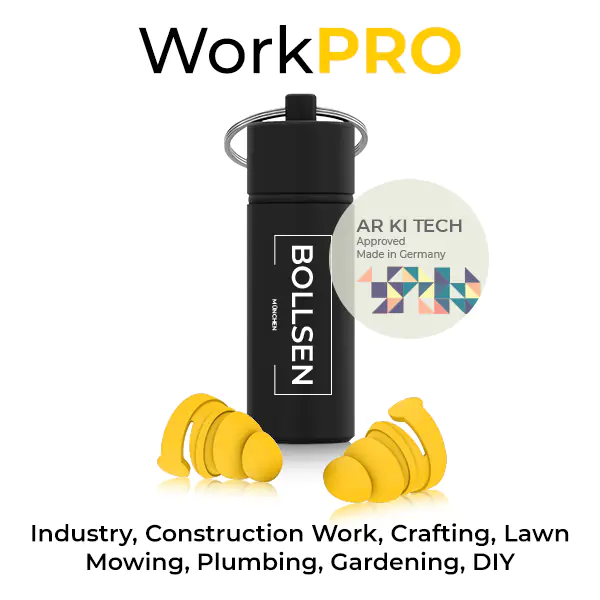
WorkPRO is our reusable work earplug: a passive plug rated SNR 24 dB (H 24 / M 21 / L 19), tested to EN 352-2 by PZT GmbH, made from hypoallergenic two-lamella silicone in high-visibility yellow, and low-profile enough to wear under ear defenders. On HSE’s band table, 24 dB sits inside the suggested range for 90–95 dB(A) noise and just under the 25–35 dB range suggested for 95–100 dB(A).
As a rough worked example, 95 dB(A) minus (24 − 4) dB leaves about 75 dB(A) at the ear, under the 85 dB target and above HSE’s 70 dB floor. Like every passive plug, WorkPRO reduces everything rather than picking sounds out, and its attenuation rises with frequency, so higher tones are reduced more than low ones. A loud alarm stays audible because it is loud, not because a filter passes it through.

The design is patented (US D961,757), the plugs are washable and reusable, and UK orders ship from our Birmingham warehouse with a 40-day money-back guarantee. WorkPRO is German-tested, independently certified 24 dB hearing protection, and Bollsen has over 10,000 verified reviews across the range.



WorkPRO is one part of an employer’s noise controls, never a substitute for them. Noise reduction at source, quieter equipment and limited exposure time come first under the 2005 Regulations, and earplugs protect what is left.
When is WorkPRO not the right pick?
WorkPRO is not the right pick on its own above 100 dB(A), around impulse noise, or in quieter 85–90 dB(A) work where a lower rating is enough. In the first two cases it belongs under ear defenders, and below 80 dB(A) it is a comfort choice rather than PPE.
Above 100 dB(A), HSE’s guidance points to protection of SNR 30 or more, which in practice means earplugs worn under ear defenders. WorkPRO’s low profile lets the defender cups seal over it. Combined protection is less than the two ratings added together, as our guide to double hearing protection explains.
Impulse noise from cartridge-operated tools, blasting or shooting is judged against the peak values of 135, 137 and 140 dB(C), not against a single-number rating. That work calls for ear defenders over earplugs and the employer’s own assessment, not a plug chosen from its packet.
Strongly low-frequency noise needs the H/M/L check, and WorkPRO’s L value of 19 dB is lower than its SNR. At 85–90 dB(A), HSE’s table suggests SNR 20 or less, so a 24 dB plug sits at the edge of over-protection for some wearers there.
If any earplug causes ear pain, discharge or itching, or you notice ringing or a change in your hearing, stop and speak to your GP or occupational health. The NHS has guidance on hearing loss and when to get your hearing checked.
How do you choose the right earplugs for your shift?
Start with the number on your employer’s noise assessment, not the number on the packet. Pick the SNR band HSE suggests for that level, then choose the type you can wear all shift alongside your other PPE. Foam covers short loud tasks, reusable silicone covers daily wear, and banded plugs suit in-and-out work, with ear defenders over plugs once noise passes 100 dB(A).
If your shifts sit at around 90–95 dB(A) and you want a washable plug that fits under a hard hat and ear defenders, WorkPRO is built for exactly that job. Get your size with AR KI TECH and try it on a real shift with our 40-day money-back guarantee. Your hearing has to last longer than your career, so protect it at every shift.

His connection to hearing protection stems from personal experience with sound sensitivity during live events and work in noisy environments, an issue that made him more aware of the long-term risks of unmanaged noise exposure. Today, as both a communicator and a user of BOLLSEN products, he is passionate about raising awareness around the importance of proactive hearing care.
At BOLLSEN, he develops data-driven marketing campaigns, writes SEO-focused articles, and manages communication channels that connect customers with practical knowledge about hearing protection. His work ensures that BOLLSEN’s message—prioritizing health, performance, and sustainability reaches a global audience in an engaging and trustworthy way.
Passionate about writing since childhood, Timotej combines creativity with a strong analytical approach, continuously testing new ideas in digital marketing, performance advertising, and social media. He believes in learning through innovation and collaboration, balancing leadership with openness to new perspectives.
Beyond his professional role, Timotej is committed to a healthy lifestyle and finds inspiration in fitness, sports, and quality time with friends. His personal passion for well-being aligns with BOLLSEN’s core values, making his work not only a career but also a cause he deeply believes in.