
⏱️ Estimated reading time: 13 min

Key Takeaways
Can riding a motorcycle cause tinnitus? Yes, and the trigger is rarely the engine you can hear. It is the turbulent air moving around your helmet, the noise you stopped noticing years ago. Tinnitus UK estimates that 994,000 British riders do not regularly protect their hearing, and that only 29% use hearing protection regularly or sometimes.

On the Tinnitus UK forum, riders ask a sharper question than the one search engines get. One rider put it exactly: “My ears always seem worse after a ride and take time to settle down, and I don’t enjoy the ride as much as I should as I am unsure whether or not I am aggravating the situation.” The real question is not whether riding can cause tinnitus, but whether it is happening to you right now.
At Bollsen we have made reusable medical-grade silicone hearing protection since 2016, and our Moto+ earplugs are German-tested and independently certified at SNR 24 dB. Riders ask us about ringing more than any other subject, which is why we treat motorcycle earplugs as a hearing decision rather than a comfort accessory. Wind noise accumulates on every mile at speed, so choosing motorcycle earplugs with a certified attenuation rating protects cochlear hair cells that never grow back.
Can riding a motorcycle cause tinnitus?
Yes. Sustained exposure to wind noise at riding speeds damages the cochlear hair cells that convert vibration into nerve signals, and once enough of them are destroyed the brain can start generating a tone that has no external source. That is tinnitus, and those cells do not regenerate.
The NIDCD reports that between 10 and 25% of adults experience tinnitus, and states plainly that there is currently no cure for it. Tinnitus UK puts prevalence among British adults at roughly 1 in 7. Its chief executive Caroline Savage is blunt about where it comes from: “Noise exposure is the single biggest preventable cause of tinnitus.”
Riders are not a hypothetical risk group either. British research on motorcyclists published in the Journal of Laryngology and Otology in 1995 found measurable permanent hearing threshold shifts in riders compared with non-riding controls, and three decades of quieter engines have not changed the physics of moving air.
Why do my ears ring after every ride?
That ringing is almost always a temporary threshold shift, a short-term drop in hearing sensitivity that follows loud exposure and usually settles within a few hours as overworked hair cells recover. It fades. What it tells you does not.
A threshold shift is evidence that the ride crossed the level at which hearing damage becomes possible. The HSE sets 80 dB as the lower action value at work, the point at which employers must start doing something about noise. A motorway ride sits comfortably above that for its entire duration, and unlike a factory shift nobody hands you protection at the gate.
Wind noise, not the exhaust, does most of the damage above roughly 40 mph, because turbulent air breaking around the helmet shell generates broadband sound right at the ear. Our full breakdown of how loud wind noise gets at riding speeds sets out the measured levels by speed and the exposure times at which damage starts, so you can see where your own commute sits.
How do you tell post-ride ringing from chronic tinnitus?
Duration is the dividing line. Ringing that arrives after a ride and clears within hours is a temporary threshold shift. A sound that is still present after three months meets the NIDCD definition of chronic tinnitus, and that is a different conversation entirely.
Riders describe the onset in very consistent terms. One poster on a tinnitus forum wrote about getting home on a Friday evening after riding and having ringing in his ears, then being left with what he called an electrical whine at 12 to 14 kHz that never went away. Knowing which side of that line you are on decides what you do next.
| Post-ride ringing | Chronic tinnitus | |
|---|---|---|
| How long it lasts | Minutes to a few hours, occasionally until the next morning | Present for 3 months or longer, constant or recurring |
| What it means | Hearing sensitivity has dipped temporarily and will recover | The change is established and does not resolve on its own |
| What it feels like | Muffled hearing plus a hiss or ring that gradually lifts | A steady tone, whine or hiss that is there in silence |
| What to do | Wear certified protection from the next ride onwards | Book a GP appointment and keep protecting what you have |
Is tinnitus from riding permanent?
It can be, and there is no honest way to soften that. Cochlear hair cells destroyed by noise are not replaced, the NIDCD confirms there is currently no cure for tinnitus, and Tinnitus UK states that damage to our hearing is irreversible.
We will not tell you that earplugs treat a condition you already have, because they do not. Hearing protection prevents new noise-induced damage. It has no effect on damage that has already happened, and any brand suggesting otherwise is selling you something that does not exist.
What that leaves is genuinely useful. The volume of your tinnitus at 40 is not fixed by biology alone, it is set by the total noise exposure you accumulate between now and then. Every protected ride is exposure that never joins the total.
Does riding for longer cancel out the protection from earplugs?
No. Attenuation applies for as long as the plug is correctly seated, so a six-hour ride in SNR 24 dB earplugs is quieter throughout than six minutes without them. Duration still counts, but it does not undo the reduction.
One rider worked the arithmetic out himself on a tinnitus forum, reducing his estimated wind noise with 30 dB plugs plus a helmet and landing at a level he believed was safe, then asking: “But is it safe after riding for 4 hours?” The answer is that noise dose combines level and time. The HSE uses a 3 dB exchange rate, so doubling your time in the saddle adds about 3 dB to the daily dose, which is why a long tour deserves better protection than a ten-minute run to the shops rather than the same protection for longer.
Fit is the variable that catches people out. That same rider wore foam plugs on every single ride, rolled to a point exactly as instructed, and still ended up with a permanent whine, because a plug that does not seal delivers a fraction of its rated attenuation. If you have never been confident about your seal, our AR KI TECH ear measurement service uses two photographs of your ears to size the plug correctly before it ships.
Can you still ride a motorcycle if you already have tinnitus?
Yes. There is no medical reason to give up riding because of tinnitus, and for many riders the road is what makes the condition bearable. The change that matters is wearing certified protection on every ride, not riding less often.
One rider on a tinnitus forum put the case better than we could: “If I cut out all the background noise all I would hear would be my tinnitus screaming at me. Riding my bike is the best therapy in the world.” Telling that rider to stay at home is both useless advice and slightly cruel.
Riders who already have the condition often start looking for earplugs for tinnitus and find advice written for offices and bedrooms rather than motorways. Our guide to earplugs for tinnitus covers how attenuation, fit and daily wear work when the ringing is already established, including the situations where plugs are the wrong tool.
When should you see a GP about ringing after riding?
Book an appointment if the ringing is regular, getting worse, or affecting your sleep, concentration or mood. The NHS advises urgent assessment if the sound pulses in time with your heartbeat, or if it starts suddenly in one ear.
A GP will check for anything simple and reversible first, usually earwax or an infection, then refer you to audiology or an ENT specialist if needed. NHS support includes hearing assessment, tinnitus counselling, cognitive behavioural therapy, tinnitus retraining therapy and hearing aids where hearing loss sits alongside the ringing. None of it is a cure, and all of it helps people cope.
Sound therapy and masking sit on the management side rather than the treatment side, and hearing protection belongs there too as prevention of further harm. Our article on earplugs for tinnitus management explains where plugs help day to day, and where over-protection in quiet rooms can make the perceived volume worse.
How do you stop riding from making tinnitus worse?
Wear certified earplugs with a rating of at least SNR 20 dB on every ride, including the short ones, and check the seal before you pull away. Consistency beats intensity, because the daily dose is what accumulates, not any single journey.
Riders try a lot of other things first. Taller screens, quieter touring helmets, a neck tube, a high collar, turning the head slightly out of the airflow, stopping every hour. Each one shaves something off the level and none replaces a plug in the ear canal, including the helmet itself, which our breakdown of whether a motorcycle helmet protects your hearing covers in detail with the measured attenuation figures.



Choosing between ratings and shapes is easier with the options side by side, especially if you have tried foam and given up on it. Our comparison of the best motorcycle earplugs for wind noise ranks the realistic choices by attenuation, comfort under a helmet and how well each one survives being fitted with gloves on.
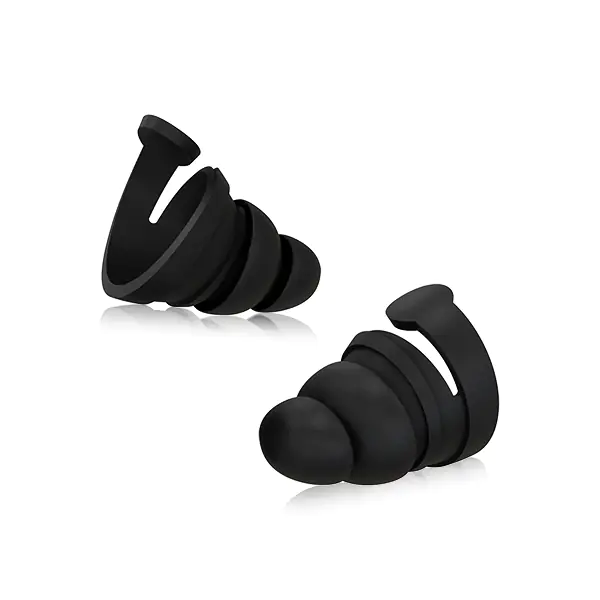
For most riders the decision is simply which certified plug they will actually wear every time. Our own Moto+ (SNR 24 dB) earplugs sit flush inside the canal so a helmet can be pulled on and off without dragging them out of position, which is usually what decides whether protection gets worn on the short rides too.
Riding does not have to cost you your hearing, but it will if nothing changes. Ringing that fades after a ride is a warning you still have time to act on. Ringing that lasts three months is a condition with no cure, and the only thing anyone can influence at that point is how much louder it gets.
Start with the next ride rather than the next bike. A certified plug fitted properly, worn on the commute as well as the Sunday run, is the whole intervention. If the ringing is already there, protect what remains and talk to your GP about the support the NHS offers, then go and ride.

His connection to hearing protection stems from personal experience with sound sensitivity during live events and work in noisy environments, an issue that made him more aware of the long-term risks of unmanaged noise exposure. Today, as both a communicator and a user of BOLLSEN products, he is passionate about raising awareness around the importance of proactive hearing care.
At BOLLSEN, he develops data-driven marketing campaigns, writes SEO-focused articles, and manages communication channels that connect customers with practical knowledge about hearing protection. His work ensures that BOLLSEN’s message—prioritizing health, performance, and sustainability reaches a global audience in an engaging and trustworthy way.
Passionate about writing since childhood, Timotej combines creativity with a strong analytical approach, continuously testing new ideas in digital marketing, performance advertising, and social media. He believes in learning through innovation and collaboration, balancing leadership with openness to new perspectives.
Beyond his professional role, Timotej is committed to a healthy lifestyle and finds inspiration in fitness, sports, and quality time with friends. His personal passion for well-being aligns with BOLLSEN’s core values, making his work not only a career but also a cause he deeply believes in.