
⏱️ Estimated reading time: 15 min

Key Takeaways
Can you hear traffic with motorcycle earplugs in, or are you swapping one risk for another? That objection keeps more riders out of hearing protection than discomfort or price ever have, and it deserves a better answer than “don’t worry, you’ll be fine”. One rider on r/motorcycle made the case more vividly than any brochure: with plugs in he could hear car tyres, horns and the revs of his own engine, and without them all he could hear was “Whoossssssshhhhhhhhhh”.
That is a description of auditory masking, and it has been measured on riders rather than assumed. At BOLLSEN we have been making reusable medical-grade silicone hearing protection since 2016. Riders wanting the buying and fitting side rather than the acoustics should start from our hub on earplugs for motorcycle use, which covers sizing, rated attenuation and helmet compatibility before you commit to a pair.
This article stays on one question: what a 24 dB earplug actually does to a siren, a horn, an intercom and your own engine note. Nothing here depends on our earplug being clever about frequencies, because it is not.
Can you hear traffic with motorcycle earplugs?
Yes, and it has been measured rather than asserted. Binnington, McCombe and Harris (1993) tested the minimum detection level of four real traffic warning signals in 19 normal-hearing listeners across three conditions, and adding earplugs under a helmet produced significant improvements in detection at speeds of 40 mph and above.
The same paper found signal detection was worst of all when riding bareheaded, at every speed above standstill. That is the opposite of what most riders expect, and no other page answering this question cites it. The full abstract sits on PubMed if you want to read the conditions yourself.
The authors also drew a boundary that we are going to keep coming back to, because it is the honest part. They concluded that earplugs are not required for motorcyclists in the urban environment, and recommended them for longer high-speed journeys. Below roughly 40 mph, the detection benefit is not the argument.
What is actually stopping you hearing traffic on a bike?
The wind, and by a wide margin. Noise measured under motorcycle helmets ran 90 to 99 dB(A) at roughly 50 mph and 97 to 104 dB(A) at 70 mph, with the frequency region around 300 to 400 Hz contributing most to the overall A-weighted level.
Low-frequency energy at that level does something specific to hearing. It masks higher-frequency sounds far more than the reverse, an effect audiologists call the upward spread of masking, and the effect grows as the noise gets louder. A 100 dB(A) roar centred just below your speech range is not sitting politely beside the siren. It is burying it.
So the thing making you deaf to the road at riding speeds is already there before you fit anything, and the measurements behind that come from Institute of Sound and Vibration Research work funded by the Home Office. Our separate breakdown of how loud wind noise gets at riding speeds takes the speed-by-speed figures further than we need them here, including the 15.5 dB rise per doubling of speed above 55 mph. The ISVR project page holds the original reports.
A helmet on its own does not protect your hearing from any of this. Its attenuation is only around 5 to 10 dB and essentially nothing below 250 Hz, which is a full question in itself and one we answer in our piece on whether a helmet protects your hearing before any earplug goes in.
Can you still hear an emergency siren with earplugs in?
Yes, because a siren is extremely loud. A German two-tone emergency siren was measured at 115 dB(A) at 3.5 m, against a DIN 14610 requirement of at least 110 dB(A) at that distance, with the two tones sitting at 420 Hz and 560 Hz. UK law sets no decibel value for sirens at all, so every measured figure available is continental.
Take that 115 dB(A) out to about 20 m and simple inverse-square arithmetic puts it near 100 dB(A). Treat that as an estimate rather than a measurement, because the same researcher documented that real-world decay is slower than inverse-square once beaming and weather are involved. At 50 mph your wind noise is somewhere near 98 dB(A), so the siren is arriving roughly level with it.
Now fit a 24 dB earplug. It takes 24 dB off the siren and 24 dB off the wind, so the ratio between them does not move at all. What moves is the absolute level: at roughly 74 dB the wind is no longer loud enough to spread its masking upward across the rest of the spectrum, and that spread was what buried the signal. Nothing is added, nothing is let through, the roar that was hiding the siren is simply smaller.

This is the point where the popular explanation goes wrong, and it is worth being blunt about it. Our roundup of the myths riders still believe about earplugs deals with the rest of them, including the idea that a properly fitted helmet makes plugs unnecessary.
Can you hear car horns and your own engine?
A car horn fitted to a road vehicle has to produce at least 93 dB(A) measured 7 m in front of it under UN ECE Regulation 28, which is louder than helmet wind noise at town speeds and only 5 dB below it at 50 mph. Reduce both by 24 dB and the horn keeps the same margin it always had.
Tyre noise and the vehicle beside you behave the same way. Riders describe this in almost identical terms every time the question comes up on forums: the plugs did not remove the traffic, they removed the roar that was sitting on top of it.
Your own engine is a slightly different case, because aerodynamic noise overtakes engine noise above roughly 65 km/h (40 mph). Below that the engine is the dominant sound and you hear it plainly through a 24 dB plug. Above it, the engine was already losing to the wind before you fitted anything, and gear changes get easier to hear once the wind comes down.
Do earplugs work with a helmet intercom or sat nav?
This is the part riders find hardest to believe until they try it. Helmet speakers and sat nav prompts become easier to follow with earplugs in, not harder, because the intercom is now competing against a background 24 dB quieter rather than against 100 dB(A) of wind.
A UK rider on r/motorcycles described his helmet speakers as tinny and inaudible once speed picked up, read that plugs would improve them, thought it sounded impossible, and became a convert immediately. Another rider put the mechanism better than most acoustics papers: he turns the volume up a little in absolute terms, but ends up at a level that feels subjectively lower, because there is less noise for the audio to fight.
There is a limit to this, and it is worth knowing before you buy. Riders using deep-fitting unfiltered moulds report needing 100% volume, or giving up on the intercom entirely. That is an over-attenuation problem rather than an earplug problem, and it is the same problem that shows up with heavy foam.
Can you tell which direction a siren is coming from?
Less well, and this is the genuine trade-off. In an eight-loudspeaker sound localisation test, correct responses fell from 96% with the naked ear to 63% with passive earplugs, dropping further to 53% with active earplugs and 40% with an active talk-through earmuff.
The shape of the errors matters more than the headline number. They were predominantly up-down confusions, followed by front-back confusions. Left-right judgement, which is the axis you use when a siren pulls up alongside and the axis you confirm in your mirrors, is the least affected of the three.
Earplugs also come off far better than earmuffs here, because the outer ear stays uncovered and the pinna cues your brain uses for direction survive. A separate study on fire, EMS and police personnel found that in-ear devices increased localisation error without reaching statistical significance, while over-ear protectors did. Under a full-face helmet you have already given up some of those cues anyway.
How much attenuation is too much for road riding?
More than you need is a real hazard, and it is the one the rest of the internet skips. HSE advises that protectors reducing the level at the ear below 70 dB should be avoided, because that degree of over-protection may cause difficulties with communication and hearing warning signals, and leaves users isolated from their environment.
Run the arithmetic on a 98 dB(A) wind noise figure and the choice makes itself. The guidance and the wording behind it are on the HSE over-protection page, which also carries the SNR selection table that puts 20 to 30 dB in the right band for 90 to 95 dB(A) exposure.
| What you fit | Typical SNR | Level at the ear in 98 dB(A) wind | What that means on the road |
|---|---|---|---|
| Nothing | 0 dB | ≈98 dB(A) | Well above the 85 dB action level, and the wind masks warning sounds |
| Filtered silicone earplugs | 24 dB | ≈74 dB | Inside HSE’s usable window, above the 70 dB floor |
| Custom moulded, unfiltered | 22–31 dB | ≈67–76 dB | Deep-fitting moulds can push you under the floor |
| Disposable foam | 33–37 dB | ≈61–65 dB | Below the 70 dB floor, which is where isolation starts |
Riders reach that conclusion without the table. One described foam as muffling everything and leaving a feeling of pressure in his head, like being out of this world, and said he genuinely does not recommend it for riding. That is the arithmetic in the bottom row arriving as lived experience, and it is why heavy foam over-isolates in traffic and why 20–26 dB is the road-riding sweet spot.



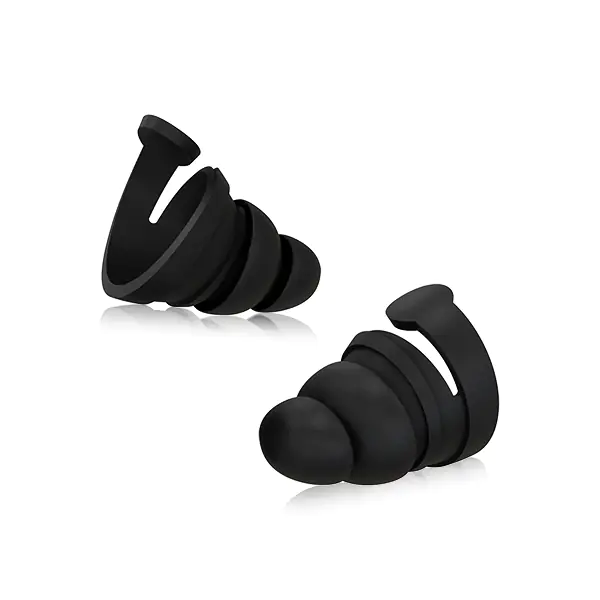
Our own answer to that band is Moto+, rated at SNR 24 dB and shaped to sit flush in the canal under a helmet. If you want the full comparison against foam, moulded and other reusable options, the best motorcycle earplugs for wind noise guide runs through the ratings, materials and fit types side by side.
Fit decides how much of that rating you actually get, since an earplug that does not seal delivers far less than its label. That is the reason we built AR KI TECH, which sizes your canal from two photographs and has cut our return rate to 3%.
Does this apply on every ride?
No, and pretending otherwise would be overselling it. The detection benefit measured by Binnington and colleagues appeared at 40 mph and above, and the same authors concluded that earplugs are not required for motorcyclists in the urban environment. A twenty-minute errand across town is a different case from a motorway run.
There is a second boundary. Research on 80 listeners across seven warning signals found that hearing protection improves audibility for normal-hearing listeners but tends to impede it for hearing-impaired ones, with the benefit holding where the average threshold at 0.5, 1 and 2 kHz is under 30 dB HL. If you already have measurable loss, that is an audiologist conversation rather than a blog conversation.
Whether you are permitted to wear them is a separate question from whether you can hear, and is it legal to ride with earplugs in the UK is its own article rather than a paragraph in this one. Everything above is about audibility.
Are you actually more aware with earplugs in, or does it just feel that way?
Measured, not just felt. Casali and colleagues (2004) found masked thresholds in 85 dBA noise were 3.2 to 4.4 dB lower, meaning better, when wearing a hearing protection device than with the open ear, and stated plainly that the result refutes the belief that protectors compromise the ability to hear necessary sounds.
Worth holding that next to the driver in the car beside you. Siren energy penetrates a closed car effectively for only 8 to 12 m at urban intersections, and the body shell alone gives more than 30 dB of attenuation above 1 kHz, both measured in the open-access Acoustics Australia paper on ambulance sirens. A separate Spanish study, Balastegui and colleagues (2013), put numbers on what the radio does: at a comfortable volume a driver’s detection distance falls to 7 m, against the 60 m those authors calculate is needed to clear safely.
One more piece of evidence, of the negative kind. Across roughly 3,500 rider comments we read while researching this article, not one rider reported a near miss caused by earplugs. What they report instead is that horns and sirens still come through, much quieter. The Casali study abstract explains why that absence is not luck.
What this means for your next ride
Three things survive from all of the above. Warning signal detection was measured on riders and improved with earplugs above 40 mph. Sirens and horns stay audible because they are loud, not because any earplug is selective, and a siren and the wind you are hearing it through both lose roughly the same 24 dB, so the gap between them does not close.
The one thing that can genuinely cost you awareness is over-protection. Fit 33 to 37 dB of foam on a public road and you push the level at your ear below the 70 dB floor HSE warns about, which is a real trade rather than a theoretical one. Somewhere in the low twenties is where road riding sits.
If you want that band in a reusable silicone plug that fits under a full-face helmet, our Moto+ (SNR 24 dB) earplugs were built for exactly this job, German-tested and independently certified 24 dB. Ride the same roads with less of the roar and more of the road.

His connection to hearing protection stems from personal experience with sound sensitivity during live events and work in noisy environments, an issue that made him more aware of the long-term risks of unmanaged noise exposure. Today, as both a communicator and a user of BOLLSEN products, he is passionate about raising awareness around the importance of proactive hearing care.
At BOLLSEN, he develops data-driven marketing campaigns, writes SEO-focused articles, and manages communication channels that connect customers with practical knowledge about hearing protection. His work ensures that BOLLSEN’s message—prioritizing health, performance, and sustainability reaches a global audience in an engaging and trustworthy way.
Passionate about writing since childhood, Timotej combines creativity with a strong analytical approach, continuously testing new ideas in digital marketing, performance advertising, and social media. He believes in learning through innovation and collaboration, balancing leadership with openness to new perspectives.
Beyond his professional role, Timotej is committed to a healthy lifestyle and finds inspiration in fitness, sports, and quality time with friends. His personal passion for well-being aligns with BOLLSEN’s core values, making his work not only a career but also a cause he deeply believes in.