⏱️ Estimated reading time: 17 min

Key Takeaways
The best earplugs for DJs are reusable high-fidelity plugs that lower the volume without muffling the mix, so you can still beatmatch, feel the bass, and read the room. A DJ booth runs at 100 to 110 dB, well past the safe limit, and cheap foam plugs kill the high end so the track sounds dull. A passive high-fidelity plug keeps the sound clear while bringing the level down to something your ears can take all night. We recommend the Music SoundPRO, a passive silicone earplug rated SNR 24 dB, reusable up to 100 times at £29.95, that still sounds good behind the decks.
If you are searching for the best earplugs for DJs, you already know the problem: a full night in the booth leaves your ears ringing, and that ring is your hearing quietly wearing down. At Bollsen, we make certified hearing protection trusted by over a million people, and DJing is one of the loudest jobs we design for. A club booth sits in the 100–110 dB range, a four hour set is normal, and an eight hour back-to-back is not unusual. That is a working environment most factories would have to legally control. The fix is not to turn the system down or mix with one ear. It is a discreet plug that lowers the whole room to a safer level while you still hear what you are doing. This guide covers how loud the booth really gets, what a season of gigs does to your hearing, what to look for in a plug that survives behind the decks, and where our earplugs for music range fits. If you also play instruments, the companion guide to the best earplugs for musicians covers stage and rehearsal use.
Do DJs really need earplugs?
DJs need earplugs because the booth is one of the few jobs where you stand next to a 100–110 dB sound system for hours, and that level of noise causes permanent hearing loss long before it ever feels painful. Hearing damage from sound is cumulative and irreversible, so the ringing after a set is not a side effect of a good night. It is a temporary threshold shift, an early warning that hair cells in the cochlea have been overworked.
The data on DJs specifically is hard to argue with. In a study of dance music disc jockeys, 70% reported a temporary shift in hearing after sessions and 74% reported tinnitus, the persistent ringing or hissing that does not switch off when the music stops. The World Health Organization classes loud leisure and occupational sound as a leading cause of preventable hearing loss, and once it is gone, no hearing aid restores the detail you need to mix.
The cruel part is that DJs rely on the exact thing that is being damaged. Your ears are your most important tool, more than any controller or pair of headphones. Protecting them is not caution, it is maintenance of the only instrument you cannot replace.
How loud is a DJ booth, really?
A DJ booth typically measures 100–110 dB at head height, and once you add a headphone cue mix at 85–100 dB in one ear, you are exposed to far more sound energy than the body can safely absorb across a night. For scale, every 3 dB increase doubles the sound energy reaching your ear, so the jump from a noisy bar at 90 dB to a booth at 105 dB is not 15% louder, it is many times the dose.
Measured sound levels in nightclubs average around 96 dB for a typical session, with readings up to 108 dB recorded on the floor and peaks of 100–115 dB near the system. Sitting behind the decks, you are often closer to the monitors than anyone on the dancefloor. For a fuller breakdown of how loud club sound systems are in decibels compared with concerts and festivals, the numbers put the booth firmly in the danger zone for any unprotected exposure over an hour.
The headphone problem makes it worse. To hear your cue over a loud room, you push the headphone level up to compete with the PA, which means you are dosing one ear with the booth and the other with a headphone signal that can hit 100 dB on its own. That asymmetric load is why many DJs end up with worse hearing in their cueing ear.
What does a season of gigs do to your hearing?
A regular DJ schedule pushes you well past the 85 dB daily exposure limit at which UK workplaces must provide hearing protection, and repeated overexposure across a season produces the noise-induced hearing loss and tinnitus that show up on DJ audiograms. Noise dose works on a time-and-level trade: at 85 dB the safe window is about eight hours, but every 3 dB louder halves that time. At a 100 dB booth, the safe daily dose is used up in roughly fifteen minutes.
That maths is why a four to eight hour set is so punishing. You are not slightly over the limit, you are over it many times before the second hour. Audiograms of working DJs show classic noise-induced notches at 6 kHz alongside losses at lower frequencies, which is the signature of noise-induced hearing loss in DJs caused by sustained club-level exposure rather than a one-off blast.
Tinnitus tends to arrive first as a temporary ring that fades by morning, then stops fading. Once it becomes permanent, it is one of the most common career-enders in dance music, because a constant internal tone makes it genuinely hard to judge a mix. Protecting your ears now is the difference between a thirty year career and a short one.
How do you know if club noise is already affecting your hearing?
You can usually spot early club-noise damage before it turns permanent: ringing or hissing that lingers after a set, muffled hearing the next morning, discomfort at everyday sounds that never used to bother you, and notes sounding slightly out of tune from one ear to the other. Each of these is a specific warning sign, and DJs get all four more than almost any other profession.
The ringing is tinnitus, and the morning muffle is a temporary threshold shift, where your hearing dips for hours after heavy exposure and then recovers, until one day it stops recovering fully. Discomfort at ordinary sounds like cutlery or running water is hyperacusis, an oversensitivity that often travels with noise damage. The most alarming one for a DJ is diplacusis, where the same note is heard at a slightly different pitch in each ear, because that directly attacks your ability to beatmatch and judge a key. If you notice any of these, treat it as the last warning before permanent loss, and start wearing protection at every set immediately. Catching it early and protecting your ears consistently from that point is what stops the damage getting worse.
What makes the best earplugs for DJs?
The best earplugs for DJs lower the volume by a meaningful amount without burying the music, stay invisible and secure for a long set, and survive repeated use, which rules out both disposable foam and doing nothing. Foam plugs do cut volume, but they smother the high end so heavily that the mix turns muddy, which is why most DJs yank them out and end up unprotected. The goal is controlled reduction, not a wall.
Here is how the realistic options compare for booth use.
| Option | Noise reduction | Can you still mix? | Reuse | Cost |
|---|---|---|---|---|
| Passive silicone plugs (Music SoundPRO) | 24 dB SNR | Yes, the whole room drops evenly enough to read the mix and cue | Up to 100 uses | £29.95 per pair |
| Disposable foam plugs | Roughly 20–30 dB but heavily muffled | Poorly, the top end is smothered so the mix sounds dull | Single use | Cheap per pair, but constant repurchasing |
| No protection | 0 dB | Yes, until tinnitus sets in | n/a | Free upfront, costly to your hearing |
Three things separate a booth-ready plug from a generic one. It needs enough attenuation for a 100 dB-plus room, which means an SNR in the low-to-mid 20s rather than the 12–17 dB of fashion plugs that are sold for casual nights out. It needs to be discreet, because a transparent plug keeps the booth looking professional and does not draw questions mid-set. And it needs to be reusable and washable, because a plug you have to remember to buy is a plug you will eventually forget.
Which earplugs do we recommend for DJs?
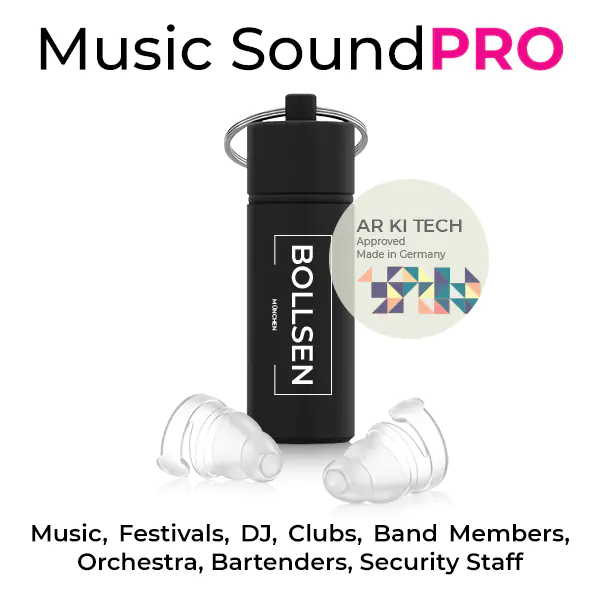
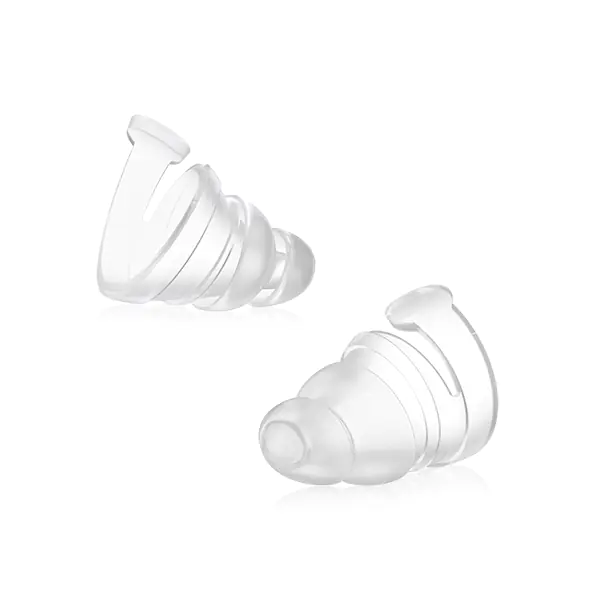
For the booth we recommend Music SoundPRO, our transparent silicone earplugs rated SNR 24 dB (H24, M21, L19), which bring a 100–110 dB room down to a safer level while keeping the track and your cue mix clearly audible. They use a two-lamella conical silicone body that seals in the ear canal and sits flush, so they stay invisible and do not work loose when you move. You can grab our Music SoundPRO earplugs for DJs for £29.95, and a single pair lasts up to 100 uses, which is around 30p a gig.
Honesty matters here, so we will be precise about what these do. Music SoundPRO is passive protection, not an electronic or flat studio filter. It reduces the overall level by about 24 dB, and because it is a passive plug the very high frequencies are actually reduced a little more than the bass, the opposite of a hi-fi reference filter. In plain terms, the booth gets quieter and stays musical. You still hear the kick, the vocal and the cue, just at a volume that will not cost you your hearing. They are certified by PZT GmbH, ship in a slim aluminium case with a rubber ring seal and a keyring so they live on your bag, and they are washable with mild soap.
For DJs who want the most reliable seal, our AR KI TECH option uses two photos of your ears and AI sizing to match you to the right fit, which matters because a plug that does not seal does not protect. You can read how AR KI TECH determines your size before you buy, which is the single biggest factor in whether a plug actually delivers its rated 24 dB.


Can you still hear the mix and cue with earplugs in?
Yes, you can mix and cue normally with earplugs in, because a passive plug lowers the room and your headphones together by a similar amount, so the balance between them stays the same and you simply work at a lower overall volume. The instinct that earplugs will leave you mixing blind comes from foam plugs, which kill the treble unevenly. A purpose-made silicone plug keeps the music intelligible.
The habit to break is the one almost every DJ has: pulling a single plug out to cue. Online, DJs constantly debate this, with some swearing they can only beatmatch with one ear bare. The problem is that the bare ear is the one taking the full 100 dB-plus booth dose for the entire set, which is exactly how you end up with lopsided hearing loss. The better move is to keep both plugs in and turn your cue level and booth monitor up a notch to compensate. Within a couple of sets your ears recalibrate and the mix feels completely normal, just quieter.
If you monitor on in-ear systems rather than headphones, plugs are less relevant in that ear, but the booth and side-fill still reach you, so most IEM DJs keep a plug in the open ear. The point is to never leave an ear exposed to the raw system for hours at a time.
Are DJ earplugs comfortable enough for a six-hour set?
A well-fitted silicone earplug is comfortable enough to forget about across a six to eight hour set, because the soft two-lamella design distributes pressure gently and sits flush rather than jamming deep into the canal like an expanding foam plug. Comfort is not a luxury here. A plug that aches after an hour is a plug you will take out, and an earplug in your pocket protects nothing.
Music SoundPRO uses hypoallergenic medical-grade silicone that is BPA-free, PVC-free and latex-free, so it stays soft against the skin through a long, sweaty night. Because it is transparent and flush, it does not press against headphones the way a protruding plug does, which is what makes wearing both at once genuinely workable. Fit is the variable that decides comfort and protection together, so if a universal size feels loose or tight, our AI sizing is there to dial it in.
How do you fit and look after DJ earplugs?
You get the full 24 dB only when the plug seals properly, so insert it with clean hands, gently pull the top of your ear up and back to straighten the canal, and push the plug in until it sits flush and the room noticeably drops. A plug that is half-seated can lose a large part of its rated protection, which is why fitting technique matters as much as the plug itself.
Looking after a reusable pair is simple and keeps the cost-per-use low. Music SoundPRO washes with water and mild soap, then air-dries before it goes back in its aluminium case, which has a rubber ring seal to keep grime out and a keyring so it clips to your gig bag. One pair is rated for up to 100 uses, so at £29.95 you are looking at roughly 30p a session across a couple of years of regular gigging. Replace them when the silicone starts to feel less springy or the seal no longer feels snug, because a plug that has lost its shape has lost some of its protection. Kept in the case between sets, a single pair easily outlasts dozens of disposable foam plugs you would otherwise burn through.
What does UK law say about noise in clubs?
UK law treats club-level noise as a workplace hazard: under the Control of Noise at Work Regulations 2005, employers must provide hearing protection at a daily exposure of 85 dB and must not let exposure exceed 87 dB, and these rules have applied to the music and entertainment sector since April 2008. A working DJ in a 100 dB-plus booth blows past those thresholds within the first hour of a set, which puts the venue firmly in the territory where protection is legally expected.
In practice, enforcement in nightlife is patchy and freelance DJs often fall through the gaps, so the responsibility usually lands on you. Knowing the UK noise regulations for club workers is worth it both for your own protection and for pushing venues to take booth noise seriously. The regulations exist precisely because sustained exposure at these levels reliably damages hearing, and you are the person standing closest to the speakers.
What does a working DJ say about ear protection?
Working DJs who have spent years in loud booths are usually the strongest advocates for protection, because they have either felt the early signs of damage themselves or watched peers lose part of their hearing. Techno DJ and producer UMEK, who has played the world’s biggest clubs and festivals for decades, puts it simply: “You have to protect your ears, I’m ready for the gig.”
That comes from someone whose entire livelihood depends on hearing detail across thousands of shows. You can read DJ UMEK on why ear protection matters for DJs and how he uses Music SoundPRO in his own sets. When the people with the longest careers are the most careful, that is the strongest argument there is for putting plugs in before your next set, not after the ringing starts.
How to protect your hearing from your next set
Your ears are the one piece of gear you cannot upgrade, replace, or repair, so they are worth more care than any controller in your bag. A DJ booth at 100–110 dB will quietly take your hearing across a career, and the ringing after a set is the early warning, not a badge of a good night. Reusable silicone plugs rated SNR 24 dB solve it without compromising your mix: the room gets safer, the music stays musical, and you keep cueing as normal.
Music SoundPRO costs £29.95, lasts up to 100 uses, disappears in your ears, and lives on your keyring so it is always there when the doors open. Put a pair in before your next set and keep doing the job you love for decades, not years. Protect your ears tonight, your future self will thank you for it.

His connection to hearing protection stems from personal experience with sound sensitivity during live events and work in noisy environments, an issue that made him more aware of the long-term risks of unmanaged noise exposure. Today, as both a communicator and a user of BOLLSEN products, he is passionate about raising awareness around the importance of proactive hearing care.
At BOLLSEN, he develops data-driven marketing campaigns, writes SEO-focused articles, and manages communication channels that connect customers with practical knowledge about hearing protection. His work ensures that BOLLSEN’s message—prioritizing health, performance, and sustainability reaches a global audience in an engaging and trustworthy way.
Passionate about writing since childhood, Timotej combines creativity with a strong analytical approach, continuously testing new ideas in digital marketing, performance advertising, and social media. He believes in learning through innovation and collaboration, balancing leadership with openness to new perspectives.
Beyond his professional role, Timotej is committed to a healthy lifestyle and finds inspiration in fitness, sports, and quality time with friends. His personal passion for well-being aligns with BOLLSEN’s core values, making his work not only a career but also a cause he deeply believes in.