
⏱️ Estimated reading time: 16 min

Key Takeaways
Every rider asks does a motorcycle helmet protect your hearing at some point, usually after a long motorway run that leaves the ears buzzing. The assumption is reasonable. A helmet covers your ears, muffles the world the moment you fasten the strap, and is the most heavily tested item of kit you own.
The measurements say otherwise. A helmet takes roughly 5 to 10 dB off the total level reaching the ear, and laboratory testing shows it does almost nothing below 250 Hz, which happens to be where wind noise keeps most of its energy. The helmet is not failing at its job. Hearing protection was never its job.
Riders work this out by feel long before they read a study. On rider forums the same two sentences repeat: the wind noise is terrible over 50 mph, and someone replies that they will always wear earplugs with that helmet from now on. At Bollsen we make medical-grade silicone hearing protection, German-tested and independently certified at 24 dB, and we have been covered by BBC Science Focus. Riders who want the wider category before the acoustics will find that our hub page on motorcycle earplugs covers helmet fit, UK legality and use cases across commuting, touring and track riding.
Does a motorcycle helmet protect your hearing?
No. A motorcycle helmet is engineered to manage impact energy, and its measured noise attenuation of roughly 5 to 10 dB is an incidental effect of the shell, the liner and the cheek pads rather than a designed acoustic function, so it cannot bring wind noise at road speed down to a level that keeps hearing safe.
Look at what ECE 22.06 actually certifies and the gap is obvious. The standard covers impact absorption, retention system strength, shell abrasion, visor optics and visor penetration, and nowhere does it ask a manufacturer to measure how much noise reaches the ear. A helmet can pass every clause of the regulation and still deliver a rider 90 dB(A) or more on a dual carriageway.
The confusion comes from what a helmet sounds like when the bike is stationary. Sitting on the drive with the engine off, a full-face lid is noticeably muffled, and that impression sticks. Once you are moving, the helmet stops being a barrier between you and the noise and starts generating noise of its own as air shears past the shell and the visor edge.
How much noise does a motorcycle helmet actually reduce?
Around 5 to 10 dB in total, and that number is an industry approximation rather than a certified figure, because no helmet standard requires noise attenuation to be tested and no manufacturer publishes an EN 352-2 style attenuation curve for a lid the way an earplug maker must for a plug.
Ten decibels sounds substantial until you compare it with the source. Research by ISVR Consulting at the University of Southampton established that aerodynamic noise overtakes engine noise above about 65 km/h, roughly 40 mph, and that riders who work on bikes for a living regularly exceed 90 dB(A) as a daily average at the ear. Subtract 10 dB from a source that loud and the remainder is still well into the range where protection is required.
We look at how loud wind noise gets inside a helmet, speed by speed, in a separate article, because the levels deserve their own treatment. What matters for the helmet question is narrower: whether the shell around your head does anything meaningful with the noise once it arrives.
Why does a helmet block the wrong frequencies?
Because helmet attenuation climbs with frequency while wind noise sits low. Młyński and colleagues measured helmet attenuation across the audible range and found essentially zero attenuation below 250 Hz, rising 8 to 9 dB per octave above 500 Hz to about 30 dB at 8 kHz, while turbulent wind noise under a helmet concentrates at 250 to 500 Hz.

The two curves point in opposite directions. A helmet performs best in the top octaves, where wind noise carries relatively little energy, and worst in the low and mid band that does the damage on a motorway run. Acoustic work on rider noise adds a further problem: the shell itself has a resonance close to 250 Hz, sitting right inside the peak of the wind spectrum.
The Polish study also carries a caveat worth repeating, which is that its figures are best case. Attenuation was measured without airflow, so the numbers describe a helmet blocking an external sound source, not a helmet coping with the turbulence it creates at 70 mph. Real-world performance can only be worse.
Do full-face helmets protect hearing better than open-face helmets?
A full-face helmet is quieter at the ear than an open-face helmet, because the chin bar and the sealed visor reduce the number of paths air can take, but quieter is not the same as protected. Neither type carries any noise rating, and both leave the 250 to 500 Hz band where wind energy concentrates largely untouched.
| Helmet type | What it is certified for | Where it attenuates most | What is left unprotected |
|---|---|---|---|
| Full-face | ECE 22.06 impact, retention and visor performance. No noise clause | Above 500 Hz, rising 8 to 9 dB per octave to about 30 dB at 8 kHz | The 250 to 500 Hz wind band, plus a shell resonance near 250 Hz |
| Modular or flip-front | ECE 22.06, tested in both open and closed positions. No noise clause | The same rising curve, minus whatever leaks at the chin bar joint | The same 250 to 500 Hz band, with extra leak paths at the hinge and seals |
| Open-face or jet | ECE 22.06 impact and retention, without a chin bar. No noise clause | Very little, since the ears sit close to open air | Most of the spectrum reaching the ear, low and high alike |
| Any helmet with certified earplugs | Impact from the helmet, attenuation from an EN 352-2 tested plug | In the low and mid frequencies the helmet misses, with attenuation rising further above them | Nothing structural, provided the plug is correctly sized and seated |
Helmet choice changes the size of the problem. It never removes it. A rider who swaps an open-face for a well-sealed full-face has made a real improvement in comfort, and has changed nothing about whether hearing protection is needed above 40 mph.
Does the SHARP rating cover helmet noise?
No. SHARP, the Department for Transport helmet safety rating scheme, awards its stars on crash performance measured through 32 impacts across a minimum of 7 samples of each model at 6, 7.5 and 8.5 m/s. Noise, acoustic comfort and ventilation are not among the criteria, so nothing in the star rating describes how loud a lid is at the ear.
That exclusion catches out a lot of UK riders, who reasonably read five stars as five stars at everything. There is no British standard for helmet noise at all, and no legal requirement for a manufacturer to publish an at-ear figure. When a magazine calls a lid quiet, it is describing one tester’s impression on one bike at one screen height, not a measurement you can compare across models.
Use SHARP for exactly what it measures, which is how well a helmet is likely to protect your skull in a crash. On noise it is silent by design, and that silence is not an oversight in the scheme but a limit on what the scheme claims to tell you.
Does a quieter helmet mean you can skip earplugs?
No. The Southampton work found that better neck roll and visor seal improvements bought 5 to 8 dB, and that even the best-sealed helmet in the programme needed active noise reduction fitted to hold 70 dB(A) at 80 km/h and 80 dB(A) at 115 km/h, which tells you how much engineering it takes to make a helmet quiet enough on its own.
Chin curtains, taller screens and tighter neck rolls all work in the sense that they move the number. They also cap out fast. Take 8 dB off a level in the low 90s dB(A) and you land in the mid 80s, still above the point at which UK regulation says protection is needed, and you have spent money on parts that only help on the bike they were fitted to.
Riders tend to treat the helmet as the variable that decides whether plugs are necessary, which is why the forum comment about always wearing earplugs with that helmet is so common. Turn it round. The helmet decides how loud the ride is, and the earplug decides whether that loudness reaches your ears, so protection is the constant and the helmet is the detail.
Is helmet noise loud enough to break the HSE noise limits?
Yes. The HSE Control of Noise at Work Regulations 2005 set a lower exposure action value of 80 dB(A) daily or weekly, an upper action value of 85 dB(A) and an absolute exposure limit of 87 dB(A), with peak values of 135, 137 and 140 dB(C), and at-ear levels under a helmet climb past all three daily values on an ordinary motorway commute.
The employment version of this is stark. An employer may not lawfully expose a worker to more than 87 dB(A) as a daily average once protection is accounted for, yet a rider covering an hour of dual carriageway each way is choosing to sit above that figure unprotected. Southampton’s measurements put professional riders regularly beyond 90 dB(A) daily.
If you ride for work as a courier, an instructor, a police or paramedic rider or a delivery rider, the regulations are not an analogy. They apply, and the helmet contributes nothing towards compliance because it has no rated attenuation to contribute.
Can a helmet make it harder to hear traffic and sirens?
Yes. Motorcycle safety literature has documented for years that a helmet impairs the wearer’s ability to hear, which leaves the rider losing twice over, because the helmet does not protect hearing from wind noise and it also degrades awareness of the sirens, horns and engine cues that matter on the road.
The mechanism is masking rather than blocking. A broadband roar in the 250 to 500 Hz region raises the level at which the ear can detect anything else in that region, so an approaching siren, a horn or a change in your own engine note gets buried under the airflow long before the helmet has muffled it. At 90 dB(A) and above, the wind is the thing standing between you and the information you want.
Riders using intercoms notice this immediately. The recurring report is that headset audio becomes easier to follow with plugs in and the volume can come down a few notches, because the wind floor has dropped and there is less noise to compete with. Cutting wind noise does not add clarity to anything. It removes the roar that was hiding it, so you still hear the road, just quieter.
Can riding in a helmet cause tinnitus?
Riding unprotected can, and a helmet does not stand between a rider and that risk, because McCombe’s study of hearing loss in motorcyclists recorded a mean temporary threshold shift of 10.3 dB at 1 kHz after just one hour of riding at 80 mph. Across 246 motorcyclists the same work found permanent threshold shifts 3.7 dB worse at 0.5 kHz and 3.6 dB worse at 1 kHz than in matched controls.
Notice where those shifts land. They cluster at 0.5 and 1 kHz, close to the band the helmet leaves alone, which is the frequency mismatch showing up in an audiogram rather than in a laboratory graph. Riders describe the early version of it in plainer language, saying that even with earplugs their ears ring when they finish a ride. That usually means the plugs were the wrong size or seated badly, not that protection failed as a concept.
Ringing after a ride is a temporary threshold shift announcing itself. It fades, hearing appears to return to normal, and the audiometric evidence from riders with years of exposure shows that the recovery is not complete every time.
What does complete hearing protection look like on a bike?
It is the helmet and a certified earplug doing separate jobs. The helmet manages crash energy, which is what it was engineered and tested for, and an EN 352-2 rated earplug supplies measured attenuation across the low and mid frequencies where wind noise concentrates and where the helmet contributes nothing.
That is the gap our Moto+ earplug was built to close. It is certified at SNR 24 dB, moulded in medical-grade silicone and shaped low-profile enough to sit inside the ear canal without a stem, so a helmet’s cheek pads press against the outer ear rather than against the plug. Across the range, 98% of customers report a reduction in tinnitus symptoms.



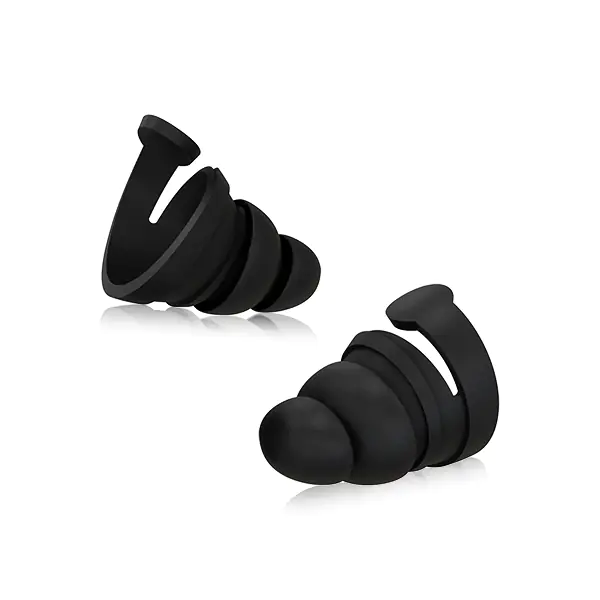
For riders who want the full specification, the sizing options and the certification detail in one place, the Moto+ low-profile earplugs page sets out the tested attenuation and what the plug is designed to do under a helmet on a long ride.
If you are choosing between plug types rather than deciding whether to wear one, our comparison of the best motorcycle earplugs for wind noise weighs filtered silicone, foam, custom moulds and earbuds on certified attenuation, helmet fit, reuse and cost per ride.
Fit is the part riders underestimate, and it decides how much of the rated attenuation you actually get. Forum threads pass round the same insertion diagram every few months because the technique is not obvious, so it is worth reading how to wear earplugs under your helmet before your next long run rather than after it.
A helmet is the best piece of safety equipment ever fitted to a motorcycle, and it is tested to prove it. Hearing is simply not on the list of things it was asked to protect. The attenuation it does give arrives in the top octaves while wind noise sits at 250 to 500 Hz, and the SHARP stars on the box say nothing about either.
So treat the two decisions separately. Buy the helmet on crash performance, comfort and fit, then add a certified plug so the noise the helmet was never going to stop does not reach your ears. Hearing does not grow back. The riders who protect it now are the ones still hearing properly thirty years in.

His connection to hearing protection stems from personal experience with sound sensitivity during live events and work in noisy environments, an issue that made him more aware of the long-term risks of unmanaged noise exposure. Today, as both a communicator and a user of BOLLSEN products, he is passionate about raising awareness around the importance of proactive hearing care.
At BOLLSEN, he develops data-driven marketing campaigns, writes SEO-focused articles, and manages communication channels that connect customers with practical knowledge about hearing protection. His work ensures that BOLLSEN’s message—prioritizing health, performance, and sustainability reaches a global audience in an engaging and trustworthy way.
Passionate about writing since childhood, Timotej combines creativity with a strong analytical approach, continuously testing new ideas in digital marketing, performance advertising, and social media. He believes in learning through innovation and collaboration, balancing leadership with openness to new perspectives.
Beyond his professional role, Timotej is committed to a healthy lifestyle and finds inspiration in fitness, sports, and quality time with friends. His personal passion for well-being aligns with BOLLSEN’s core values, making his work not only a career but also a cause he deeply believes in.