
⏱️ Estimated reading time: 12 min

Key Takeaways
Do earplugs work at concerts? Yes, and for once there is a proper trial to point at rather than a marketing claim. Researchers took 51 volunteers to an outdoor festival in Amsterdam, randomly handed earplugs to half of them, and measured everyone’s hearing before and after four and a half hours at 100 dBA.
Temporary hearing loss turned up in 8% of the protected ears and 42% of the unprotected ones. Almost nobody argues with that part. The argument is about the second question hiding underneath this search: will earplugs wreck the gig you paid for?
That objection deserves a straight answer instead of a sales pitch. At Bollsen we have made reusable medical-grade silicone earplugs since 2016, independently tested and certified in Germany, and we would rather tell you precisely what a plug changes about live music than oversell you. Our pillar guide to earplugs for music maps every use case, from festivals and club nights through to rehearsal rooms and studio monitoring.
Do earplugs actually work at concerts?
Yes. A randomised clinical trial published in JAMA Otolaryngology tested earplugs at an Amsterdam festival on 5 September 2015 and found temporary threshold shift in 4 of 50 protected ears (8%) against 22 of 52 unprotected ears (42%) after four and a half hours at 100 dBA.
The unprotected group carried a relative risk of 5.3 for temporary hearing loss, with a 95% confidence interval of 2.0 to 14.3. The number needed to treat was 2.9, meaning roughly one in every three festival-goers handed earplugs avoids a measurable hearing shift that they would otherwise have walked home with. You can read the randomised trial on earplug effectiveness at music festivals in full on PubMed, and a secondary analysis of the same festival trial is open access.
Tinnitus followed the same pattern. Newly induced ringing affected 3 of 25 participants (12%) in the earplug group against 10 of 25 (40%) in the unprotected group. Several articles get this bit wrong, so let us be precise: the trial measured temporary effects on the day, not permanent deafness decades later. Repeated temporary shifts are the warning marker, and this trial is the strongest direct evidence that earplugs stop them happening.

How loud is a gig, and how quickly does damage start?
Live music typically runs 100 to 115 dB, and the damage clock moves faster than most people expect. NIOSH sets a recommended exposure limit of 85 dBA averaged over eight hours, then halves the safe duration for every 3 dBA increase in level.
Run that NIOSH exchange rate for noise exposure duration upwards and the arithmetic gets uncomfortable quickly. Eight hours at 85 dBA becomes four at 88, two at 91, one at 94, and about fifteen minutes once you reach 100 dBA. A support act’s opening number can spend your entire daily budget.
This is not a niche worry. The WHO estimate of hearing loss risk from unsafe listening puts over 1 billion young adults at risk of permanent, avoidable hearing loss. Your cochlea does not repair itself, and the hair cells you lose at 22 do not grow back at 40.
Do earplugs ruin the concert experience?
Cheap foam earplugs genuinely can, and that is where the reputation comes from. Foam is usually rated SNR 33 to 37, which is a lot of hearing protection for a factory floor and far too much for a gig. Cutting 35 dB out of live music removes most of the music along with the risk.
The real problem with foam has nothing to do with exotic quirks in its frequency response. Foam simply takes away too much, and it does it from deep inside a fully blocked ear canal. A plug rated SNR 24 dB removes around eleven decibels less than foam, and those eleven decibels are the difference between a band playing in front of you and a band playing next door.
| At a 105 dB gig | No protection | Foam earplugs | Passive silicone, SNR 24 dB |
|---|---|---|---|
| Rated attenuation | 0 dB | SNR 33–37 | SNR 24 |
| Roughly what reaches your ear | 105 dB | 68–72 dB | 81 dB |
| How the music reads | Full volume, unsafe | Distant and closed in | Quieter, still clearly audible |
| Risk of ringing after a long set | High | Low | Low |
Treat those residual figures as round numbers. Single-number ratings assume a proper seal, and no box can promise you one. We have covered the sound quality question in depth, so if you want the full breakdown of why music earplugs sound better than foam at concerts, that comparison walks through insertion depth, occlusion and perceived clarity side by side.
How does a passive silicone earplug keep the music audible?
By lowering the whole gig. A passive silicone earplug is no clever filter handing your ears a perfect miniature of the mix. It brings the volume down so the music stays clearly audible, just quieter, and at 105 dB that is the only thing that matters.
We will be straighter about this than the category usually is. Our EN 352-2 lab data shows attenuation that rises with frequency: about 22 dB through the lows and mids, climbing to 35.3 dB at 8 kHz. The top end takes the biggest cut, so a passive plug is not tonally neutral and we will not pretend otherwise.
That turns out to suit a loud gig rather well. The frequencies being trimmed hardest are the piercing highs doing most of the damage and most of the wincing, while the body of the music survives. For the mechanics behind how music earplugs keep the music audible while lowering volume, our honest guide to the hi-fi filter category takes apart the marketing claims attached to that label.
Why does the music sound muffled for the first few songs?
Because you are stacking an earplug on top of a reflex that has already fired. The acoustic reflex tightens your middle-ear muscles in response to sustained loud sound, damping mainly the lower frequencies by roughly 10 to 20 dB before you put anything in your ears at all.
Insert a plug into an ear that is already clamped down and the first impression is duller than the reality. Those muscles fatigue over minutes, the reflex relaxes, and the sound opens back up while the earplug carries on doing its job. This is the single most common complaint about concert earplugs and the least explained.
Gig-goers describe this constantly. Two or three songs in, they stop noticing. The people who hate earplugs at concerts are very often the people who pulled them out during the opener.
Do earplugs kill the bass at a concert?
No, and the reason has more to do with your skeleton than your ears. A large share of the bass at a gig never travels through your ear canal in the first place. It arrives through your chest, your ribcage and your skeleton, and an earplug has no influence whatsoever over that route.
This is why the fear of losing the low end is misplaced. Stand near a rig at a festival and the kick drum lands in your sternum. Plug your ears and it still lands in your sternum, because your sternum is not wearing earplugs.
Plenty of people report the low end feeling better with plugs in. Once the painful top end comes down to a level your ears are not fighting, there is room to actually feel the bass instead of bracing against the noise.
Why do gig-goers say they enjoy shows more with earplugs in?
Because of listening fatigue. Sustained exposure above roughly 100 dB pushes your auditory system into a defensive state, and past a certain point your ears stop resolving detail and start simply enduring volume. Everything compresses into a loud wall.
Take 24 dB off the top and your ears stay in a range where they can still discriminate. Vocals separate out from guitars. You are hearing a band again. That is the mechanism behind the claim you see asserted everywhere and explained almost nowhere, and it also explains why you can still hold a conversation at the bar afterwards.
Our brand partner DJ UMEK, who has spent three decades behind decks in rooms far louder than the average gig, puts it plainly: “You have to protect your ears. I’m ready for the gig.”
Will anyone notice you are wearing them?
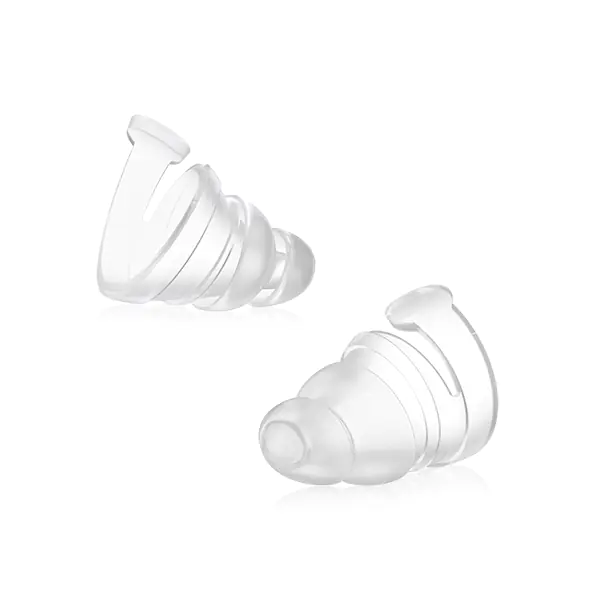
Almost certainly not. The transparent silicone body of a modern concert earplug sits flush in the ear canal with no protruding stem, so there is nothing to catch the light or the eye of the person next to you in the crowd.
This objection comes up more than people admit, usually from anyone who remembers bright foam plugs poking out of their ears at 19. That look is gone. Nobody at the barrier is going to spot them, and the ones who do are usually wearing a pair themselves.
Which earplugs should you wear to your next gig?
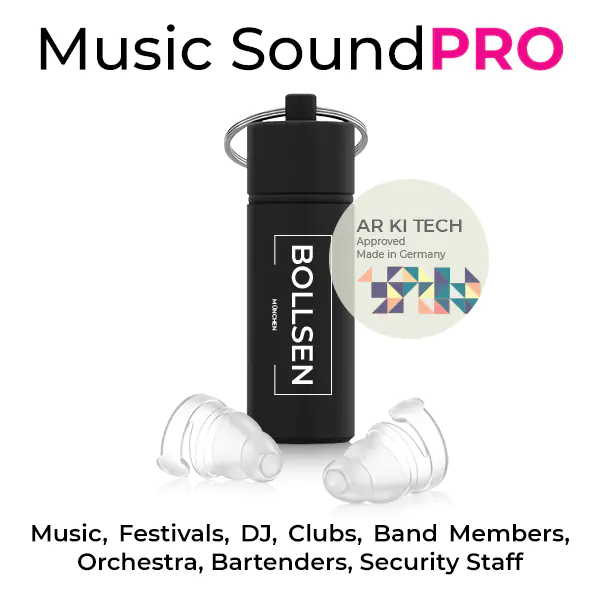
For live music, we make Music SoundPRO concert earplugs, a passive medical-grade silicone plug that is German-tested and independently certified at 24 dB SNR for exactly this job. That single rating is the whole argument: enough to get a 105 dB room down to around 81 dB, and not so much that you lose the gig. They cost £29.95 a pair and are reusable up to 100 times, which works out at pennies a gig.
Rated attenuation assumes a proper seal, which is why fit matters more than any figure on a box, and our AR KI TECH ear measurement exists to get that seal right first time.


If you would rather weigh several options before committing, our roundup of the best earplugs for concerts ranks the realistic choices for UK gig-goers across price, attenuation and comfort over a long night.
So, do earplugs work at concerts? The trial evidence says yes, decisively, on both temporary hearing loss and tinnitus. The sound quality worry is real but misdirected. It belongs to foam and over-attenuation, not to hearing protection itself.
A passive plug at 24 dB does not hand you a tonally perfect gig, and anyone promising that is selling you something. It brings a dangerous room down to a safe one while the music stays clearly audible, and it gives you back the two hours after the show when your ears would otherwise be ringing. Your hearing does not regenerate. The gig is worth protecting.

His connection to hearing protection stems from personal experience with sound sensitivity during live events and work in noisy environments, an issue that made him more aware of the long-term risks of unmanaged noise exposure. Today, as both a communicator and a user of BOLLSEN products, he is passionate about raising awareness around the importance of proactive hearing care.
At BOLLSEN, he develops data-driven marketing campaigns, writes SEO-focused articles, and manages communication channels that connect customers with practical knowledge about hearing protection. His work ensures that BOLLSEN’s message—prioritizing health, performance, and sustainability reaches a global audience in an engaging and trustworthy way.
Passionate about writing since childhood, Timotej combines creativity with a strong analytical approach, continuously testing new ideas in digital marketing, performance advertising, and social media. He believes in learning through innovation and collaboration, balancing leadership with openness to new perspectives.
Beyond his professional role, Timotej is committed to a healthy lifestyle and finds inspiration in fitness, sports, and quality time with friends. His personal passion for well-being aligns with BOLLSEN’s core values, making his work not only a career but also a cause he deeply believes in.