
⏱️ Estimated reading time: 13 min

Key Takeaways
A swimmer training five times a week completes roughly 500 flip turns per week. Each tumble turn generates a sharp pressure spike at the wall and a rapid rotation that tests any earplug’s ability to stay seated. This is why the single most common complaint in competitive swimmer forums is not swimmer’s ear; it is earplugs that fall out on every turn. At Bollsen, we make hearing protection used by over 1,000,000 people worldwide, and the flip turn problem is the specific reason we engineered the dual-lamella compression seal in our earplugs for water range.
This guide covers the mechanical challenge of flip turn retention, the clinical context that makes high-frequency training a different risk category to recreational swimming, and the EAV breakdown that lets you compare options on actual specs rather than marketing language.
Why Does Training Frequency Change the Risk Profile?
The direct link between otitis externa risk and training frequency is established in peer-reviewed research: a PubMed outbreak study (PMID 6787118) found that swimmers training twice daily had an infection rate dramatically higher than those training once daily, with Pseudomonas aeruginosa isolated from the ears of 18 of 25 high-frequency swimmers versus just 1 of 54 lower-frequency swimmers. Competitive swimmers training five or more sessions per week are not in the same risk category as someone doing a leisure swim on Saturday morning.
The mechanism involves both water volume and chemistry. Chlorinated pool water disrupts the ear canal’s naturally acidic pH of approximately 6.0-6.5, shifting it toward a more alkaline environment where bacterial multiplication accelerates. Cerumen (earwax), which acts as a protective barrier and natural antimicrobial agent, is washed away with each session. High-volume training repeats this disruption daily.

There is a second, longer-term consequence that almost no competitive swimmer article addresses. External auditory exostosis, also known as surfer’s ear, is bony canal growth triggered by repeated cold or wet exposure. A survey of high-level aquatic athletes found exostosis present in 12 of 433 athletes, with the condition bilateral in 20 cases. Cold-water surfer cohort studies report prevalence rates of 69-90% among athletes with prolonged exposure histories. Pool swimmers are not immune, and the condition is progressive and surgical to correct. The external auditory exostosis clinical evidence from PMC9668263 shows that earplugs are correlated with reduced severity in prospective studies.
What Makes Flip Turn Retention So Hard to Solve?
A flip turn subjects an earplug to two forces simultaneously: the rapid head rotation through the tumble, and the momentary pressure spike as the swimmer pushes off the wall at velocity. Foam earplugs rely on an outward expansion force within the canal and have no mechanical anchoring element. When the head rotates, the expansion force is insufficient to counteract the rotational inertia, and the plug moves.
Putty earplugs form a surface seal at the canal entrance rather than seating inside the canal itself. They are particularly vulnerable to flip turn ejection because the rotational force acts directly on the exposed putty mass. Chlorine accelerates the problem: putty loses its plasticity with repeated chemical exposure, forming a harder, less-conforming plug that breaks the canal seal progressively. As one competitive swimmer noted across multiple forum discussions: chlorine keeps destroying putty plugs after a few weeks, and once they lose moldability, the seal is gone.
A dual-lamella flanged design addresses both failure modes. The inner lamella seats within the canal and compresses under the flip turn pressure spike, maintaining the seal rather than being pushed out by it. The outer lamella anchors at the concha and resists the rotational force independently of the inner seal. The geometry is passive: it works with the pressure spike, not against it.
Which Earplug Type Is Right for Competitive Swimmers?
Earplug type determines both the protection level and the practical durability under training conditions. The table below compares the three main types against the specific demands of club-level and masters swimming.
| Type | Flip Turn Retention | Chlorine Durability | Cost per Session (est.) | Otitis Externa Prevention | Best For |
|---|---|---|---|---|---|
| Foam (disposable) | Poor: expansion seal fails under rotation | Degrades rapidly; single-use to 5 uses | 10-15p but replaced frequently | Moderate: degrades before seal fails, but wearers often stop using them | Occasional recreational swimmers only |
| Putty / moldable | Poor: surface seal breaks on rotation; putty hardens with chlorine | Poor: loses plasticity in 2-4 weeks of daily training | 20-30p, replaced every 2-4 weeks | Moderate initially, worsens as putty degrades | Casual swimmers; not suitable for 5x/week training |
| Flanged silicone (dual-lamella) | Excellent: compression seal holds through pressure spike and rotation | Excellent: medical-grade silicone resists chlorine; up to 100 uses | 30p at 100 uses (£29.95 / pair) | High: consistent seal maintained session after session | Competitive swimmers, masters swimmers, club training, race use |
The cost-per-session picture is often misread. At first glance, foam plugs appear cheaper. At 5 sessions per week, a competitive swimmer completes roughly 260 training sessions per year. Putty plugs replaced every three weeks cost approximately £5 per month, around £60 per year. A single pair of flanged silicone earplugs lasting 100 sessions costs £29.95, covering 20 weeks. Two pairs per year is £59.90, and the seal quality never degrades the way putty does.
What Are the Best Earplugs for Competitive Swimmers?
Our Watersafe+ flanged swimming earplug is built specifically for the demands of competitive pool training: dual-lamella medical-grade silicone that compresses under flip turn pressure, a waterproof seal certified to 3 m depth, and 24 dB SNR noise reduction independently certified by PZT GmbH (Notified Body No. 1974). Each pair is reusable for up to 100 sessions, working out to 30p per session at the standard price of £29.95. Over 10,000 verified reviews and as featured in BBC Science Focus and Which?.


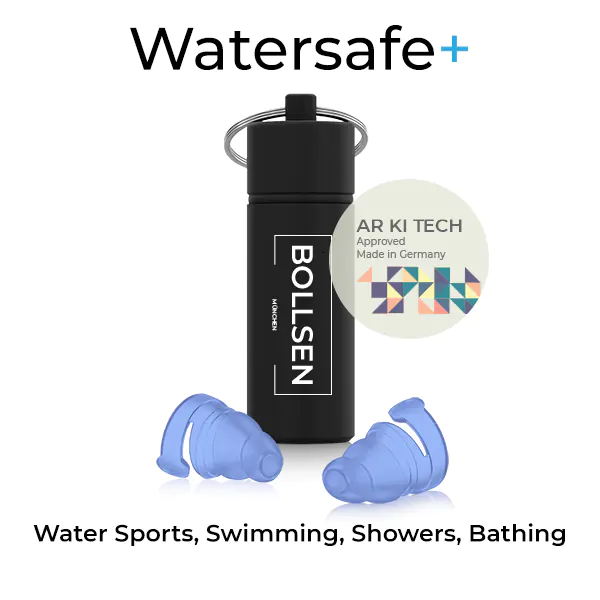
For swimmers with retention concerns specific to racing or those with unusual ear canal geometry, our Watersafe+ with AR KI TECH adds precision fit measurement. You upload two photos of your ears, our AI service analyses the canal dimensions, and the correct size is delivered. That process reduces returns to 3% (compared to an industry average of 15-20%), because a plug that fits precisely seats correctly at the first push, every session. This matters most when you are trusting the seal through a race start, and you have one chance to get it right.
Our best swimming earplugs guide for all swimmer types covers the full water range including open water and children’s options, if your training spans more than pool sessions.
How Should Competitive Swimmers Insert Earplugs for Maximum Retention?
The insertion technique for flip turn retention differs from recreational use. For the right ear, reach over the top of the head with the left hand, pull the ear gently upward and back to straighten the canal, then insert the plug with the right hand. The canal straightening step is the most commonly skipped, and it is the primary reason earplugs feel loose: a bent canal prevents the inner lamella from seating at the correct depth. Straightening the canal before inserting applies regardless of earplug brand.
A correctly inserted flanged earplug should feel secure but not painful. If it feels as though it could dislodge under a tumble turn, the most likely cause is insufficient depth on insertion, or a size mismatch. A size that is too large will not seat at depth; a size that is too small will not compress to create the seal. This is where the AR KI TECH fit measurement removes guesswork entirely.
Wearing a swim cap over the earplugs after insertion provides a secondary retention layer and is common practice in club training. It does not change the seal quality but adds resistance against rotational ejection during turns. For frequent users, silicone earplugs have no meaningful effect on balance; the canal remains unblocked to sound while water is excluded.
What Does Research Say About Earplug Use in Training vs Racing?
The MDPI Water 2022 risk analysis of otitis externa in pool swimmers found that risk increases with the number of days swimming, and swimmers with recurrent ear disease had a greatly elevated infection rate. This provides a clinical argument for using earplugs in every training session rather than only when symptomatic; prevention is cheaper and less disruptive than treatment.
The NICE clinical knowledge summary and NHS otitis externa protocol both recommend earplugs as a preventive measure for recurrent sufferers. For competitive swimmers training twice daily during peak season, this recommendation applies with particular force: the bacterial exposure during a twice-daily session mimics the outbreak conditions documented in the PMID 6787118 study.
Race-day use comes with a different psychological dimension. Competitive swimmers who only use earplugs in training, and not in races, report anxiety about mid-race ejection as the primary reason. A precision-fitted earplug removes this variable. If the plug has seated correctly through 300 training sessions, it will seat correctly in a race. The distinction between earplugs designed specifically for pool retention and general-purpose plugs is most visible at race pace.
What Is the Long-Term Cost Case for Reusable Earplugs in Competitive Training?
The cost-per-session arithmetic is simple but often overlooked. Watersafe+ at £29.95 over 100 sessions equals 30p per session. A swimmer training 5 days a week, 46 weeks a year completes 230 sessions. That is 2.3 pairs per year at £61.99 total. Compare this to putty earplugs at approximately £3-5 per pack, lasting 2-3 weeks of heavy training, with an annual cost of £65-£130 and a deteriorating seal throughout. The economics favour reusable silicone before you factor in the infection treatment costs that a failed seal can generate.
For masters swimmers who train less frequently but want the highest-grade protection, the Watersafe+ with AR KI TECH at £44.95 amortises across the same 100-session lifespan to 39p per session. The additional 12p buys the certainty of a precision-fitted seal measured to your individual canal geometry. For swimmers with recurrent otitis externa history, or those competing at level where ejection anxiety is real, that is a straightforward trade.
All Bollsen products are backed by our 40-day money-back guarantee. If Watersafe+ does not stay in through your training flip turns, return it. The guarantee exists because we know it will.
Competitive swimming puts ears through more daily water and chemical exposure than almost any other sport. The clinical evidence on otitis externa frequency and training volume is clear, and the mechanical case for a dual-lamella compression seal over foam or putty is settled by physics. If your current earplugs are leaving you with wet ears after every tumble turn, that is not a swimmer’s ear problem waiting to happen: it is one already in progress. Try Watersafe+ across your next training block with our 40-day guarantee, and read our earplugs for water hub for the full range.

His connection to hearing protection stems from personal experience with sound sensitivity during live events and work in noisy environments, an issue that made him more aware of the long-term risks of unmanaged noise exposure. Today, as both a communicator and a user of BOLLSEN products, he is passionate about raising awareness around the importance of proactive hearing care.
At BOLLSEN, he develops data-driven marketing campaigns, writes SEO-focused articles, and manages communication channels that connect customers with practical knowledge about hearing protection. His work ensures that BOLLSEN’s message—prioritizing health, performance, and sustainability reaches a global audience in an engaging and trustworthy way.
Passionate about writing since childhood, Timotej combines creativity with a strong analytical approach, continuously testing new ideas in digital marketing, performance advertising, and social media. He believes in learning through innovation and collaboration, balancing leadership with openness to new perspectives.
Beyond his professional role, Timotej is committed to a healthy lifestyle and finds inspiration in fitness, sports, and quality time with friends. His personal passion for well-being aligns with BOLLSEN’s core values, making his work not only a career but also a cause he deeply believes in.