
⏱️ Estimated reading time: 16 min

Key Takeaways
There are 4.1 million night shift workers in the UK, and nearly all of them face the same daily problem: trying to sleep when the world is awake. The noise outside a bedroom at 10am, 11am, noon, is not quiet background hum. Delivery vans, lawnmowers, school runs, roadworks, neighbour doors. One Reddit thread about shift work sleep puts it bluntly: “The neighbours mow the lawn at 10am every bloody day.”
If you have worked nights, you know exactly what that sentence feels like. Daytime sleep is not just noisier than night sleep; it is physiologically harder. Your cortisol peaks in the morning precisely when you are trying to wind down. Earplugs do not fix cortisol, but they do address noise, one of the two things that make shift worker sleep so hard to protect.
Why Is Sleeping After a Night Shift So Much Harder Than Normal Sleep?
The difficulty of daytime sleep is not simply a matter of willpower or blackout curtains. Your circadian rhythm, controlled by the suprachiasmatic nucleus (SCN) in the hypothalamus, keeps your body primed for wakefulness during daylight hours by suppressing melatonin and elevating cortisol. When you try to sleep at 8am after a night shift, you are fighting that biological clock directly.
A large-scale UK Biobank study of 285,175 participants found that always-night shift workers had 50% higher odds of sleep disturbance compared to non-shift workers, with an odds ratio of 1.50 (PMC12829381). This is not an inconvenience; it is a documented medical outcome. Shift Work Sleep Disorder (SWSD) is diagnosed in 10–30% of shift workers across meta-analyses, characterised by insomnia when trying to sleep and excessive sleepiness when needing to be awake.
Noise makes all of this worse. The UK Health Security Agency reports that 40% of adults in England are exposed to road traffic noise exceeding 50 dB continuously, and sleep begins to fragment at levels as low as 35 dB. If you are a nurse driving home after a 12-hour night shift, you are trying to sleep in a building where ambient street noise alone may already exceed the threshold for sleep disruption.
A PubMed review of shift work impact on sleep and health found that approximately 30% of shift workers develop a clinically significant sleep disorder, compared to around 10% of standard day workers, driven by misalignment between their sleep schedule and the body’s circadian clock.What Kind of Noise Actually Wakes Shift Workers Up?
Not all daytime noise is the same, and the distinction matters for which earplug you choose. Continuous background noise such as traffic, distant road hum, and HVAC systems sits roughly in the 50–65 dB range and operates in low frequencies (60–500 Hz). Noise spikes such as a delivery van slamming its door, a lawnmower starting up, or a car horn land at 75–85 dB and often peak in the mid and high frequencies where the auditory system is most alert.
Shift workers who have tried standard foam earplugs often report the same frustration on sleep forums: the background hum gets duller, but a sudden knock at the door still wakes them up. Foam attenuates frequencies fairly uniformly and relies on bulk material rather than acoustic design. Those sudden, transient spikes that pierce through are not a fitting problem; they are a design problem. An earplug built only for overall noise reduction does not address the spike-to-background ratio that determines whether your sleep stays intact.
Will I Still Hear My Alarm Clock with Earplugs In?
This is the single most common reason shift workers hesitate to try earplugs, and it is a completely legitimate concern. Most earplug advice skates past it in a footnote. The answer depends entirely on the acoustic design of the earplug you choose.
Standard earplugs, both foam and generic silicone, block broadly across the frequency spectrum. An alarm clock or phone notification sits at 2,000–4,000 Hz, well within the range that broad-spectrum earplugs attenuate. If you are sleeping with a deeply blocking earplug and a phone under the pillow, you may genuinely struggle to hear it.
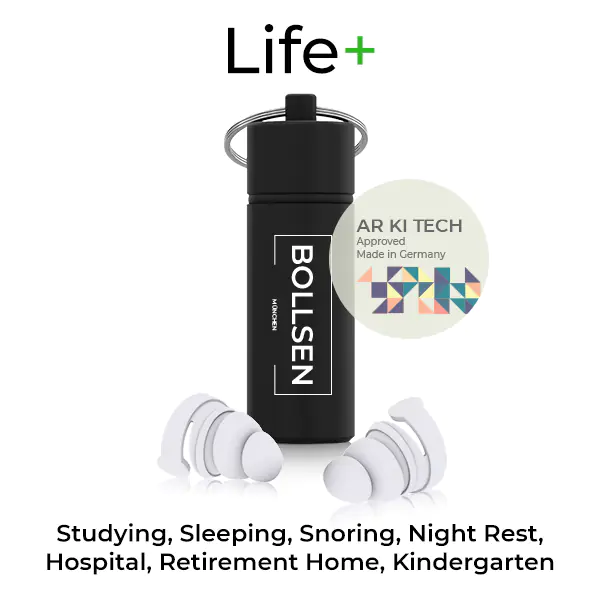
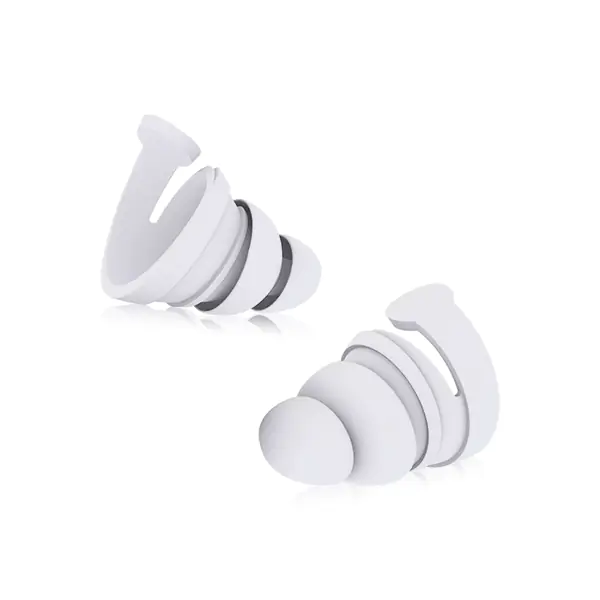
The Bollsen Life+ uses a patented conical 2-lamellae design that is acoustically tuned to solve a different problem. It filters low-frequency continuous noise (traffic, street noise in the 60–500 Hz range) while deliberately passing through high-frequency alerts such as alarm clocks, fire alarms, and baby monitors, all of which sit at 2,000 Hz and above. That is not a marketing claim; it is the reason the Life+ was designed specifically for sleep rather than industrial use. You will hear your alarm.
Our full guide to earplugs for sleeping covers which design characteristics matter most for each sleeper type.
How Does SNR Rating Translate to Real Noise Reduction?
The SNR (Single Number Rating) is the standardised European measure of how many decibels an earplug reduces noise by under laboratory test conditions (ISO 4869). A 24 dB SNR earplug worn in a 53 dB ambient street noise environment brings the perceived level to approximately 29 dB, well below the 35 dB threshold at which sleep fragmentation begins.
For context: UK urban daytime street noise averages 53 dB across postcode districts according to noise pollution research from the UK Health Security Agency. A noise spike from a reversing lorry or a lawnmower can reach 75–85 dB. With 24 dB SNR protection, that spike lands at 51–61 dB at the eardrum. Still audible if very close, but substantially reduced rather than sharp enough to trigger a cortisol spike and pull you out of REM. The SNR is not about achieving silence; it is about keeping noise below the neurological threshold that activates the stress response during sleep.
The Life+ is certified at 24 dB SNR through independent testing at German laboratories to ISO standards, with over 1,700 tests conducted across the Bollsen range. This is the same certification level applied to medical and industrial hearing protection, not a brand-assigned rating.

Daytime residential noise sits 10-20 dB above night-time baseline levels, so NRR and SNR rating requirements for daytime shift worker sleep are higher than the 24 dB adequate for a quiet bedroom at night.
Under the HSE Control of Noise at Work Regulations, employers must provide hearing protection when workplace noise reaches 85 dB(A), the same decibel threshold used to assess whether your sleeping environment requires additional noise attenuation from earplugs.Silicone vs Foam vs Wax: Which Earplug Type Works Best for Daytime Sleeping?
If you are using earplugs every day, material matters more than most buying guides let on. The choice affects comfort, hygiene, and long-term cost in ways a single-use trial does not reveal.
| Type | SNR Range | Reusable? | Side Sleeper Comfort | Daily Hygiene | Typical Cost / Year (daily use) |
|---|---|---|---|---|---|
| Foam (disposable) | 27–35 dB | No (single use) | Poor: protrudes, falls out | Cannot be washed | £260–£364 |
| Wax / cotton | 20–27 dB | No (1–2 uses) | Moderate: moulds but deforms | Cannot be washed | £180–£280 |
| Medical-grade silicone (Life+) | 24 dB | Yes, up to 100 uses | Excellent: flush profile, stays in | Washable after each use | £10–£27 (10x Pack or single pair) |
Foam earplugs used every day cannot be cleaned. After a few uses, earwax and moisture trapped inside the foam create a surface where bacteria accumulate. That is not a concern for occasional travellers using foam once a month, but for a nurse or factory worker using them daily for 6–7 hours, it becomes a hygiene issue quickly. The Life+ is 100% medical-grade silicone, washable under running water, and reusable up to 100 uses per pair.
Side sleepers have an additional problem: foam earplugs protrude from the ear canal. Multiple forum threads describe the same thing: “I wake up and they’re just in the bed.” A protruding earplug pressed against a pillow creates pressure on the canal, causes the plug to lever out, and often cuts sleep short before the intended wake-up time. The Life+’s conical 2-lamellae design sits flush, disappearing into the canal so there is nothing for the pillow to press against. The guide to earplugs for side sleepers covers the mechanics of pillow pressure and canal geometry in more detail, including why profile depth matters as much as SNR for this sleep position.
Which material holds its seal across a full 8-hour block depends on compression resistance. Silicone, foam, and wax attenuation differences for sleep vary significantly between materials at equivalent SNR ratings.What Do the Bollsen Life+ Earplugs Cost per Night for a Shift Worker?
Daily earplug use is a different cost calculation than occasional use, and it is worth running the numbers before choosing a product.
Disposable foam earplugs run at approximately £5–£7 per pack of 10 pairs. Used once per shift, five days a week, that is £1–£1.40 per week, or £52–£73 per year at minimum. For a full seven-day-a-week use pattern over a year, that rises to £260–£364.
The Life+ at £29.95 per pair, reusable up to 100 uses, costs 30p per session. The Life+ 10x Pack at £99.95 for 10 pairs provides 1,000 uses in total, working out to approximately 10p per sleep session.
Over a year of five-days-a-week use (260 sessions), the Life+ 10x Pack total cost is £99.95. The same 260 sessions using disposable foam cost between £52–£182 depending on brand, though that assumes single use per pair, which most foam users do not strictly observe. If you sleep seven days out of seven, the 10x Pack covers you for over three years.
Which Bollsen Earplugs Are Best for Shift Workers?
At Bollsen, we make medical-grade silicone earplugs trusted by over 1,000,000 people, with over 10,000 verified reviews and independent certifications from German test laboratories. For shift workers sleeping during the day, these are the two products built for that use case.


The evidence base for noise masking in shift worker sleep is direct. A prospective study published in PMC8984824 followed emergency medicine residents, who work shift patterns comparable to NHS nurses and factory workers, and found that on days when noise-masking devices were used, sleep quality scores improved by 0.5 points, daytime sleepiness reduced by 0.6 points, and reported tension dropped by 0.6 points. That improvement came purely from addressing the noise component of a multifactorial sleep disruption problem.
For shift workers with unusually large or narrow ear canals who find standard silicone earplugs difficult to fit, the AR KI TECH sizing service at how AR KI TECH measures your ear canal for a custom fit uses augmented reality and AI to recommend the correct size from two photos. It takes approximately 2 minutes in a browser with no app download and reduces the return rate to 3%, compared to a significantly higher industry average. An earplug that fits correctly protects correctly.
Are Earplugs Enough, or Do Shift Workers Need More Sleep Aids?
Earplugs address the noise input. Light is the other major disruption during daytime sleep: it suppresses melatonin production and signals wakefulness to the circadian system. A bedroom with curtains that do not fully seal is physiologically disruptive even if it is quiet.
The Bollsen Deep Sleep Mask (100% natural mulberry silk, £39.95) blocks 100% of incoming light including full daylight, and is designed for an XXL ergonomic fit that accommodates back, stomach, and side sleepers without pressing on the eyelids. It is available as part of the Deep Sleep Duo bundle with the Life+ at £49.95 (saving 25% versus buying separately). Together, they cover both noise and light in one purchase.
The Sleep Charity (UK) recommends specifically that shift workers “muffle external noise” as part of their daytime sleep environment management, alongside blackout curtains and a consistent pre-sleep routine. Earplugs appear on their guidance list because the evidence for them in shift-specific sleep contexts is solid.
Reusable earplugs worn before every shift sleep accumulate debris at twice the standard rate, so how to insert and care for sleep earplugs used daily on shift sets out the hygiene routine and how to fit it around a rotating schedule.
The HSE guidance on managing shift work health and safety identifies sleep disruption as the primary health risk of shift work and recommends a combination of environmental controls, sleep hygiene strategies, and noise management to reduce its impact.What Does the Research Say About Shift Worker Sleep and Earplugs?
The numbers here are population-scale. The UK Biobank study of 285,175 participants (PMC12829381) found that always-night shift workers have an odds ratio of 1.50 for sleep disturbance. Among NHS nurses on night shifts specifically, 86% get 6 hours or less of sleep between shifts and 49% reported nodding off at the wheel on the drive home (PMC8574312). These are not quality-of-life statistics; they are safety statistics.
The intervention evidence for noise masking in this population is clear. Where noise-masking was used, sleep quality measurably improved. Earplugs are not a complete solution to Shift Work Sleep Disorder because circadian misalignment has additional physiological dimensions. But they are the most direct, lowest-cost, non-pharmaceutical intervention available to a shift worker who needs to sleep in a noisy building during the day.
If you want a broader comparison of every sleep earplug option on the market, the complete sleep earplugs buyer’s guide covers every material, design, and use case including shift workers, light sleepers, and couples with mismatched sleep schedules. If you are specifically interested in the daily safety angle, the guide on whether it is safe to wear earplugs every night addresses hygiene, ear canal health, and how long daily use is medically appropriate.
If you are reading this as a nurse, a factory worker, an emergency services responder, or anyone whose job runs when the rest of the world is asleep, the daytime sleep problem is real and documented at scale. The noise coming through your window is above the threshold your brain needs to stay asleep, your cortisol is fighting you at the same time, and most standard earplug advice was not written for someone using them every day of the week. The Life+ and the Life+ 10x Pack were designed for sustained daily use, wash after every session, and sit flush so your side-sleeping position does not dislodge them at 3am when you are finally in deep sleep. Try them risk-free for 40 days, and if they do not change how you sleep, send them back.
Research published via PubMed research on brain health risks of shift work found that shift workers face elevated long-term risks of cardiometabolic conditions, cognitive decline, and mood disorders, all linked directly to circadian disruption and cumulative sleep deprivation.

His connection to hearing protection stems from personal experience with sound sensitivity during live events and work in noisy environments, an issue that made him more aware of the long-term risks of unmanaged noise exposure. Today, as both a communicator and a user of BOLLSEN products, he is passionate about raising awareness around the importance of proactive hearing care.
At BOLLSEN, he develops data-driven marketing campaigns, writes SEO-focused articles, and manages communication channels that connect customers with practical knowledge about hearing protection. His work ensures that BOLLSEN’s message—prioritizing health, performance, and sustainability reaches a global audience in an engaging and trustworthy way.
Passionate about writing since childhood, Timotej combines creativity with a strong analytical approach, continuously testing new ideas in digital marketing, performance advertising, and social media. He believes in learning through innovation and collaboration, balancing leadership with openness to new perspectives.
Beyond his professional role, Timotej is committed to a healthy lifestyle and finds inspiration in fitness, sports, and quality time with friends. His personal passion for well-being aligns with BOLLSEN’s core values, making his work not only a career but also a cause he deeply believes in.