
⏱️ Estimated reading time: 11 min

Key Takeaways
Most people who buy earplugs for snorkelling are doing it after their first painful return from holiday. Swimmer’s ear following a snorkelling trip is far more common than after a standard pool session, and the reason comes down to water temperature and frequency: a week of snorkelling means multiple sessions in warm seawater before the ear canal has a chance to dry out and recover.
NICE clinical guidelines identify prolonged water exposure as the primary trigger for otitis externa, and the 25–28°C seawater of the Mediterranean, Red Sea, and Maldives creates far more hospitable conditions for the bacteria behind the infection than a chlorinated pool ever does. Whether earplugs are necessary depends on two things: how deep you plan to go and how many times you plan to go in.
What Does Snorkelling Actually Do to Your Ears?
Surface snorkelling at 0 metres depth exposes the ear canal to sustained water contact but creates no pressure differential on the eardrum, because water pressure at the surface is identical to atmospheric pressure. The mechanical risks that scuba divers and free-divers face simply do not apply to someone floating face-down on the surface. The risk that does apply is biological: water entering the ear canal changes its local environment in a way that makes infection possible.
The ear canal normally maintains a slightly acidic pH of 4.5–5.0, which is hostile to most bacteria and fungi. Water exposure, especially warm tropical seawater, dilutes and neutralises that acid layer. When moisture sits in the canal after a session, the skin softens and bacteria find a warm, nutrient-rich environment ready to colonise.
Repeated daily sessions accelerate the process considerably. Someone who snorkels once over an entire trip may notice nothing. Someone who spends two hours in the water on each of six consecutive days is doing precisely what leads to a painful ear infection by day four.
Does Snorkelling Cause Swimmer’s Ear?
Snorkelling in warm tropical seawater carries a significantly higher swimmer’s ear risk than pool swimming because the combination of water temperature (25–28°C), salt content, and repeated daily sessions disrupts the ear canal’s natural defences more thoroughly than a chlorinated pool can. A PubMed study on otitis externa associated with aquatic activities confirms that water sports are a primary risk factor for external ear canal infection, with risk increasing proportionally with exposure frequency.
Warm seawater at 25–28°C sits in precisely the temperature range where Pseudomonas aeruginosa and Staphylococcus aureus, the two bacteria most commonly responsible for otitis externa, multiply most efficiently. Chlorinated pool water disrupts bacterial growth; warm seawater does not. NHS guidance on outer ear infection specifically recommends keeping the ear canal dry to prevent recurrence.
The early signs of swimmer’s ear are itching or a feeling of fullness in the ear within 24 hours of water exposure. Recognising them early matters: otitis externa treated in the first 48 hours typically resolves within 5–7 days with topical antibiotic or antifungal drops. Left untreated, it can progress to a condition requiring systemic antibiotics and a much longer recovery.
Can You Wear Standard Swimming Earplugs While Snorkelling?
Standard sealed swimming earplugs are safe and effective for surface-level snorkelling, where depth is 0 metres, water pressure equals atmospheric pressure, and no meaningful force acts on the eardrum. For the majority of recreational holiday snorkellers who stay at the surface, a standard waterproof swimming earplug is the right and sufficient choice.
The situation changes the moment you duck dive. Even a 1-metre duck dive takes you from 1 atmosphere at the surface to approximately 1.1 atmospheres of water pressure. A sealed earplug traps a pocket of air between the plug and the eardrum. As pressure increases with descent, that trapped air compresses per Boyle’s Law, and the plug is pushed progressively harder toward the eardrum. At 2 metres the pressure differential causes significant discomfort; below 3 metres without equalisation, it can cause real damage to the outer and middle ear.
For most UK snorkellers on a Red Sea or Mediterranean holiday, this is largely academic. They are floating at the surface, head down, looking at fish. For anyone who routinely duck dives to get closer to the seabed or reef, however, the earplug question becomes more specific.
What Happens If You Duck Dive with Sealed Earplugs?
Wearing sealed earplugs while duck diving creates a trapped air space between the plug and the eardrum that compresses under increasing water pressure, producing discomfort at 1–2 metres and a real barotrauma risk at greater depth. The Divers Alert Network (DAN), the primary safety authority for recreational diving, explicitly advises against earplug use during any underwater diving because sealed earplugs prevent natural equalisation through the Eustachian tube and transfer the pressure differential directly to the eardrum.
A PMC study on earplug use and pressure-related ear injuries confirms that even shallow descents can produce enough pressure to move a sealed plug toward the tympanic membrane. ENT Health guidance on free-diving and ear care notes that barotrauma injuries most commonly occur at depths shallower than 10 metres, where pressure changes per metre of descent are proportionally largest.
Vented earplugs address this partially. A small pressure-equalisation channel allows air to pass through slowly, reducing build-up during descent and making shallow duck dives to 1–3 metres considerably safer than a fully sealed plug. They are not a complete solution for serious free-diving, and DAN advises against any earplug use at scuba diving depths.
Which Earplugs Work Best for Snorkelling?
For surface snorkelling, the best earplugs are waterproof, made from soft medical-grade silicone, and form a watertight seal without requiring deep insertion into the ear canal, where repeated-use irritation is a genuine risk across a full week of holiday sessions. Foam earplugs are not suitable: they absorb water, offer no meaningful waterproofing, and degrade with repeated wet use.
| Snorkelling type | Depth | Pressure risk | Recommended earplug |
|---|---|---|---|
| Surface snorkelling only | 0 m | None | Sealed waterproof swimming earplug |
| Occasional shallow duck diving | 1–3 m | Low to moderate | Vented earplug with pressure-equalisation channel |
| Regular free-diving below 3 m | 3+ m | High | No earplug, consult an ENT specialist |
| Scuba diving | Any depth | Very high | Earplugs contraindicated |
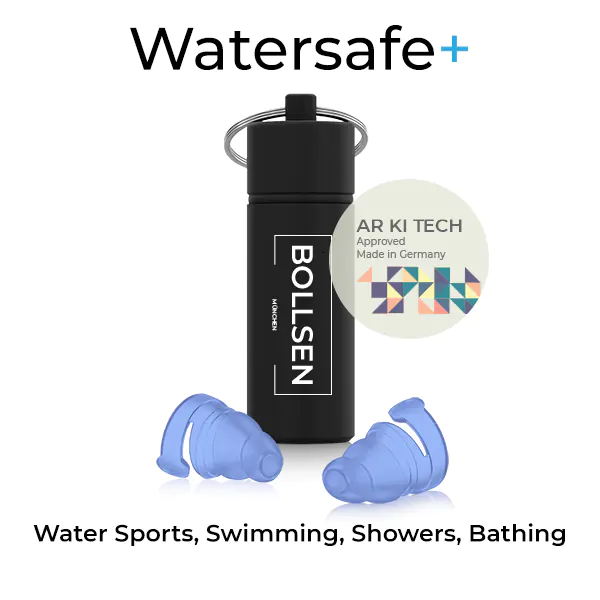
At Bollsen, our Watersafe+ swimming earplugs seal the outer ear canal at the water’s surface with a 24 dB SNR rating, a medical-grade silicone 2-lamellae design that holds through wave movement and head-turning. For a comparison of how earplug protection differs across snorkelling and other water activities, the guide to earplugs for water sports covers everything from pool swimming to open water.


How Do You Stop Water Getting Into Your Ears While Snorkelling?
The most reliable way to prevent water entering the ear canal during snorkelling is a well-fitted silicone earplug that seals the outer canal before you enter the water, worn with a mask that does not press against or dislodge the plug when the strap is tightened at the temples. Insert the earplugs before putting on the mask so the strap pressure does not compromise the seal.
After each session, tilt your head to each side to drain any water that reached the outer canal, then dry gently with a clean towel. Avoid using cotton buds inside the canal: both push residual moisture further inward and can damage the canal lining, increasing infection risk rather than reducing it.
For anyone with a history of ear infections, previous ear surgery, or a perforated eardrum, earplugs are advisable for every snorkelling session regardless of depth or duration. For a full overview of how swimming earplug types compare across conditions, including for swimmers with ear health concerns, the complete buyer’s guide covers all the key variables.
Earplugs for snorkelling matter most not for noise, but for biology. The warm seawater of popular holiday destinations is a highly effective bacterial growth medium, and repeated sessions across a holiday week give it exactly the time it needs to cause a real infection. For a complete overview of waterproof hearing protection across all water activities, the full range of earplugs for water covers how requirements change by depth, frequency, and environment.

His connection to hearing protection stems from personal experience with sound sensitivity during live events and work in noisy environments, an issue that made him more aware of the long-term risks of unmanaged noise exposure. Today, as both a communicator and a user of BOLLSEN products, he is passionate about raising awareness around the importance of proactive hearing care.
At BOLLSEN, he develops data-driven marketing campaigns, writes SEO-focused articles, and manages communication channels that connect customers with practical knowledge about hearing protection. His work ensures that BOLLSEN’s message—prioritizing health, performance, and sustainability reaches a global audience in an engaging and trustworthy way.
Passionate about writing since childhood, Timotej combines creativity with a strong analytical approach, continuously testing new ideas in digital marketing, performance advertising, and social media. He believes in learning through innovation and collaboration, balancing leadership with openness to new perspectives.
Beyond his professional role, Timotej is committed to a healthy lifestyle and finds inspiration in fitness, sports, and quality time with friends. His personal passion for well-being aligns with BOLLSEN’s core values, making his work not only a career but also a cause he deeply believes in.