
⏱️ Estimated reading time: 13 min

Key Takeaways
Half of the sound technicians in one peer-reviewed study showed measurable hearing loss, roughly five times the rate of matched controls. Yet hearing protection for sound engineers is still treated as optional kit, and 85.4% of technicians in that same study wore no earplugs regularly.
At BOLLSEN, we are a family-owned hearing protection company founded in 2016, and our certified earplugs for music, sleep and work are trusted by 1,000,000+ people. We spend a lot of time with the people behind the desk, and we have noticed the advice they get rarely matches how the job actually works.
On Gearspace, live engineers describe the same working rhythm again and again. Plugs go in once the mix is dialled in, and come out for critical listening. This guide works the same way. It covers what the Control of Noise at Work Regulations 2005 actually require, how risk differs between FOH, monitor and studio roles, and what a passive SNR 24 dB earplug can and cannot do at the desk.
How loud is it at the FOH mixing position?
The FOH mixing position at a live venue typically measures 95 to 105 dB, the monitor engineer position beside the PA and stage wedges carries the highest exposure of any crew role, and studio engineers face lower levels per session but accumulate headphone exposure across an entire career.
Those figures match measured workplaces. A cross-sectional study of sound technicians recorded 101 dB(A) in audio operators’ studios, 94.2 dB(A) around microphone operators and 91.1 dB(A) in the sound mixing area. Every one of those values sits above the UK’s 85 dB(A) upper action level.
Safe exposure time halves with every 3 dB increase in level. At 91 dBA the safe dose is about two hours, at 97 dBA it is 30 minutes, and at 100 dBA it is 15 minutes. A four-hour festival shift at the desk can spend a full week’s safe noise budget in a single night.

| Role | Typical exposure | Main risk | Protection approach |
|---|---|---|---|
| FOH engineer | 95–105 dB at the desk, higher during crowd peaks | Long shows, repeated nights, no recovery time | SNR 24 dB plugs for all non-critical listening, open ears reserved for mix decisions |
| Monitor engineer | Highest of any position, directly beside PA and wedges | Proximity to sources, cue stacking across a full set | Plugs in as the default, removed briefly for cue checks |
| Studio engineer | Lower per session, up to 101 dB(A) measured in operator studios | Cumulative headphone dose over years | Calibrated monitoring levels, tracked hours, scheduled quiet |
What do UK noise regulations require for sound engineers?
The Control of Noise at Work Regulations 2005 set three thresholds for sound engineers: at the 80 dB(A) lower action value employers must assess risk and provide training, at the 85 dB(A) upper action value they must provide hearing protection and health surveillance, and the 87 dB(A) exposure limit must never be exceeded.
The music and entertainment sector was given until 6 April 2008 to comply, two years later than other industries. That grace period ended a long time ago. Note that the 87 dB(A) limit is measured with hearing protection factored in, which is why a certified SNR value matters and guesswork does not. The full employer duties, including hearing protection zones and daily exposure calculation, are set out in HSE’s Control of Noise at Work guidance, which applies to every UK venue and production company.
Employment status complicates the picture. If a venue or production company employs you, it must provide hearing protection once your daily exposure LEP,d reaches 85 dB(A). Most UK live engineers work freelance, though, and the UK noise regulations that apply to sound engineers were written around employers, so self-employed engineers effectively carry the duty to protect themselves.
Why do so many sound engineers lose their hearing?
Noise-induced hearing loss affected 50% of sound technicians in a matched study, against 10.5% of controls, and tinnitus affected 36.6% versus 11.6%, which puts the hearing loss risk for sound professionals at roughly five times the level found in comparable non-exposed workers.
The same research recorded the behaviour behind those numbers, with 85.4% of technicians using no regular hearing protection. The full dataset appears in this cross-sectional study of sound technicians’ hearing, measured across working areas of 91 to 101 dB(A).
Damage also starts earlier than most engineers expect. In a hearing conservation study of sound engineers with a mean age of 27.6, 62.5% already showed an audiometric notch of 10 dB or more at 3000 to 6000 Hz, despite describing their hearing as normal. The notch is the classic early signature of noise-induced hearing loss, and it arrives years before you notice anything in conversation.
There is a cultural layer too. A former engineer writing in TPi Magazine described feeling guilty for choosing to protect his hearing, as if he were refusing to sacrifice himself for the art. He had it backwards. Looking after your hearing is not a compromise. It is the professional decision.
Can you mix sound with earplugs in?
Mixing with earplugs is not the same as mixing without them, because a passive earplug changes what you hear: with an SNR 24 dB plug, attenuation rises with frequency, so the top end is reduced more than the lows and mids, and that difference matters for critical EQ decisions.
Engineers know this. Two of the eight engineers in the hearing conservation study above avoided earplugs entirely, citing a restricted hearing range during work. Any brand that claims its plugs are acoustically invisible is ignoring both the lab data and your experience. The honest answer is a workflow, not a miracle product.
Experienced engineers wear plugs during non-critical listening, which covers load-in, line checks, support sets and long loud passages once the mix is set, and they reserve open ears for critical mix decisions. One Gearspace engineer describes putting plugs in once the mix is dialled in during a loud band or DJ set, and allowing a minute for his ears to adjust after popping them out.
| Show moment | Plugs in or out? | Why |
|---|---|---|
| Load-in and line check | In | No critical listening, plenty of impulse noise and feedback risk |
| Support sets and DJ warm-up | In | Someone else’s mix, your exposure budget |
| Dialling in the headline mix | Out, briefly | Critical EQ and balance decisions need your reference hearing |
| Long loud passages once the mix is set | In | Monitoring for problems does not require open ears at 100 dB |
| Teardown and load-out | In | Cases, flightpacks and forklifts produce impact noise |
Protection and better mixes are not opposites. The less ambient noise you have to overcome, the lower you can keep your show volume, a point live sound educators make repeatedly. Lower volume means less exposure for you, the band and the audience.
If you insist on mixing entire shows with plugs in, the correct tool is a calibrated custom flat-filter plug from an audiologist, at £100 to £400 or more. For every other hour of the working day, a certified passive plug at a fraction of that price does the protective work.
How do sound engineers protect their hearing in the studio?
Studio engineers face a quieter room but a longer dose, because headphone cueing across an eight-hour session builds daily exposure LEP,d the same way a live show does, and audio operators’ studios have measured as high as 101 dB(A) during normal working hours.
In the studio, the fix is level discipline rather than earplugs. Calibrate your monitoring level and track your session hours, then protect the recovery window, because ears need roughly 10 hours of quiet to reset after loud exposure. Back-to-back sessions with loud commutes and gigs in between remove that recovery window entirely.
An annual baseline audiogram is the cheapest insurance an engineer can buy. Health surveillance is mandatory for employed staff exposed above 85 dB(A), and freelancers can book the same test privately. Catching a 3 to 6 kHz notch early is the difference between adjusting your workflow and ending your career.
What SNR do sound engineers need?
An SNR 24 dB earplug brings a 105 dB venue down to roughly 81 dB at the ear, below the UK’s 85 dB(A) upper action value, so which SNR level sound engineers need for regulatory compliance depends on the measured level at their working position rather than on a generic recommendation.
The arithmetic follows the 3 dB exchange rate. Each 3 dB of reduction doubles your safe exposure time, so 24 dB of attenuation turns a 15-minute safe window at 100 dBA into a full shift. The exchange rate tables and the 85 dBA recommended exposure limit are published in NIOSH’s occupational noise guidance, which most UK acousticians use alongside HSE figures.
More attenuation is not automatically better. Overprotection cuts you off from talkback, cues and the room, which is exactly what pushes engineers to abandon plugs altogether. For FOH work at 95 to 105 dB, SNR 24 lands the residual level in the low 80s, protected but still connected to the show.
Which earplugs do we recommend for sound engineers?
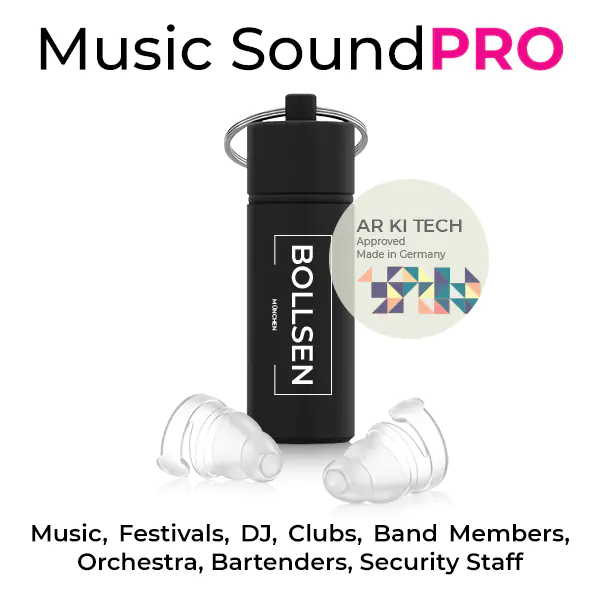
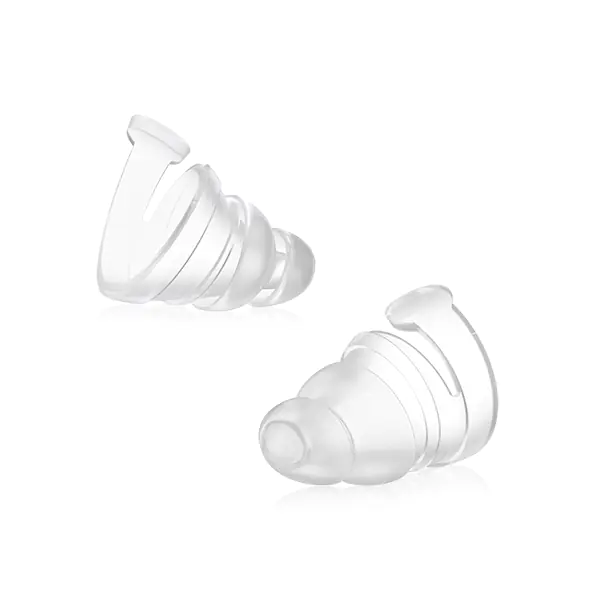
Our Music SoundPRO is a passive 2-lamella medical-grade silicone earplug rated SNR 24 dB (H24, M21, L19), German-tested and independently certified, and it is the plug we recommend as default protection for FOH, monitor and studio engineers through every non-critical listening moment of a working day.
We will be straight about what it is not. Under EN 352-2 testing, attenuation rises with frequency, from about 22 dB in the lows and mids to 35.3 dB at 8 kHz, so this is not a flat or reference filter. You still hear the music and conversation clearly, just quieter, with the top end reduced most. It is not a substitute for a calibrated custom or electronic monitoring plug when a critical mix decision needs accurate frequency response.
The transparent design sits flush in the ear canal, invisible from a metre away and compatible with headphones or IEMs worn over the top, and each pair is reusable up to 100 times with an aluminium case that survives life in a work box. It is the same answer we give across the music world, from drummers to DJs, and it has featured in coverage from Mixmag to BBC Science Focus. Because a poor seal costs real attenuation, our AR KI TECH measurement matches photos of your ears to the correct size, explained at AR KI TECH fit measurement.


For the complete EN 352-2 attenuation table, sizing options and certification documents, the Music SoundPRO for sound engineers product page lists the lab data behind the SNR 24 dB rating.
Where do sound engineers go from here?
If you also perform, teach or tour, our guide to the best earplugs for musicians and audio professionals compares protection for drummers, DJs, vocalists and the rest of your stage.
The numbers in this guide point one way. The desk exceeds the 85 dB(A) action value on almost every show, half of unprotected technicians develop measurable hearing loss, and the law already expects protection to be in place. Wear an SNR 24 dB plug for every non-critical hour, reserve open ears for the decisions that genuinely need them, and book a baseline audiogram this year.
Your ears are the only monitors you cannot replace. Try the Music SoundPRO risk-free with our 40-day money-back guarantee, and if the fit or the sound is not right for your work, send them back.

His connection to hearing protection stems from personal experience with sound sensitivity during live events and work in noisy environments, an issue that made him more aware of the long-term risks of unmanaged noise exposure. Today, as both a communicator and a user of BOLLSEN products, he is passionate about raising awareness around the importance of proactive hearing care.
At BOLLSEN, he develops data-driven marketing campaigns, writes SEO-focused articles, and manages communication channels that connect customers with practical knowledge about hearing protection. His work ensures that BOLLSEN’s message—prioritizing health, performance, and sustainability reaches a global audience in an engaging and trustworthy way.
Passionate about writing since childhood, Timotej combines creativity with a strong analytical approach, continuously testing new ideas in digital marketing, performance advertising, and social media. He believes in learning through innovation and collaboration, balancing leadership with openness to new perspectives.
Beyond his professional role, Timotej is committed to a healthy lifestyle and finds inspiration in fitness, sports, and quality time with friends. His personal passion for well-being aligns with BOLLSEN’s core values, making his work not only a career but also a cause he deeply believes in.