
⏱️ Estimated reading time: 13 min

Key Takeaways
Triathletes have a more complex relationship with earplugs for water sports than almost any other aquatic athlete. A typical UK training week combines three to five pool sessions, one or two open water swims, and daily post-ride showers, each one a separate water-entry event for the ear canal. Then race day adds the hardest test: a cold-water mass start where dozens of bodies thrash together and create exactly the chaos that rips standard earplugs out within the first 100 metres.
The earplug choice that works for a recreational pool swimmer is often the wrong choice for a triathlete. Three specific demands, open water retention, T1 removal speed, and cold water exostosis protection, require a different approach. This guide covers each directly.
Why Do Triathletes Need Different Earplugs from Pool Swimmers?
Triathletes face three ear-related demands that pool swimmers largely avoid: an open water mass start that dislodges standard earplugs, a T1 transition that penalises slow removal, and sustained cold water training at UK lake temperatures of 4 to 6°C in winter that creates genuine long-term auditory exostosis risk.
A pool swimmer inserts their earplugs, completes their session, and removes them calmly at the wall. A triathlete is dealing with something categorically different from the moment the start horn sounds. Beyond race day, training volume amplifies ear exposure in ways pool swimmers do not experience, a triathlete in peak preparation may train twice daily with post-ride showers adding a third ear contact each day.
NHS guidance on otitis externa notes that repeated water exposure softens the ear canal’s skin and makes it significantly more susceptible to bacterial infection, with an estimated 1 in 10 people affected at some point in their lives. For triathletes with multiple daily water exposures, that baseline risk is meaningfully higher.
Can You Wear Earplugs in a Triathlon Race?
Standard waterproof silicone earplugs worn for ear protection are permitted in most triathlon events. British Triathlon’s competition rules prohibit “technical earplugs” and in-ear audio devices, a rule targeting headphones, audio tempo devices, and electronic aids, not non-audio medical-grade waterproof silicone plugs.
The specific British Triathlon rule states that any equipment acting as an impediment to hearing or concentration is prohibited. The intent is to prevent competitive audio advantages, not to restrict athletes from using medical-grade silicone for ear canal protection. In practice, waterproof silicone earplugs are widely used by competitive triathletes at British and international events without challenge from officials.
Rules differ by governing body and event. Athletes competing under World Triathlon or USA Triathlon rules, or at any event with a strict equipment check, should verify with the event’s technical officials before race day.
What Makes Earplugs Fall Out During an Open Water Mass Start?
The primary cause of earplug loss during an open water mass start is poor fit. An earplug that does not match an individual ear canal’s geometry relies on friction alone, and that friction fails within the first 200 metres when turbulent water pressure, head rotation during sighting, and full-effort freestyle arm-stroke vibration all act on the plug simultaneously.
Foam earplugs are particularly poorly suited to this context. Their mechanism, compress, insert, allow to expand, creates a single surface of outward pressure rather than a conforming seal. In cold water, ear canal tissue contracts slightly, and the expanding foam no longer contacts the wall with the same force it had at air temperature. Wax plugs face a different failure: they deform under turbulent water contact and leave residue that makes T1 removal messy.
Medical-grade silicone flanged plugs hold because each lamella forms a separate contact ring along the canal wall. The silicone’s compliance means it moves with the canal rather than fighting it. For a full technical comparison of how different earplug types hold against open water conditions, the open water swimming earplug guide covers the performance differences in detail.
How Do You Remove Earplugs Quickly in T1?
A flanged medical-grade silicone earplug with an integrated pull-tab removes in approximately 2 to 3 seconds per ear, a negligible time cost in a sprint or Olympic-distance race, but only when the earplug was correctly fitted and the removal action has been practised in training.
T1 is already the most cognitively loaded transition in triathlon. Athletes arrive from cold water with reduced fine motor control, are simultaneously stripping a wetsuit, and need to locate their bike all while running. Adding earplug removal to this sequence needs to cost as little time as possible. An athlete who has practised this motion fifty times on poolside will remove their plugs without breaking stride. One who has not will fumble and waste five or more seconds.
Does Cold Water Training Cause Ear Canal Damage in Triathletes?
Yes. Sustained cold water exposure causes auditory exostosis, progressive bony growth that narrows the ear canal over years. Research published in PubMed shows exostosis risk rises by 12% for every additional year of cold water swimming, with prevalence reaching 70 to 80% in committed cold water athletes, who develop exostoses at six times the rate of those who swim in warm water only.
Most triathletes associate exostosis with surfers, not themselves. The mechanism is identical: cold water entering the ear canal causes a chronic periosteal response, stimulating bony growth as the body attempts to protect against repeated thermal shock. UK open water training takes place at lake temperatures that regularly fall to 4 to 6°C from October through April, well within the temperature range associated with exostosis development. A triathlete training outdoors through winter may log 30 to 50 open water sessions in water below 10°C in a single off-season.
According to StatPearls via NCBI, as the exostosis progressively narrows the canal, water and cerumen become trapped more readily, creating conditions for recurrent infection. Earplugs used consistently during open water training sessions function as genuine long-term protective equipment in the same category as a helmet or wetsuit. The mechanism and timeline of exostosis development relevant to triathletes who train outdoors year-round is covered in the dedicated earplugs for cold water swimming guide.
Which Earplug Type Stays In Through Open Water Swimming?
Medical-grade silicone flanged earplugs with a multi-lamella design provide significantly better open water retention than foam or wax alternatives because each lamella creates a separate contact ring along the canal wall, a distributed, conforming seal that absorbs movement rather than relying on a single surface of friction.
At Bollsen, our Watersafe+ uses a patented 2-lamellae conical design made from 100% natural medical-grade silicone, free of BPA, PVC, latex, plasticisers, and cadmium, with a certified 24 dB SNR noise reduction rating. The design is tested to hold through dive-block starts, flip turns, and open water conditions. Each pair is reusable up to 100 times and comes with an aluminium carry case that fits in any transition bag.


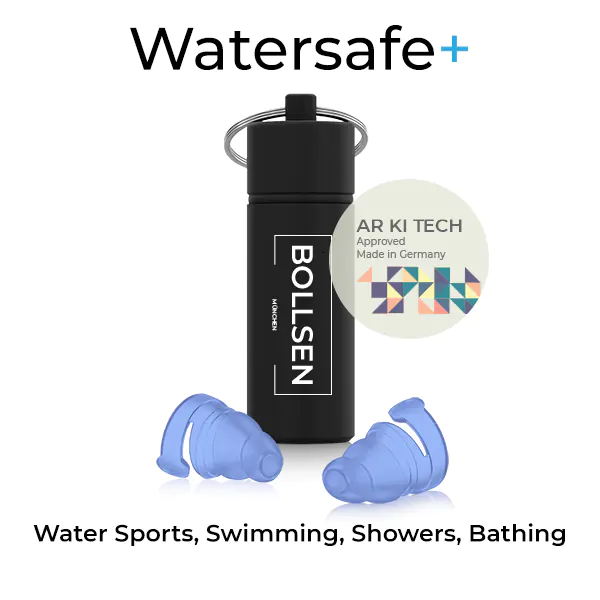
Watersafe+ vs Watersafe+ AR KI TECH: Which Is Right for Your Race?
Both products share the same 24 dB SNR medical-grade silicone construction and patented 2-lamellae design. The difference is how the fit is determined, and for triathletes, that difference is most visible at the worst possible moment.
| Watersafe+ | Watersafe+ AR KI TECH | |
|---|---|---|
| Price | £29.95 | £44.95 |
| Fit method | Standard S/M/L sizing | AI ear measurement from 2 photos (~2 min) |
| SNR rating | 24 dB | 24 dB |
| Material | Medical-grade silicone | Medical-grade silicone |
| Return rate | Industry standard | 3% |
| Reusable | Up to 100 times | Up to 100 times |
| Best use case | Pool training, general open water | Race-day, open water mass starts |
For most triathletes in weekly pool training and regular open water sessions, Watersafe+ at £29.95 covers all of it. For athletes racing a key event where every potential equipment failure matters, Watersafe+ AR KI TECH eliminates the fit guesswork. For a broader comparison across all swimmer profiles and use cases, the complete swimming earplugs buyer’s guide covers all earplug types across pool, open water, and triathlon contexts.
How Does AR KI TECH Sizing Improve Earplug Retention for Triathletes?
Watersafe+ AR KI TECH uses AR mapping and AI sizing from two photos of the ear, processed in the browser in approximately 2 minutes, to recommend the correct size from the S/M/L range. This precision reduces the return rate from standard industry levels to just 3%, directly addressing the fit gap that causes earplug loss in open water.
Ear canal geometry varies considerably between individuals. An earplug that fits 70% of ear canals at M will fail the remaining 30% through discomfort from oversizing or seal failure from undersizing. For a pool swimmer, that failure means mild irritation. For a triathlete in an open water start, it means a lost earplug and an exposed ear canal for the remaining 45 minutes of the swim leg.
The AR KI TECH service runs entirely in a browser, no app, no download, no audiologist appointment. Two photos are taken in good light, uploaded in around 10 seconds, and a size recommendation arrives in approximately 2 minutes. The standalone sizing service is available at /ar-ki-tech/ for £12.00.
How Often Do Triathletes Need to Replace Their Swimming Earplugs?
Watersafe+ is rated for up to 100 uses, which at five sessions per week equates to approximately 20 weeks of training, one pair per half-season, or two pairs per year for a triathlete who trains year-round in pool and open water.
At £29.95 per pair, two pairs per year costs £59.90, less than a single entry fee for most half-distance events. The 100-use rating assumes regular rinsing under clean water after each session and storage in the included aluminium carry case. Medical-grade silicone does not degrade from chlorine exposure and maintains its performance across cold water use.
Signs that a pair should be replaced are visible tearing of the lamellae, permanent surface tackiness, or noticeably reduced retention relative to when the pair was new.
Protecting Your Ears Is Part of the Sport
For any triathlete training in UK open water through autumn and winter, earplugs are protective equipment in the same category as a wetsuit. They prevent the long-term canal damage that a season without them accumulates steadily, and they keep water-related infections from interrupting a training block at exactly the wrong time.
Trusted by 1,000,000+ people and backed by a 40-day money-back guarantee, Bollsen Watersafe+ (24 dB SNR, medical-grade silicone, reusable up to 100 times, £29.95) provides the protection and durability needed across the full training week. It is long enough to test retention across several open water sessions before committing.

His connection to hearing protection stems from personal experience with sound sensitivity during live events and work in noisy environments, an issue that made him more aware of the long-term risks of unmanaged noise exposure. Today, as both a communicator and a user of BOLLSEN products, he is passionate about raising awareness around the importance of proactive hearing care.
At BOLLSEN, he develops data-driven marketing campaigns, writes SEO-focused articles, and manages communication channels that connect customers with practical knowledge about hearing protection. His work ensures that BOLLSEN’s message—prioritizing health, performance, and sustainability reaches a global audience in an engaging and trustworthy way.
Passionate about writing since childhood, Timotej combines creativity with a strong analytical approach, continuously testing new ideas in digital marketing, performance advertising, and social media. He believes in learning through innovation and collaboration, balancing leadership with openness to new perspectives.
Beyond his professional role, Timotej is committed to a healthy lifestyle and finds inspiration in fitness, sports, and quality time with friends. His personal passion for well-being aligns with BOLLSEN’s core values, making his work not only a career but also a cause he deeply believes in.