
⏱️ Estimated reading time: 16 min

Key Takeaways
Yes, but only in the right environment. If you share a bed with a snoring partner or sleep somewhere noisy (traffic, hotel, hospital), earplugs remove the unpredictable sound spikes that shatter sleep cycles. They don’t silence your ears completely; your tinnitus fills that space. But they stop the external intrusions that are far more disruptive than a steady internal ring.
Total-blocking foam earplugs can make tinnitus feel more intense in an already-quiet room. They strip out the ambient environment, leaving the internal ringing as the loudest thing you can hear. Filtered silicone earplugs, which reduce noise by 24 dB SNR rather than blocking it completely, are less likely to cause this because they let some background sound through.
During the day, background noise naturally masks tinnitus. When the room goes quiet at night, there’s nothing to compete with the internal ringing, so the brain notices it more acutely. Poor sleep also directly worsens tinnitus the following day, which makes the next night harder still. Research shows tinnitus patients have 2.08 times higher odds of sleep disturbance than people without tinnitus.
It depends on your sleep environment. If you’re somewhere noisy (snoring partner, street traffic, hospital ward), filtered silicone earplugs can meaningfully improve sleep quality. If your bedroom is already quiet, earplugs may deepen the silence and make the ringing more prominent. Sound therapy combined with earplugs in a noisy environment is often the most effective approach.
Significantly. A meta-analysis of 7 studies covering 3,041 tinnitus patients found that 53.5% experience sleep impairment. The relationship goes both ways: tinnitus disrupts sleep, and insufficient sleep amplifies tinnitus perception the following day, creating a feedback loop that’s difficult to break without directly addressing both triggers.
Filtered medical-grade silicone earplugs rated at 24 dB SNR are the better choice over foam. Foam earplugs create near-total silence, which can sharpen tinnitus perception. Silicone earplugs with a filtered design reduce disruptive noise spikes while allowing a low level of ambient sound to pass through, cutting external disruption without creating the deep auditory void that makes ringing more noticeable.
Over 7 million people in the UK live with tinnitus, 1 in 7 adults hearing a persistent ring, hiss, or buzz that no one else can detect. For most of them, bedtime is the hardest part of the day. Whether earplugs help with tinnitus at night, or make things worse, is a question worth answering properly. Both outcomes are possible, and which applies to you depends almost entirely on what’s happening outside your ears.
A pattern keeps coming up in tinnitus communities: a snoring partner jolts you awake at 2am, and then the tinnitus kicks in. Now you have two problems. The snore spike ended, but the ringing is all you can hear in the silence that follows. Remove that snore spike, and the whole picture changes.
Why Does Tinnitus Get Louder at Night?
Tinnitus doesn’t actually get louder at night. The internal signal stays constant, but the daytime noise that masked it disappears. Traffic, conversation, office hum, background music all keep your auditory cortex occupied during the day. Once the room goes quiet, the brain has nothing to process except the ringing, and it becomes the loudest thing in your environment.
This is called central gain, a neurological process where the auditory cortex amplifies internal signals to compensate for reduced external input. The quieter the environment, the more the brain turns up its own internal volume. It’s the same mechanism that makes total silence feel louder than ambient noise to many people with tinnitus.
A large UK cohort study of 109,783 patients found that tinnitus is associated with an odds ratio of 1.45 for insomnia, meaning tinnitus patients are nearly 50% more likely to develop insomnia than the general population. The relationship goes in both directions: the worse you sleep, the worse your tinnitus perception the next day, which makes the following night harder still.
The NHS tinnitus information page explains that tinnitus is most commonly caused by prolonged exposure to loud noise and age-related hearing changes, and that the perceived loudness often increases when background sound is removed.
Is the Tinnitus–Sleep Feedback Loop Real?
Yes, and it doesn’t get explained enough. When tinnitus fragments your sleep, your body starts the next day sleep-deprived. Sleep deprivation increases the sensitivity of the auditory cortex, which makes tinnitus perception more acute the following evening. You sleep worse again, and the cycle tightens.
A meta-analysis published in the European Archives of Otorhinolaryngology examined 7 studies involving 3,041 tinnitus patients and found a pooled prevalence of sleep impairment at 53.5% (95% CI: 40.2–66.8%). A separate large-scale study using US National Health data found that tinnitus is linked to an adjusted odds ratio of 2.08 for sleep disturbance (95% CI: 1.83–2.36). For a condition affecting 7 million UK adults, the cumulative impact is significant: the NHS spends an estimated £750 million annually on tinnitus care.
Breaking the loop means tackling sleep quality directly. Better sleep reduces the neural sensitivity that amplifies tinnitus, which makes the next night more manageable. Managing what you can hear at night is one of the few practical levers available without clinical intervention.
According to Tinnitus UK guidance on tinnitus and sleep, the shift from a noisy daytime environment to the quietness of the bedroom is the primary reason tinnitus sounds more intrusive at night, a cycle that worsens anxiety and further delays sleep onset.
Can Earplugs Actually Help With Tinnitus at Night?
Earplugs for tinnitus sleep work best when the primary problem is external noise competing with or triggering the ringing. A snoring partner produces peaks of 70–90 dB next to your ear. Traffic outside an urban window adds unpredictable spikes throughout the night. These sudden noise events fragment sleep and jolt the nervous system awake, leaving the auditory cortex hyperactivated and the tinnitus front of mind.
Removing those spikes with filtered earplugs doesn’t create total silence. Your internal ringing is still there, and it fills the space. But a steady internal sound is far easier for the brain to habituate to than unpredictable external spikes. The brain adapts to consistent signals, not random ones. That’s what earplugs do here: remove variability, not all sound.
That distinction matters when choosing the type of earplugs suited for sleeping with tinnitus in a noisy environment. Foam earplugs block nearly all sound, creating something closer to a sealed anechoic chamber than a bedroom. Filtered silicone earplugs designed for sleeping reduce disruptive noise by a measured amount while allowing a background level of ambient sound to pass through.
Tinnitus UK advice on hearing protection and earplugs recommends hearing protection in loud environments to prevent further noise-induced hearing damage, the most common reversible cause of worsening tinnitus over time.


Do Earplugs Make Tinnitus Worse?
Foam earplugs carry a genuine risk for tinnitus sufferers in already-quiet environments. A clinical study referenced by tinnitus specialists found that sustained foam earplug use over two weeks in normal-hearing subjects increased sound sensitivity and central gain, the brain’s internal amplification response to auditory deprivation. In someone who already has tinnitus, additional deprivation could intensify the perceived volume of the internal signal.
The risk is specific to context. In a quiet bedroom, adding earplugs removes the last remnants of environmental sound and leaves the auditory cortex with nothing to process but the ringing. In a noisy bedroom (snoring partner, street noise, thin hotel walls), the earplugs are competing with genuine external interference, not creating artificial silence. Sleep impairment in tinnitus patients correlates most strongly with disrupted sleep architecture, not with ambient sound levels per se.
Filtered silicone earplugs in a noisy environment are unlikely to worsen tinnitus. Foam earplugs in a quiet bedroom are more likely to. The environment determines the outcome far more than the earplug type.
Earplugs vs White Noise: Which Is Better for Tinnitus Sleep?
Both tools target different parts of the problem. White noise and sound masking fill the auditory environment with a steady, non-threatening signal, giving the brain something to process that competes with the tinnitus. Earplugs reduce the intrusion of external disruptive noise. The two can be used together.
| Sleep situation | Best approach | Why it works |
|---|---|---|
| Quiet bedroom, tinnitus only | White noise / sound therapy | Fills auditory silence; gives brain something to habituate to other than the ringing |
| Snoring partner | Filtered silicone earplugs | Removes unpredictable snore spikes (70–90 dB) without creating total silence |
| Street noise / traffic / hotel | Filtered silicone earplugs | Reduces variable external noise that fragments sleep architecture |
| Noisy environment + strong tinnitus | Filtered silicone earplugs + white noise | Earplugs cut external spikes; white noise fills remaining auditory space |
| Foam earplugs in any quiet setting | Avoid | Near-total silence intensifies tinnitus perception via central gain |
People in tinnitus communities consistently reach for fans, rain recordings, or anything that creates a steady background signal. It’s a self-discovered form of sound therapy that works because it stops the brain focusing entirely on the internal ring. If you’re dealing with both external noise and tinnitus, combining filtered earplugs with a soft background sound source covers both triggers at once.
What Makes Silicone Earplugs Different From Foam for Tinnitus?
Filtered medical-grade silicone earplugs rated at 24 dB SNR reduce noise by a measured, controlled amount rather than cutting it as completely as possible. A foam earplug at 30+ dB SNR pushes the wearer into near-total auditory isolation. A filtered silicone earplug at 24 dB SNR cuts the worst of the external noise while leaving a residual ambient sound level, enough to prevent the auditory deprivation effect that sharpens tinnitus perception.
The physical design matters too. Silicone earplugs sit at the canal entrance rather than deep inside it, which reduces the occlusion effect: the sensation of your own internal sounds (including tinnitus) being amplified by a sealed ear canal. They’re also designed to stay comfortable through the night without sustained pressure on the canal walls, which matters for anyone whose ears are already hypersensitive.
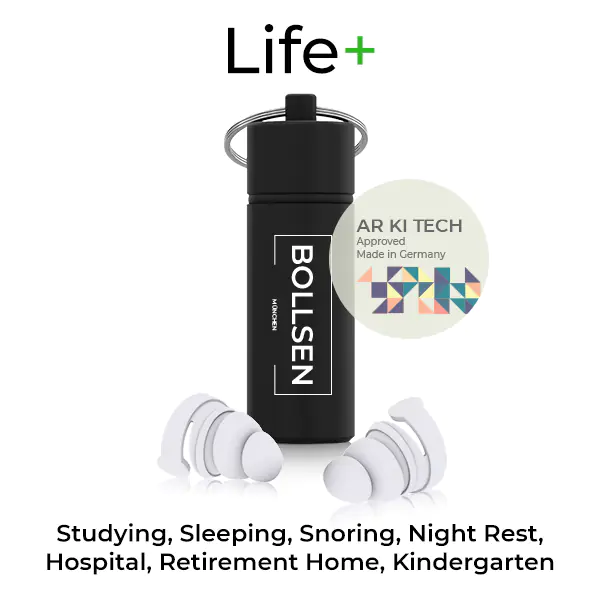
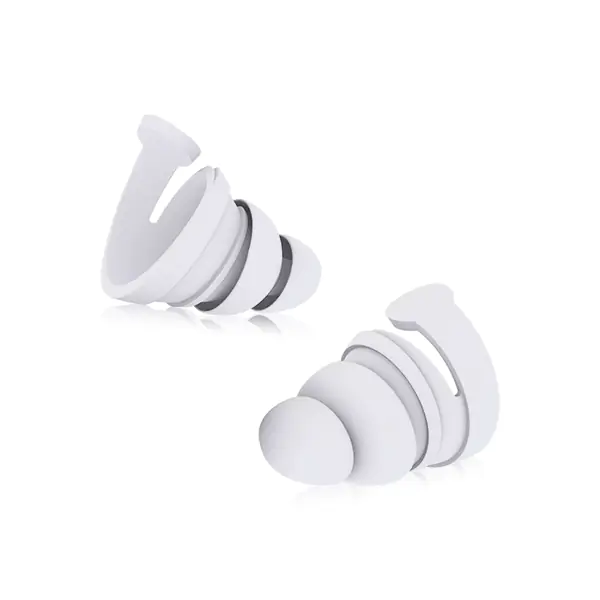
At Bollsen, we make the Life+ earplug specifically for sleeping. It’s made from medical-grade silicone, rated at 24 dB SNR, reusable up to 100 times, and uses a patented 2-lamellae design that disappears in the ear for back, side, and stomach sleepers. It passes high-frequency sounds (alarm clocks, baby monitors, fire alarms) while filtering the low-frequency noise most associated with snoring and traffic. Trusted by over 1,000,000 people, with more than 10,000 verified reviews and a 40-day money-back guarantee.
Filtered attenuation at tinnitus-matching frequencies requires a different rating than broadband noise reduction. NRR and SNR rating for tinnitus-related earplug selection depends on whether the goal is suppressing external triggers or preserving the low-level background that prevents total auditory isolation.
Is It Safe to Sleep With Earplugs Every Night If You Have Tinnitus?
Nightly earplug use is generally safe when the earplugs are clean, well-fitting, and made from medical-grade materials. The auditory deprivation concern applies primarily to total-blocking foam worn continuously over weeks, which is a different situation from filtered silicone earplugs used for sleep in a noisy environment. nightly earplug safety and the specific conditions to watch for are covered in detail for anyone considering regular use.
A hospital ICU study offers useful context: patients given earplugs during overnight hospital stays had a 53% reduction in confusion and delirium risk (Hazard Ratio 0.47) across 136 patients. Better sleep quality directly improves neurological outcomes, and for tinnitus sufferers, any improvement in sleep quality tends to reduce tinnitus perception the next day.
The real question is whether your sleep environment is genuinely noisy. If you’re using earplugs because your room is quiet and you’re hoping to reduce tinnitus awareness by removing all sound, that’s the wrong direction. If you’re using them because a snoring partner or urban noise is breaking your sleep, that’s a legitimate, evidence-consistent application.
What Else Helps With Tinnitus Sleep Beyond Earplugs?
Sound masking is the most widely used self-management tool: a consistent ambient sound (fan, white noise machine, rain recordings) that the brain can habituate to rather than focusing on the tinnitus signal. Cognitive behavioural therapy (CBT) adapted for tinnitus has strong clinical evidence behind it, addressing the emotional and attentional response to the sound rather than the sound itself. sleep impairment in tinnitus patients is reported across a 25–77% prevalence range in clinical literature, which reflects how widely individual responses vary and why no single approach works for everyone.
Sleep hygiene changes (consistent sleep and wake times, keeping the bedroom cool, avoiding screens before bed) reduce the overall neurological arousal that makes tinnitus harder to ignore. They don’t treat tinnitus directly, but they lower the sensitivity threshold that determines how prominently the brain registers the internal signal.
Tinnitus UK and the RNID both provide clinical guidance and support for people managing tinnitus long-term. If tinnitus is consistently disrupting your sleep, a referral to an audiologist for formal tinnitus management therapy is worth pursuing alongside any self-management approach. For a fuller overview of how earplugs interact with earplugs for tinnitus across different contexts, the tinnitus pillar covers the broader picture beyond the sleep-specific angle.
The Sleep Foundation overview of sleep stages explains that deep NREM sleep (stage 3) is the most physically restorative phase, protecting this stage from tinnitus-driven arousals is the primary goal of any tinnitus sleep management approach.
The Snoring Partner Problem: Tinnitus’s Hidden Accelerant
Snoring at close range produces noise in the 70–90 dB range, equivalent to a busy road or a vacuum cleaner. For someone without tinnitus, this disrupts sleep but is recoverable. For someone with tinnitus, each snore spike not only wakes you up; it activates the auditory system at the precise moment the brain is trying to suppress its own internal signal, making both the snore and the subsequent ringing more distressing.
Filtered silicone earplugs with 24 dB SNR bring a 70–90 dB snoring peak down to 46–66 dB, comfortably below the threshold at which noise fragments sleep. The tinnitus remains audible internally, but it’s no longer competing with an external spike louder than itself. The brain gets a consistent internal signal rather than alternating between external intrusion and sudden silence.

This is where earplugs demonstrably help tinnitus sleep. Not by making the ringing quieter, but by removing the external factor that makes it feel overwhelming. For anyone sharing a bed with a snorer, the silicone earplugs for tinnitus management article covers the broader relationship between tinnitus and hearing protection in more depth.
A snoring partner adds sustained low-frequency exposure on top of existing tinnitus arousal sensitivity. How to sleep next to a snoring partner when tinnitus amplifies the exposure operates through the same central gain mechanism as other acoustic stressors at night.
Conclusion
Earplugs can help with tinnitus at night, but they’re the right tool for a specific situation. If your bedroom is noisy, a snoring partner, traffic, a thin-walled hotel room, filtered silicone earplugs remove the external intrusions that are objectively more disruptive than a steady internal ring. If your bedroom is already quiet, sound therapy is the better first step. The two aren’t mutually exclusive; in a noisy environment with strong tinnitus, using both at once covers the problem from both sides.
The tinnitus-sleep feedback loop is real and measurable, and breaking it means improving sleep quality as much as managing the ringing. Removing preventable sleep disruptions, the snore, the traffic spike, the hotel corridor, is one of the most practical things you can do tonight. For more on choosing the right protection across every sleeping situation, explore our full range of earplugs for sleeping.

His connection to hearing protection stems from personal experience with sound sensitivity during live events and work in noisy environments, an issue that made him more aware of the long-term risks of unmanaged noise exposure. Today, as both a communicator and a user of BOLLSEN products, he is passionate about raising awareness around the importance of proactive hearing care.
At BOLLSEN, he develops data-driven marketing campaigns, writes SEO-focused articles, and manages communication channels that connect customers with practical knowledge about hearing protection. His work ensures that BOLLSEN’s message—prioritizing health, performance, and sustainability reaches a global audience in an engaging and trustworthy way.
Passionate about writing since childhood, Timotej combines creativity with a strong analytical approach, continuously testing new ideas in digital marketing, performance advertising, and social media. He believes in learning through innovation and collaboration, balancing leadership with openness to new perspectives.
Beyond his professional role, Timotej is committed to a healthy lifestyle and finds inspiration in fitness, sports, and quality time with friends. His personal passion for well-being aligns with BOLLSEN’s core values, making his work not only a career but also a cause he deeply believes in.