⏱️ Estimated reading time: 18 min

Key Takeaways
Finding the best earplugs for festivals in the UK comes down to one honest question: can a plug protect your hearing across a full day without making the music sound like it is coming from the next field over? Festival sound systems are built to push 100 to 115 dB across a crowd, and most people stand in that wall of sound for 8 to 12 hours, sometimes across three or four days.
At Bollsen, we are a family-run hearing protection company that has fitted reusable earplugs for more than 1,000,000 people since 2016, and festival-goers are one of the groups we hear from most. A common story turns up again and again on festival forums: someone grabs free foam plugs at the gate, finds the music goes flat and muffled, takes them out by the second band, and wakes up the next morning with their ears ringing. That ringing is the problem this guide is built to prevent.
Below we cover how loud festivals get, why a whole day matters more than any single set, and what to look for so you can pick the right pair. If you want the wider picture first, our hub on earplugs for music covers every use case, and our guide to the best earplugs for concerts is the closest companion to this one.
How loud are UK music festivals, really?
UK festival main stages typically run between 100 and 115 dB at the audience, and the area directly in front of the PA stacks can reach 110 to 120 dB. For comparison, normal conversation sits around 60 dB and a busy road is about 80 dB, so a festival stage is many times more intense than anything in daily life.
The number that surprises people is how the scale works. Decibels are logarithmic, so every increase of 10 dB represents roughly ten times more sound intensity. A 110 dB stage is not slightly louder than a 100 dB one, it is about ten times more intense, which is why the front of a crowd can feel physically overwhelming. The CDC’s guidance on noise and hearing loss puts repeated exposure above 85 dB firmly in the harmful range.
Outdoor sound also behaves differently from an indoor club. Open-air stages disperse sound, so levels drop noticeably the further back you stand, while the bass still travels a long way. If you want the full breakdown by venue type, our explainer on how loud festival stages get in decibels shows where the real risk sits across a site.
Why does a full festival day put your hearing at such high risk?
The danger at a festival is not one loud song, it is the cumulative dose of sound your ears absorb across the whole day. Hearing damage works on a time-and-volume budget: the louder the sound, the less time you can safely take before the risk climbs.
Health bodies use a 3 dB exchange rule to describe this. The WHO’s safe-listening guidance treats about 85 dB for eight hours as the daily limit, and every extra 3 dB cuts the safe time in half. So 88 dB is safe for four hours, 91 dB for two, and by 100 dB you have used your safe dose in roughly 15 minutes. A festival day at 100 to 115 dB across 8 to 12 hours pushes you hundreds of times past that limit.
Multi-day festivals stack the problem, because your ears do not fully reset overnight between days. The most common result is temporary ringing or muffled hearing the morning after, and as one festival-goer put it online, “my ears rang for two days straight.” That ringing can settle into permanent tinnitus, and our piece on how festivals can cause tinnitus after the event explains why those after-effects are a warning rather than a quirk. The NHS lists loud music as a leading cause of tinnitus, and it is far easier to prevent than to treat.
What should you look for in festival earplugs?
The best festival earplugs balance four things: enough attenuation to make a long day safe, sound that stays clear rather than muffled, comfort across 8 to 12 hours, and a design you will actually keep in and not lose. Raw noise blocking on its own is easy. Doing it without ruining the music is the harder part.
This is where the type of plug matters. Disposable foam expands to seal the ear canal and can cut a lot of volume, but it does so unevenly and leaves the music sounding dense and muffled, like it is happening underwater. Reusable filtered silicone is designed to lower the level in a more usable way, so the set still sounds like the set. The table below compares the two on the points that matter for a festival.
| Feature | Disposable foam earplugs | Reusable silicone earplugs (Music SoundPRO) |
|---|---|---|
| Noise reduction | High raw blocking, uneven across pitches | SNR 24 dB, brings the whole day to a safe level |
| Sound quality | Dense, muffled, “underwater” feel | Quieter but clear, music stays intelligible |
| Comfort over 8-12 hours | Pressure and itch as foam expands | Low-profile silicone, sits flush in the ear |
| Reusability | Single use, cannot be cleaned | Up to 100 uses, washable |
| Cost per use | ~£0.05-0.10, thrown away daily | ~£0.30 over 100 uses, then keeps going |
| Easy to keep with you | Loose, easily lost | Aluminium case with keyring |
Foam still has its place if you forgot everything and need any protection at all. But for anyone who cares about hearing the music and is going to more than one event, a reusable filtered plug is the better long-term choice.
What are the best earplugs for festivals in the UK?
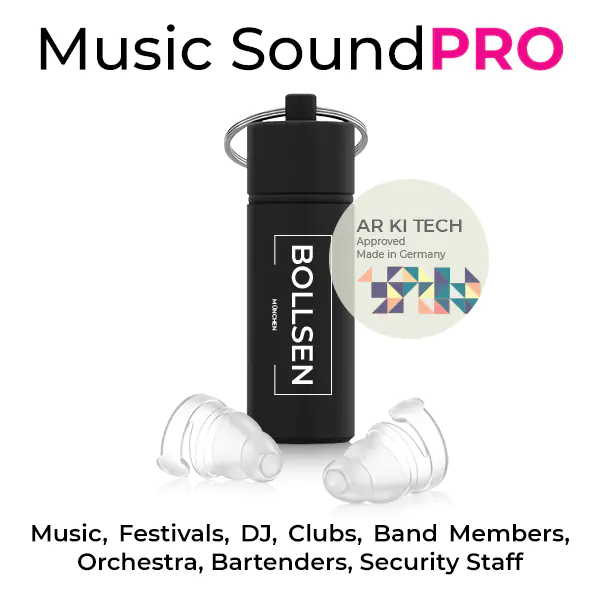
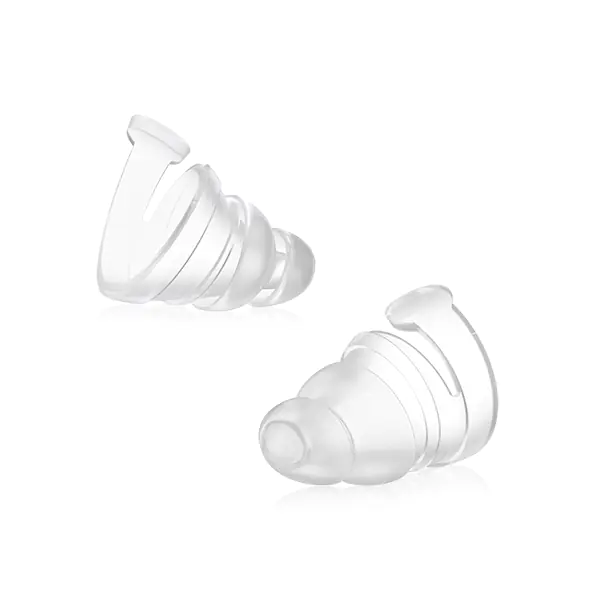
For most festival-goers, our Music SoundPRO festival earplugs are the pair we recommend. They are a passive 2-lamella earplug made from medical-grade silicone, rated SNR 24 dB, transparent so they are almost invisible in the ear, and reusable up to 100 times for £29.95 a pair.
It is worth being straight about how they work, because there is a lot of marketing nonsense in this category. Music SoundPRO is a passive plug, which means under EN 352-2 the attenuation rises with frequency: it trims roughly 22 dB in the low and mid range and more in the very high treble. It does not reduce every pitch by an identical amount, and it is not a flat or “hi-fi” filter that leaves the music untouched. What it does is bring the overall volume down to a safer level so you still hear the music clearly, with far less of the muffle you get from foam. For the difference between the ratings you see on packaging, our guide to what SNR rating means for festival protection is the place to start.
For festivals specifically, the practical details earn their place. The aluminium case with a rubber ring seal clips to a belt loop or bag on a keyring, so the plugs survive a muddy field and you are not hunting for them in a pocket. They are German-tested and independently certified at 24 dB, washable with mild soap, and backed by our 40-day money-back guarantee, so a first festival is a low-risk way to try them. The same Music SoundPRO has been used and reviewed by working artists, including techno DJ UMEK, who relies on hearing protection night after night.
Our festival earplugs


How much noise reduction do you actually need at a festival?
The right amount of attenuation brings the loudest part of your day down to roughly 80 to 85 dB at the ear, which is the level you can sustain for hours. With Music SoundPRO at SNR 24 dB, a 105 dB main stage drops to around 81 dB at your ear, and even a 110 dB front-of-stage position lands near 86 dB, far safer than going in unprotected.
SNR, or Single Number Rating, is the European measure of how many decibels a plug removes under test conditions. Real-world reduction is usually a little lower than the lab figure because no plug seals perfectly, which is another reason to err towards a higher rating rather than a token one. The table shows roughly where you land at different spots on a festival site with a 24 dB plug.
| Where you are standing | Typical level | Level with SNR 24 dB at the ear | Verdict |
|---|---|---|---|
| Back of an outdoor crowd | ~95 dB | ~71 dB | Comfortable for the full day |
| Mid-crowd, main stage | ~105 dB | ~81 dB | Safe for hours of listening |
| Front rows near the PA | ~110-115 dB | ~86-91 dB | Protected, but take breaks |
If you spend most of your time near the front or you are at a multi-day event, a 24 dB plug gives you the headroom to enjoy it without burning through your safe dose in the first hour.
Which earplugs suit your kind of festival-goer?
The right setup depends on how close you stand and how many days you are there, but one pair of SNR 24 dB reusable earplugs covers the large majority of festival-goers, from a casual day-tripper to a multi-day camper. The differences are mostly about how you use them, not which pair you buy.
If you are a casual day-tripper who drifts around the mid-crowd, a 24 dB plug is more than enough, and a single pair will see you through several seasons of one-day events. Keep them in for the headline sets you care about most, when the levels and the crowd density both peak.
If you live at the front rail or on the bass-heavy dance stages, you sit in the highest sustained levels on site, often 110 dB or more for hours. Here the plugs need to stay in continuously rather than coming out between drops, and a short break each hour matters even more. The 24 dB rating still does the job, it just has more work to do.
Multi-day campers face the cumulative problem head on, because ears do not fully recover overnight when the next day starts at noon. A reusable plug you can wash between days, kept safe in its case, is far more practical than rationing a bag of disposable foam. And if you are actually working the event, as a performing musician, crew member or vendor, you are exposed all day every day, so a precise seal counts. Our guide to the best earplugs for musicians and performers covers that heavier-use case in detail.
How do earplugs compare to noise-cancelling headphones at a festival?
Noise-cancelling headphones are built to reduce steady background hum, not the sudden high-energy peaks of live music, and they are bulky, battery-dependent and easily knocked in a crowd, which is why compact earplugs remain the practical choice for a festival. The technology and the setting are a poor match.
Active noise cancellation works by generating a counter-signal against constant, low-frequency sound, the kind you get from a plane engine or a train carriage. Live music is dynamic and unpredictable, so the cancellation cannot keep up with fast transients, and over-ear cups also trap heat across an 8 to 12 hour day in a field. Add the risk of loss or damage in a packed crowd and the case for headphones falls apart for general festival use.
Headphones do have a place in the quieter corners of a site, like a seated chill-out area or the journey home. But in the crowd, a passive earplug with no battery, no bulk and a pocketable case is the more reliable way to keep your hearing safe while you move around.
Will festival earplugs ruin the music?
No, and this is the worry that stops most people from wearing protection at all. A good passive silicone earplug turns the whole performance down like a volume knob rather than smothering it, so vocals, melody and rhythm all stay recognisable, just at a safer level. The bass you feel in your chest is still there.
The honest detail is that a passive plug does take a little more off the highest frequencies than the lows, so the very top end is gentler. In practice that is a world away from the thick, sealed-off muffle of foam, and most people stop noticing within a song or two. The trade-off festival-goers describe online is almost always the same: a small change in tone in exchange for hearing the headliner clearly and waking up without ringing ears.
If anything, many people find they hear the set better with plugs in, because the sound stops distorting and overloading the ear at extreme volume. Taking the edge off the loudest peaks can make a wall of noise resolve back into actual music.
How do you get a comfortable, secure fit for a long day?
Comfort over a long day comes from a low-profile plug that sits flush in the ear canal rather than pressing or sticking out. Music SoundPRO uses a universal-fit 2-lamella silicone design, so it suits most ears straight out of the case without a moulding appointment, a fitting fee, or a wait for a lab to make a custom pair.
Custom-moulded plugs do exist and can fit beautifully, but they are expensive, slow to order, and overkill for someone who goes to a handful of events a year. For festival use, a well-designed universal plug is comfortable enough to forget you are wearing it. If you want a tailored seal without the moulding process, our AR KI TECH fit scanning technology uses augmented reality to match you to the right size, which is part of how we keep returns down to around 3 percent.
To get the seal right on the day, pull the top of your ear up and back, insert the plug, and hold it for a few seconds. The crowd should sound noticeably quieter and a touch deeper. If it still sounds open and loud, the plug is not seated, so reinsert it rather than pushing it harder.
What about protecting children at festivals?
Children are more vulnerable to loud sound than adults because their ear canals are smaller and the same volume hits them harder, so a family-friendly festival still needs a plan for young ears. Small adult plugs are not a substitute for protection sized and rated for children. Our guide to hearing protection for children at festivals covers the right options by age, including earmuffs for toddlers who cannot yet manage earplugs.
How should you protect your hearing during and after the festival?
Earplugs do most of the work, but a few habits stretch their benefit further. Stand back from the PA stacks where you can, take a 10 to 15 minute quieter break each hour to let your ears recover, and keep the plugs in for the whole set rather than removing them between songs.
Afterwards, give your ears a genuine rest. Keep the volume low for a day or two, avoid stacking another loud night straight on top, and pay attention to any ringing or muffled feeling. According to the American Academy of Otolaryngology on noise-induced hearing loss, symptoms that linger beyond a couple of days are worth getting checked, because early signs are the moment to act rather than ignore.
Build protection into your festival kit the same way you pack sun cream and a water bottle. The point is not to dampen the experience, it is to make sure you can keep enjoying live music for decades, not just this summer.
Final word: enjoy the festival, keep your hearing
A festival day puts your ears under more strain than almost anything else you will do all year, and the damage is cumulative, silent until it is permanent, and completely preventable. The fix is small enough to fit on a keyring.
Reusable silicone earplugs rated SNR 24 dB let you stay in the crowd for the whole set, keep the music clear, and walk out without the ringing that used to feel like part of the deal. They cost £29.95, last up to 100 uses, and come with a 40-day money-back guarantee, so trying them this season costs you nothing if they are not for you. Find your pair, pack the case, and protect the hearing you will want for every festival after this one.

His connection to hearing protection stems from personal experience with sound sensitivity during live events and work in noisy environments, an issue that made him more aware of the long-term risks of unmanaged noise exposure. Today, as both a communicator and a user of BOLLSEN products, he is passionate about raising awareness around the importance of proactive hearing care.
At BOLLSEN, he develops data-driven marketing campaigns, writes SEO-focused articles, and manages communication channels that connect customers with practical knowledge about hearing protection. His work ensures that BOLLSEN’s message—prioritizing health, performance, and sustainability reaches a global audience in an engaging and trustworthy way.
Passionate about writing since childhood, Timotej combines creativity with a strong analytical approach, continuously testing new ideas in digital marketing, performance advertising, and social media. He believes in learning through innovation and collaboration, balancing leadership with openness to new perspectives.
Beyond his professional role, Timotej is committed to a healthy lifestyle and finds inspiration in fitness, sports, and quality time with friends. His personal passion for well-being aligns with BOLLSEN’s core values, making his work not only a career but also a cause he deeply believes in.
Comments are closed.