
⏱️ Estimated reading time: 10 min

Key Takeaways
If you have ever finished a rehearsal with your ears ringing, you already know why earplugs for guitarists are worth taking seriously. A 100W stack at one metre hits around 115 dB, and most guitarists only start wearing protection after a tinnitus scare rather than before one.
At BOLLSEN, we are a German-tested hearing protection company trusted by over 1,000,000 people, and we hear the same worry from guitar players again and again. They resist earplugs out of fear that wearing them will distort how they hear the music, or that they will lose the instrument in the mix.
That fear is fair, and this guide answers it honestly. We will walk through how loud your rig actually is at playing position, the protection level that fits guitar, and what changes when you put plugs in. You still hear your guitar, just at a safer volume.
How loud is a guitar amp, really?
A combo amp on stage typically runs at 90–100 dB, while a 100W stack reaches roughly 115 dB at one metre and a stage monitor wedge aimed at you sits around 95–105 dB. All three sit above the level where prolonged exposure starts to damage hearing.
The risk is about time as much as volume. According to CDC and NIOSH guidance, 85 dB(A) is safe for up to eight hours, and the safe exposure time halves with every extra 3 dB. At 91 dB that drops to two hours, and at around 100 dB you are into minutes, not hours.

An acoustic guitar at one metre measures about 80–90 dB, which is lower risk on its own. Once you add drums, a bassist, or your own amplified rig, even acoustic players cross into territory worth protecting against.
Do guitarists really need hearing protection?
Yes. Sustained sound above 85 dB damages the cochlear hair cells in your inner ear, and unlike skin these cells do not grow back, so the loss is permanent and starts at high frequencies first. Guitarists routinely play well above this level.
The numbers in your community are stark. A review covering 4,618 musicians found 38.6% noise-induced hearing loss, rising to 45% in student musicians, with 78% of audiometric notches landing at 6 kHz. The mechanism is documented by the NIDCD on noise-induced hearing loss, which confirms high-frequency hair-cell damage comes first.
For most guitarists, the thing that finally prompts action is tinnitus, the ringing that lingers after a loud gig. The point of protection is to prevent that scare before it happens, not to react once your ears already ring.
How much does regular band rehearsal add up?
Regular rehearsal is the hidden risk because exposure accumulates as a daily personal noise dose (LEP,d). Three two-hour band practices a week at 95–100 dB is a far heavier load than the occasional gig, yet it rarely feels dangerous in the moment.
The WHO recreational sound limit sets a reference of 40 hours per week at no more than 80 dB. A rehearsal room easily blows past that in a single evening, which is why a casual hobby band can carry the same cumulative risk as a touring act.
This is exactly where earplugs for music earn their place, by lowering every session by a fixed amount so the weekly dose stays inside safe limits.
Can you still hear your amp and play in tune with earplugs in?
Yes, you still clearly hear the guitar, just quieter and safer. A passive silicone plug brings the whole sound down by roughly 24 dB, so you keep tuning and playing by ear at a level your inner ear can tolerate for far longer.
This is the single most-asked question among guitarists, who play and tune by ear and fear losing the instrument. The honest answer is that the guitar does not disappear, it simply drops to a safer volume, and after a few minutes your ears adjust to the new reference level.
Will earplugs muffle my guitar tone?
A passive earplug does change the sound slightly, attenuating high frequencies most: our EN 352-2 data shows roughly 22 dB in the lows and mids climbing to 35 dB at 8 kHz. So this is not a perfectly flat or tonally faithful filter, and we will not pretend it is.
What it does do is bring the whole guitar down to a safer level while keeping it clearly audible. That is the honest trade-off, and it is a world away from cheap foam, which many players say makes everything sound distorted and really muddy. Medical-grade silicone feels far less muffled in comparison.
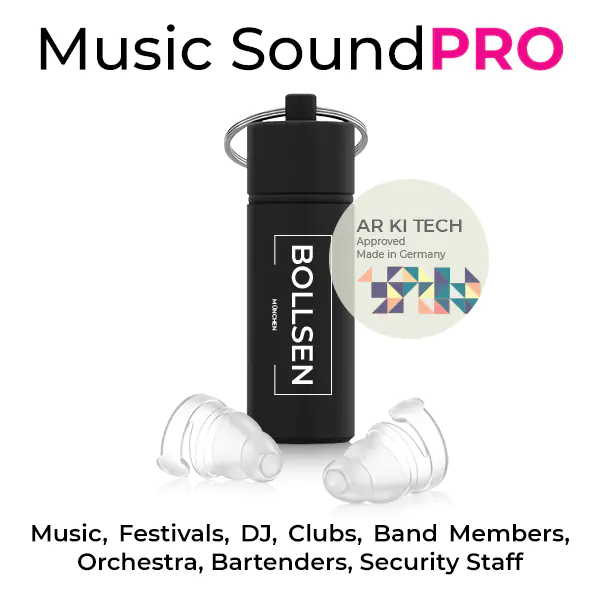
Our Music SoundPRO earplugs with SNR 24 dB are transparent silicone plugs built for exactly this, reducing concert and rehearsal volume so you can play longer without your ears paying for it. Brand partner DJ UMEK uses them for the same reason.
What SNR should guitar earplugs be?
An SNR of around 24 dB suits most guitar settings, moving you from minutes of safe exposure into hours. The table below shows common guitar sources at playing position against the level you reach once a 24 dB plug is in.
| Guitar source (at playing position) | Typical level | Level with SNR 24 dB plug | Risk shift |
|---|---|---|---|
| Acoustic guitar at 1 m | 80–90 dB | ≈ 56–66 dB | Comfortable, all-day safe |
| Combo amp on stage | 90–100 dB | ≈ 66–76 dB | Minutes to hours of headroom |
| Stage monitor wedge | 95–105 dB | ≈ 71–81 dB | Into the safe-exposure window |
| 100W stack at 1 m | ≈ 115 dB | ≈ 91 dB | Seconds of risk to ~2 hours |
A correctly fitted plug keeps speech and your bandmates understandable, so you can still take cues during a song. If you are unsure about fit, our AR KI TECH ear measurement uses two photos of your ears to ship the right size and improve the seal.


How do you fit and look after silicone musician earplugs?
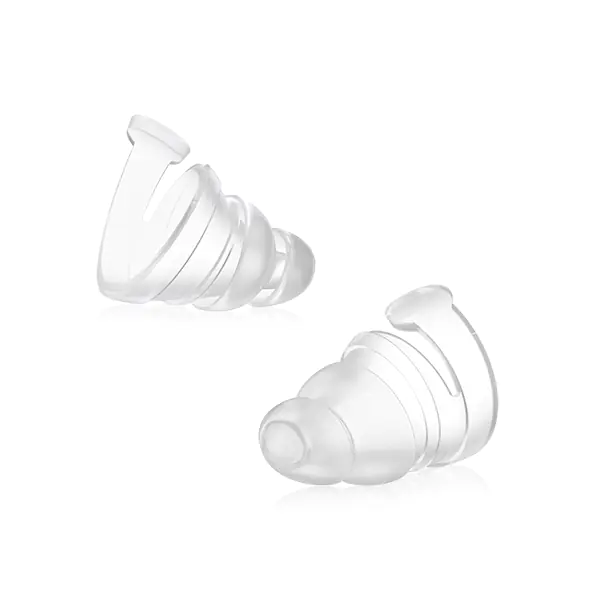
Insert the 2-lamella silicone plug with a gentle twist until it sits flush in the ear canal, then check the seal by speaking, your own voice should sound a little fuller. A good seal is what delivers the rated 24 dB, so a loose fit quietly costs you protection.
Looking after them is simple. Rinse with water and mild soap, let them dry, and store them in the case, which keeps a pair usable for up to 100 uses. That reusability is also why silicone beats a pocketful of disposable foam over a year of gigs.
For the wider picture across instruments and venues, our guide to the best earplugs for musicians covers drummers, singers, and sound engineers alongside guitar players.
Protecting your hearing as a guitarist comes down to three honest points. Your rig is louder than it feels, regular rehearsal adds up faster than the occasional gig, and the right plug lets you keep playing by ear at a safer volume rather than muffling you into silence. The American Academy of Audiology on noise-induced hearing loss backs the same message: the damage is permanent, but it is almost entirely preventable. Treat protection as part of your kit, the same as a tuner or spare strings, and you get to keep both your ears and your tone for the long run. Find your fit and protect the hearing your playing depends on.

His connection to hearing protection stems from personal experience with sound sensitivity during live events and work in noisy environments, an issue that made him more aware of the long-term risks of unmanaged noise exposure. Today, as both a communicator and a user of BOLLSEN products, he is passionate about raising awareness around the importance of proactive hearing care.
At BOLLSEN, he develops data-driven marketing campaigns, writes SEO-focused articles, and manages communication channels that connect customers with practical knowledge about hearing protection. His work ensures that BOLLSEN’s message—prioritizing health, performance, and sustainability reaches a global audience in an engaging and trustworthy way.
Passionate about writing since childhood, Timotej combines creativity with a strong analytical approach, continuously testing new ideas in digital marketing, performance advertising, and social media. He believes in learning through innovation and collaboration, balancing leadership with openness to new perspectives.
Beyond his professional role, Timotej is committed to a healthy lifestyle and finds inspiration in fitness, sports, and quality time with friends. His personal passion for well-being aligns with BOLLSEN’s core values, making his work not only a career but also a cause he deeply believes in.