
⏱️ Estimated reading time: 14 min

Key Takeaways
How loud is motorcycle wind noise? Measured at the ear inside a helmet at a steady 70 mph, it runs between 97 and 104 dB(A), and on-road studies have logged peaks above 109 dB(A). Riders on forums describe it as sounding like a jet once they pass 50 mph, which is closer to the physics than most helmet reviews get.
The noise is not your engine. It is turbulence at the edge of your windscreen’s wake striking the helmet, and it climbs with road speed whatever you ride. Because it arrives as a steady roar rather than a stab of pain, most riders never file it under hazard until their ears ring after a motorway run.
At Bollsen, a family-owned hearing protection company whose silicone earplugs are German-tested, independently certified 24 dB, our earplugs for motorcycle riding exist because wind turbulence, not engine note, drives the exposure. This article sets out what the published measurements actually say, speed by speed, with each figure traced to the study that produced it.
How loud is motorcycle wind noise at 70 mph?
At a steady 70 mph, wind noise inside a motorcycle helmet measures 97 to 104 dB(A) at the rider’s ear, based on wind tunnel testing of 27 helmet samples by Lower and colleagues at the Institute of Sound and Vibration Research. At around 50 mph, the same programme recorded 90 to 99 dB(A).
Those numbers came from two BMW motorcycles in a controlled wind tunnel under Home Office funding, which makes them the most carefully conditioned figures available. On-road work at the University of Ulster later found a wider span, from 83.6 dB(A) at the quiet end to 109.4 dB(A) at the loud end. The two data sets agree on the shape of the curve even where they differ on the exact value.
The measurement programme behind the wind tunnel figures is documented in the ISVR motorcycle helmet noise project, which covered 13 helmet types across two machines.
| Speed | Measured level at the ear | Source study | What it means for exposure |
|---|---|---|---|
| 25 mph / 40 km/h | 63 to 90 dB(A) in town riding | Ross 1989, Ann Occup Hyg | Mostly under the 85 dB(A) point at which workplace protection becomes mandatory |
| 40 mph / 64 km/h | about 90 dB(A) | Binnington, McCombe & Harris 1993, Br J Audiol | Wind has overtaken the engine and the dose starts to accumulate |
| 50 mph / 80 km/h | 90 to 99 dB(A) | Lower et al. 1994, ISVR wind tunnel | At 99 dB(A) the safe unprotected time is counted in minutes, not hours |
| 56 mph / 90 km/h | above 90 dB(A) even in the quietest helmet tested | Jordan et al. 2003, University of Ulster | No helmet on test held the rider below 90 dB(A) at this speed |
| 70 mph / 113 km/h | 97 to 104 dB(A) | Lower et al. 1994 | Motorway cruising sits 12 to 19 dB above the 85 dB(A) action value |
| 100 mph / 161 km/h | up to 112 dB(A) | Binnington et al. 1993 | Roughly 27 dB above the action value, which is a very short safe dose |
Read the table as bands rather than fixed points. Your machine, screen, helmet and posture all move the figure, which is why the studies report ranges instead of single values.
Is it the wind or the engine that damages a rider’s hearing?
The wind, not the engine. Above roughly 35 to 45 mph (60 to 70 km/h), aerodynamic noise at the rider’s ear overtakes engine and exhaust noise and becomes the dominant exposure, and it keeps climbing with speed long after the engine has settled into cruising revs.
Lower and colleagues traced the source precisely. It is not smooth airflow over the shell, but turbulence at the edge of the windscreen’s wake striking the helmet as the rider punches through it. A taller screen can move that shear line straight onto your head.
Kerbside measurements mislead for exactly this reason. A bike measured from the pavement is being judged on its exhaust, which is a different quantity from the level at the rider’s ear sitting behind a screen at 70 mph.
Is wind noise high-frequency hiss or something lower?
Lower than almost every gear review assumes. Noise under a helmet peaks at 250 to 500 Hz, a cavity resonance in the low-mid range, and the hearing loss measured in riders concentrates at 0.25 to 2 kHz rather than the 4 kHz notch typical of industrial noise damage.
McCombe set out that spectral picture in the Journal of the Royal Society of Medicine review of hearing loss in motorcyclists, alongside the fatigue, headache and disequilibrium that riders report after long, loud days. The frequency signature matters because it tells you where protection has to work.
Riders are right to be sceptical of plugs sold as filters that remove only the wind and leave everything else untouched. Passive silicone earplugs do not behave that way, and their attenuation rises with frequency rather than staying flat.
What is measurable is more useful than the marketing claim. A plug rated SNR 24 dB under EN 352-2 attenuates 21.8 dB at 250 Hz and 22.1 dB at 500 Hz, which lands directly on the wind noise peak. You still hear the road, just quieter.
Can riding a motorcycle cause hearing loss?
Yes, and it has been measured in riders rather than inferred from noise levels. McCombe and colleagues screened 246 motorcyclists against controls from the MRC National Study of Hearing and found rider hearing 3.7 dB worse at 0.5 kHz and 3.6 dB worse at 1 kHz.
That deficit is permanent threshold shift, the part that does not recover. The full cohort study is on PubMed as Hearing loss and motorcyclists, published in the Journal of Laryngology and Otology in 1995.
Noise-induced hearing loss builds quietly over years of repeated exposure, and our explainer on what hearing loss is covers the cochlear damage mechanism in more depth than this page needs. Riders also ask, can riding a motorcycle cause tinnitus, and the exposure levels above are more than sufficient to trigger it.
Tinnitus UK puts regular or occasional hearing protection use among British riders at just 29%, which leaves roughly 994,000 riders taking the full dose.
How long can you ride before wind noise damages your hearing?
Less time than most riders expect. Eighteen riders tested after one hour at a steady 80 mph showed a significant threshold shift at 0.25, 0.5, 1 and 2 kHz, greatest at 1 kHz with a mean temporary threshold shift of 10.3 dB.
Dose is what does the damage, and dose is speed plus time. Every 3 dB increase halves the time you can safely absorb, so a 30-minute run at 100 dB(A) costs more than a two-hour potter at 88 dB(A). Ross measured open-road exposures of up to 105 dB(A), at which 15 minutes already exceeds the 90 dB(A) eight-hour maximum that was the standard in force at the time of that study.

The UK thresholds come from the HSE Control of Noise at Work Regulations 2005: 80 dB(A) lower action value, 85 dB(A) upper action value where protection becomes mandatory, and an 87 dB(A) exposure limit at the ear. A 70 mph commute clears all three.
Riders describe the pattern themselves without knowing its name. Twenty minutes on the motorway, then ringing afterwards, is temporary threshold shift. Repeat it often enough and the temporary shift stops going away.
Do professional riders exceed the legal noise limits?
Comfortably, and by a margin no workplace would accept indoors. Riders who work on a motorcycle accumulate daily personal exposures far above the 87 dB(A) limit value, with police riders measured at 109.4 dB LEP,d in the University of Ulster study.
The same paper projected what those doses do across a working life. The figures below are the proportion of riders expected to exceed a 30 dB hearing loss after 45 years in the job.
| Occupational rider | Daily exposure (LEP,d) | Exceeding 30 dB hearing loss after 45 years |
|---|---|---|
| Police rider | 109.4 dB | 68% |
| Paramedic | 106.0 dB | 52% |
| Breakdown patrol | 101.6 dB | 36% |
| Taxi bike | 100.4 dB | 30% |
| Tour guide | 96.1 dB | 16% |
| Courier | 93.6 dB | 12% |
| Driving instructor | 92.3 dB | 8% |
For police riders the projection is 35% after 25 years and 44% after 30. The full paper is published as Jordan et al. on occupational motorcyclist noise exposure from ICBEN 2003. A weekend rider covering 6,000 miles a year is on a slower version of the same curve.
Does a quieter helmet solve the problem?
No helmet yet tested brings the level at the ear down to a safe figure at motorway speed. The quietest helmet in the Ulster on-road study still exceeded 90 dB(A) above 90 km/h (56 mph), and the spread between helmets on the same bike at the same speed was only 7 to 10 dB.
There is a stranger finding buried in the ISVR work. A helmet that measured quietest on one motorcycle became the noisiest on another, so helmet and machine behave as a pair rather than as independent parts. Riders spending £400 to £700 chasing a quiet lid are buying into a ranking that does not survive a change of bike.
Sealing helps at the margins, with visor sealing worth 5 to 8 dB and neck sealing up to 6 dB in the ISVR tests, though neither removes the hazard. Riders reasonably ask, does a helmet protect your hearing, and the honest answer is that it improves on no helmet at all without ever becoming hearing protection.
Taking the helmet off is worse, not better. Binnington and colleagues found a bareheaded rider is 18 dB(A) louder at the ear above 10 mph, which is a large penalty in exchange for feeling the air.
Why do published motorcycle noise figures disagree so much?
Because the level at your ear depends on the machine, the screen, the helmet and your posture, not on speed alone. On-road measurements span 83.6 to 109.4 dB(A), and that range reflects real variation between riders rather than sloppy measurement.
Fairings work against you here. The Ulster on-road data put faired bikes 1.5 dB(A) louder on average than naked ones, and the rate of increase was 2.0 dB(A) per 10 km/h on a roadster against 2.5 dB(A) per 10 km/h on a faired machine. The screen that keeps the weather off your chest is generating the wake that hits your helmet.
Growth with speed is predictable even when the absolute level is not. Binnington and colleagues found the level rises linearly with the logarithm of speed, from roughly 90 dB(A) at 40 mph to 112 dB(A) at 100 mph. Treat any single quoted decibel figure with suspicion, and treat the curve as reliable.
At what speed do you need earplugs on a motorcycle?
From roughly 40 mph upwards, where measured levels at the ear reach about 90 dB(A) and every extra 3 dB halves the time you can absorb safely. That is the point at which riders start asking which are the best motorcycle earplugs for wind noise.
Below that speed the case is genuinely weaker. Binnington and colleagues concluded that earplugs are not required in the urban environment, where the helmet alone already improves detection of warning signals and levels sit closer to the 63 to 90 dB(A) town-riding band Ross recorded.
At Bollsen we make Moto+, a low-profile reusable silicone earplug rated SNR 24 dB under EN 352-2, with no protruding stem so it sits flush inside the ear canal under a full-face helmet. It cuts the wind roar without pretending to be selective about it.



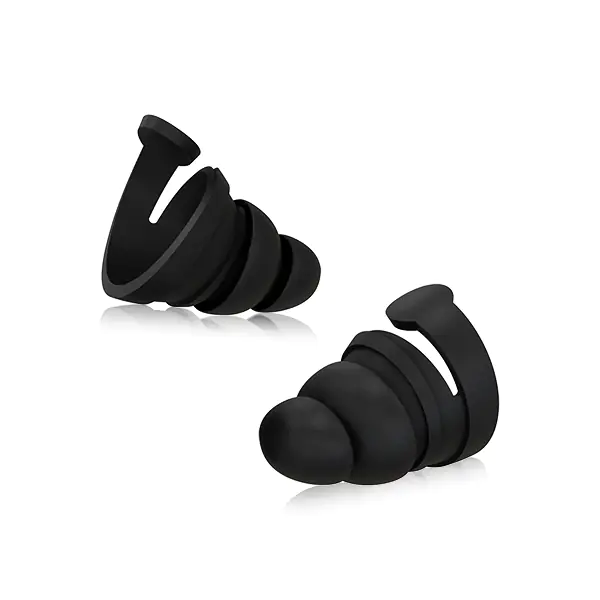
Riders who want the plug-by-plug comparison, covering foam, filtered and custom-moulded options, will find our guide to the best motorcycle earplugs for wind noise works through fit, SNR ratings and what suits each riding style and mileage.
Riders who mostly cruise at motorway speed and want a plug designed to sit flush under a full-face helmet can weigh Moto+ (SNR 24 dB) against the attenuation figures at 250 and 500 Hz set out earlier in this article.
One rider’s account sums up the stakes better than any decibel figure. He toured Europe at 21, lost his earplugs, rode a few loud days without them, and a year later still hears ringing when he tries to sleep.
The measurements are unusually consistent for consumer safety data. Wind noise overtakes your engine at around 40 mph, reaches 97 to 104 dB(A) at 70 mph, peaks in the 250 to 500 Hz band where passive silicone attenuates roughly 22 dB, and produces measurable threshold shift after a single hour at speed.
None of that depends on which bike you ride or how good your helmet is. It depends on how fast you go and how long you stay there. Work out the speed you actually spend your miles at, look it up in the table above, and decide from the number rather than from how loud it feels.

His connection to hearing protection stems from personal experience with sound sensitivity during live events and work in noisy environments, an issue that made him more aware of the long-term risks of unmanaged noise exposure. Today, as both a communicator and a user of BOLLSEN products, he is passionate about raising awareness around the importance of proactive hearing care.
At BOLLSEN, he develops data-driven marketing campaigns, writes SEO-focused articles, and manages communication channels that connect customers with practical knowledge about hearing protection. His work ensures that BOLLSEN’s message—prioritizing health, performance, and sustainability reaches a global audience in an engaging and trustworthy way.
Passionate about writing since childhood, Timotej combines creativity with a strong analytical approach, continuously testing new ideas in digital marketing, performance advertising, and social media. He believes in learning through innovation and collaboration, balancing leadership with openness to new perspectives.
Beyond his professional role, Timotej is committed to a healthy lifestyle and finds inspiration in fitness, sports, and quality time with friends. His personal passion for well-being aligns with BOLLSEN’s core values, making his work not only a career but also a cause he deeply believes in.