
⏱️ Estimated reading time: 13 min

Key Takeaways
Search for the best earplugs for concerts and you will get a ranked list of products within two scrolls. Knowing how to choose earplugs for concerts is a different problem, and the ranked list does not solve it. A Tuesday rehearsal, a club night on Friday and eight hours in a festival field are three separate exposure problems, and the pair that handles one can be the wrong call for another.
One r/livesound thread put the real question plainly. “I think 25 dB is the minimum I should consider, but I don’t know whether 30 dB is necessary. I want concerts to sound good, but my main priority is protecting my hearing.” That person has already accepted they need protection. They are stuck on how much, and no product list answers that.
At Bollsen we have made reusable medical-grade silicone hearing protection since 2016, tested and certified by an independent German lab, and the question we hear most about earplugs for music is some version of that one.
Work through the six questions below in order and the answer falls out at the end. Every attenuation rating, silicone body and travel case we ship across our earplugs for music range answers that same venue-first sequence, from 85 dB rehearsal rooms to 115 dB festival fields.
Why should the venue decide your earplugs?
A nightclub runs at about 100 dB, which the RNID says is safe for just 15 minutes without protection, while a live gig sits nearer 110 dB and a festival front row can reach 120 dB, so the venue sets how much attenuation you need long before any product does.
Those are not small gaps. The RNID puts the safe daily baseline at 85 dB for eight hours, and the World Health Organization went further in 2022 with a global standard capping venues at 100 dB(A) on average. Most rooms you actually go to sit above that line.
| Venue | Typical sound level | Safe time with no protection | Level behind SNR 24 dB earplugs |
|---|---|---|---|
| Rehearsal room | 85–95 dB | 8 hours at 85 dB, about 45 minutes at 95 dB | Roughly 61–71 dB. More protection than the room strictly demands |
| Bar or nightclub | 100–112 dB | 15 minutes at 100 dB, under a minute at 112 dB | Roughly 76–88 dB. Well inside limits at the lower end, about 4 hours at the top |
| Live gig | Around 110 dB | Under 2 minutes | Roughly 86 dB. Buys you hours instead of minutes |
| Festival, front of stage | 110–120 dB | Seconds | Roughly 86–96 dB. A full day still needs breaks away from the stacks |
Read that last column as a laboratory estimate rather than a promise. SNR is measured on trained subjects with a textbook seal, and your night out is not a lab. That gap is the whole reason step three exists.
Sound pressure level shifts constantly between the support act’s soundcheck and the headliner’s encore, which is why our breakdown of how loud concerts actually get maps the decibel range by venue type and by where you stand in the crowd.
How long will you be exposed to it?
Sound dose is level multiplied by time, and every 3 dB increase halves the time you can safely take it, which means 15 minutes at 100 dB loads your ears with the same dose an industrial worker absorbs across a full 8-hour day at 85 dB.
That 3 dB exchange rate is why a 30-minute support slot and a three-hour club night are not the same decision. The RNID gives a field test that needs no equipment. If you have to shout to be understood by someone two metres away, the level is already dangerous.
There is a second case worth separating out. If you work the room rather than visit it, the Control of Noise at Work Regulations 2005 have applied to the UK music and entertainment sector since April 2008, with a lower action value of 80 dB(A) and an exposure limit of 87 dB(A). Bar staff, engineers and touring crew accumulate dose across every shift, not just the good gigs.
Will your earplugs actually seal?
The World Health Organization puts real-world earplug attenuation at 5 to 45 dB depending on the type and on whether they are inserted correctly, a 40 dB spread that is far wider than the gap between any two ratings on the market.
Sit with that figure for a second. Every argument about 20 dB versus 25 dB is a debate over five decibels, while the WHO’s own attenuation range for correctly inserted earplugs swings by forty. Fit is not criterion three. It is criterion one, and most buying guides have it in the wrong order.

Gig-goers already know this in their bones, they just describe it as a retention problem. One r/Metalcore poster wanted plugs that “don’t fall out even when in the pit” because “the ones I had kept falling out to the point I lost them last night at a concert”. A plug on the floor of a venue attenuates nothing at all.
Test the seal with your own voice. Insert the plug, hum or talk, and listen for your voice going deeper and fuller as it starts resonating in a closed canal. If it sounds the same as it did before, you have inserted the plug without sealing it, and your 24 dB is closer to 5. Sizing is where most of that goes wrong, which is why our AR KI TECH ear measurement uses two photos of your ears to work out the size before shipping, and cuts our return rate to 3%.
What should concert earplugs be made of?
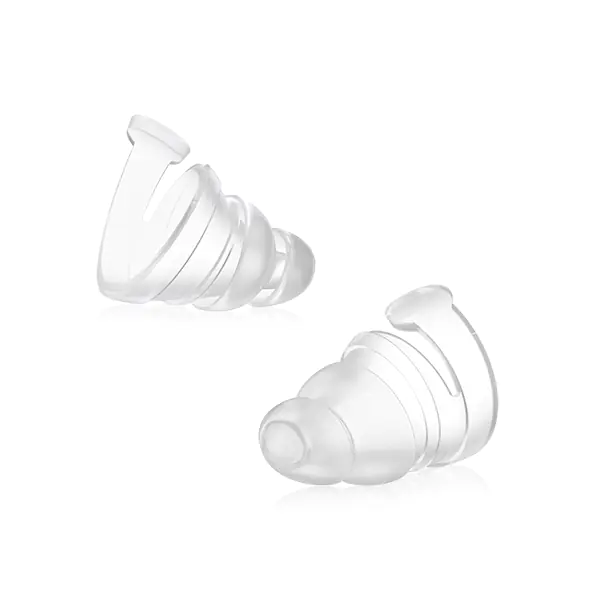
Medical-grade silicone in a 2-lamella conical shape seals the canal with two flexible flanges rather than expanding to fill it the way foam does, which is why silicone tends to publish a lower attenuation figure but hold it far more consistently across a four-hour night.
Foam rates well on paper and then derates hard in the field, because it only reaches its lab number when it is rolled thin, inserted deep and left to expand undisturbed. Nobody does that in a queue for the bar. Foam also loosens as it warms, which is exactly when you stop noticing that it has.
Silicone lamellae give you a seal you can reseat in two seconds between songs, and the case for why music earplugs beat foam for concerts comes down to that repeatability across a night rather than to any single decibel figure on the packet.
Fit type is the other fork here. A universal silicone plug is sized off your canal, while a custom mould is cast from an impression of it, and for occasional gig-goers the universal option is usually enough. Cost, lead time and how many nights a year you are exposed all shift that answer, so our comparison of custom vs universal earplugs works through where each one earns its money.
How many times will you use them?
A reusable medical-grade silicone pair is rated for up to 100 uses and washes with water and mild soap, while a foam plug is designed for a single insertion, so the number that matters is cost per gig rather than the number on the packet.
Spread across a hundred nights out, a reusable pair costs a fraction of a pair of foam plugs bought fresh for every gig. That is before you count the pairs you buy at the door because you forgot, which are always the most expensive earplugs you will ever own.
Reusability also decides whether you have them on you at all. A hard aluminium case on a keyring is why our earplugs travel to the gig instead of living in a drawer, and a plug in your pocket at 110 dB beats a better plug at home.
Will earplugs make the music sound muffled?
A 2-lamella silicone earplug brings the overall level down rather than packing the canal with dense foam, so the music reads as quieter instead of buried, but no passive earplug is tonally neutral and EN 352-2 testing shows attenuation rising with frequency.
An r/audiophile thread described the goal exactly. Wearing plugs should mean “things just sound quieter instead of muffled and bassy”. That is what people want, and it is a fair description of silicone against foam, but it is not a claim that any passive plug reproduces the mix untouched.
Our own lab curve makes the point. Music SoundPRO measures 21.9 dB at 63 Hz and climbs to 35.3 dB at 8 kHz, so the highs come down hardest. We would rather tell you that than sell you a fidelity claim the test sheet does not support.
There is a real benefit hiding in that curve. The WHO notes that noise-induced hearing loss damages the high-frequency range first, so a plug that attenuates the highs most is protecting the part of your hearing that fails soonest. Understanding what SNR rating means for concert protection matters more than chasing the biggest number on a box.
Filters are a separate category with a separate physics, and the high-fidelity label gets used loosely online. Our explainer on what high-fidelity earplugs are sets out what an acoustic filter does differently and where the term is being stretched past what the measurements show.
So which earplugs should you choose for concerts?
Only once you have settled the venue, the exposure time, the seal, the material and the reuse count does the pair itself matter, and for most gig-goers a passive silicone earplug rated SNR 24 dB covers rehearsal rooms, clubs and live gigs from one pair.
Our Music SoundPRO is that pair, a transparent silicone plug independently certified in Germany at SNR 24 dB. At a quiet rehearsal it is more protection than the room strictly needs, and that is a trade we would take every time, because you can reseat or remove a plug between songs but you cannot add attenuation you did not bring.


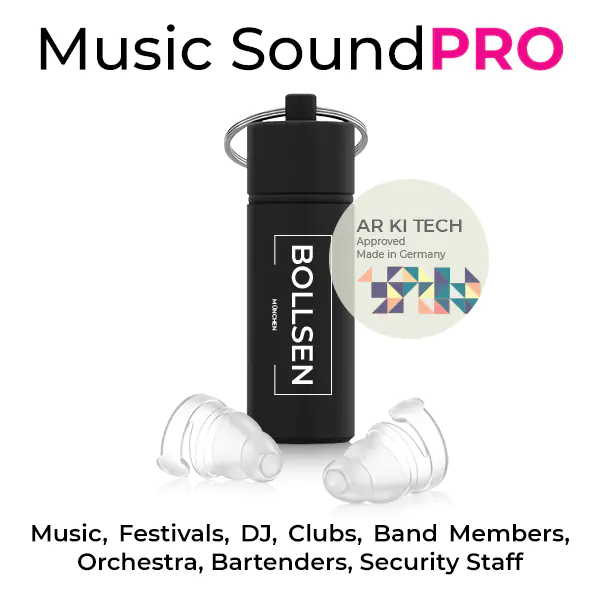
Ranking pairs against each other is a different job from routing the decision, and we keep the two apart on purpose. If you have worked the six steps and want the shortlist with attenuation, fit and case compared side by side, our roundup of the best earplugs for concerts does that job for UK gig-goers who have already decided what they need.
Attenuation curve, sizing, case and the EN 352-2 test sheet all sit on the Music SoundPRO product page, if you want the lab data behind the SNR 24 dB rating before you commit to anything.
The six questions are the whole method. Where you are going sets the level, how long you stay sets the dose, and whether the plug seals decides whether the rating on the box means anything at all. Everything after that is preference.
So you already know the parts that count. A 100 dB club gives you 15 unprotected minutes. A 40 dB swing lives in your fit rather than your rating. And the pair you actually carry beats the pair you researched. Your ears do not recover, so decide once and go enjoy the gig.

His connection to hearing protection stems from personal experience with sound sensitivity during live events and work in noisy environments, an issue that made him more aware of the long-term risks of unmanaged noise exposure. Today, as both a communicator and a user of BOLLSEN products, he is passionate about raising awareness around the importance of proactive hearing care.
At BOLLSEN, he develops data-driven marketing campaigns, writes SEO-focused articles, and manages communication channels that connect customers with practical knowledge about hearing protection. His work ensures that BOLLSEN’s message—prioritizing health, performance, and sustainability reaches a global audience in an engaging and trustworthy way.
Passionate about writing since childhood, Timotej combines creativity with a strong analytical approach, continuously testing new ideas in digital marketing, performance advertising, and social media. He believes in learning through innovation and collaboration, balancing leadership with openness to new perspectives.
Beyond his professional role, Timotej is committed to a healthy lifestyle and finds inspiration in fitness, sports, and quality time with friends. His personal passion for well-being aligns with BOLLSEN’s core values, making his work not only a career but also a cause he deeply believes in.