
⏱️ Estimated reading time: 13 min

Key Takeaways
Water in the ear is, for most people, a temporary inconvenience. A shake of the head, a moment of muffled hearing, and it passes. But for others – people with ear tubes, a perforated eardrum, or a history of swimmer’s ear – the same exposure carries real risk of pain, infection, or damage.
This guide covers both situations: what actually works for everyday swimmers, and what’s necessary when your ear’s natural defences are compromised.
Why Water Enters the Ear So Easily
The ear canal is a short, slightly curved tube roughly 2.5 cm long, ending at the eardrum. It has no valve, no natural seal, and no mechanism that closes during submersion. When you put your head underwater, water pressure pushes directly into the canal.
For a healthy ear, the eardrum acts as a final barrier – water can enter the canal but cannot pass beyond it. The canal also naturally drains when you tilt your head or shake it. In most cases, residual water evaporates within minutes or hours.
The problem arises when:
– The canal doesn’t drain efficiently (common with narrower canals or excess earwax)
– The protective outer skin barrier is disrupted by repeated wetness (the starting point for swimmer’s ear)
– The eardrum itself is perforated or has surgical tubes fitted, removing the natural barrier entirely
Understanding which category you’re in determines how seriously you need to treat ear protection – and which type actually works.
When Water in the Ear Is a Real Problem
For healthy ears: irritation and infection risk
Repeated water exposure softens and breaks down the thin skin lining the ear canal. Over time, this creates small entry points for bacteria – particularly Pseudomonas aeruginosa and Staphylococcus aureus, the organisms responsible for otitis externa (swimmer’s ear). Symptoms typically begin as itching and progress to pain, swelling, and discharge.
Regular swimmers, surfers, and anyone spending extended time in water are at higher cumulative risk, even with healthy eardrums.
For ears with tubes or a perforated eardrum: direct access to the middle ear
Ear tubes (grommets) and perforations remove the eardrum’s barrier function. Water that enters the canal can now pass directly into the middle ear – a cavity that is normally sterile. The result can be middle ear infection (otitis media), which in the short term causes pain and discharge, and in the long term, if repeated, can affect hearing.
People in this group need ear protection reliably, not just occasionally. The standard advice for casual swimmers – “you’ll probably be fine” – does not apply.
If you have a perforated eardrum specifically, there is a dedicated guide on ear protection with a perforated eardrum that covers this situation in full detail.
What Actually Keeps Water Out: The Methods Ranked
1. Swimming-specific earplugs (most effective)
Purpose-made swimming earplugs form a physical seal at the entrance to the ear canal, preventing water from entering in the first place. They are the only method that reliably works in all conditions – surface swimming, submersion, and high-splash activities.
The key word is “swimming-specific.” General-purpose foam earplugs, designed for noise reduction, are not watertight. They absorb water rather than repel it. Using them for swimming gives a false sense of protection.
Silicone vs foam swimming earplugs
Silicone earplugs are the preferred choice for water protection. They mould to the ear canal entrance, create a conforming seal without being pushed deep inside the canal, and do not absorb water. They are reusable, easy to clean, and suitable for children and adults. Soft silicone is also the only material appropriate for people with ear tubes or perforated eardrums, where no pressure or deep insertion should be applied.
Foam earplugs are designed for sound attenuation, not water. They expand inside the canal, which can trap moisture against the eardrum rather than preventing entry. They are not recommended for swimming and should be avoided entirely by anyone with a perforation or ear tubes.
When choosing swimming earplugs, prioritise fit over brand or price. An earplug that fits correctly will seal naturally with minimal discomfort. If water is still entering, the issue is almost always fit – not the product failing.
2. A swim cap – as support, not as protection
A swim cap that covers the ears adds a secondary layer of resistance to water splash. For surface-level swimming, particularly in calm water, it can reduce the volume of water that reaches the ear canal entrance.
It does not, however, create a watertight seal. Water still enters around the edges of the cap, particularly during submersion, turns, and any lateral movement. Relying on a swim cap alone for ear protection is not effective.
The practical use of a swim cap is as a supplementary layer over earplugs – it helps keep them in place and reduces the water they need to block. For people with ear tubes or perforations, this combination (earplugs + cap) is commonly recommended by ENTs for swimming.
3. Fit quality matters more than any other variable
The most common reason swimming earplugs fail is poor fit. An earplug sitting slightly loose – even imperceptibly – will allow water to bypass the seal under pressure. This accounts for the majority of cases where people report that “earplugs didn’t work.”
Signs of poor fit:
– Water enters consistently despite wearing earplugs
– The earplug shifts position during swimming
– One side leaks more than the other (canals are rarely perfectly symmetrical)
– Discomfort or pressure sensation
Children’s ears require child-specific earplugs. Adult earplugs placed in a smaller canal will never seal correctly. If you’re buying for a child, child-specific swimming earplugs are sized for narrower canals.
4. Head position and technique: helpful, not sufficient
Keeping your head above water, minimising submersion, and tilting your head to drain the canal after swimming all reduce exposure. They are worth doing as secondary measures.
They are not a substitute for physical protection. Water enters the ear during any partial submersion, and technique does not create a seal.
5. Improvised solutions: avoid them
Cotton wool, tissue, DIY wax plugs, or other improvised barriers are not watertight, can leave residue in the canal, and can push debris deeper toward the eardrum. For anyone with a perforation or tubes, the risks are considerably higher – any material breaking down inside the canal near a compromised eardrum creates an infection risk.
Specific Situations
Showering
The risk during showering is lower than during swimming – water is not pressurised in the same way and the head is rarely fully submerged. For healthy ears, no special protection is typically needed.
For people with ear tubes, a perforated eardrum, or recent ear surgery, showering does still require care. A soft silicone earplug or a petroleum jelly-coated cotton ball at the canal entrance is commonly recommended by ENTs during recovery. There is more detail on this in the guide to ear protection for showering.
Bathing and bath water
Bath water carries higher bacterial load than chlorinated pool water, making it a meaningful risk for people with open middle ears. For children with grommets, paediatric guidance increasingly supports the use of earplugs in the bath, particularly for prolonged soaks.
Open water: sea and lakes
Open water presents higher microbiological risk than pool water. Saltwater and freshwater each carry different bacterial and fungal profiles. For anyone with a perforated eardrum or ear tubes, open water swimming requires robust protection – purpose-made silicone earplugs plus a cap – and medical clearance is advisable before starting.
Children and Ear Tubes: A Higher Standard
Children who have had grommets fitted are a specific group requiring consistent ear protection during water activities. The evidence on exactly how much protection is necessary is mixed – some large reviews suggest the risk from surface swimming in chlorinated pools is lower than previously thought – but ENT guidance consistently recommends protection as a precaution, particularly for lake and sea swimming.
For parents managing this, the practical question is usually about compliance: children resist earplugs, earplugs fall out, the child is wet and moving fast. Purpose-made children’s earplugs with a correctly fitted design reduce this problem significantly. More detail on this is in the article on what happens if water gets in ears with tubes.
Key Takeaways
- Swimming-specific silicone earplugs are the only reliably effective protection.
- Foam earplugs are not water-resistant and should not be used for swimming.
- Swim caps reduce splash but do not create a watertight seal – use in combination with earplugs.
- Fit determines effectiveness more than brand or price.
- Healthy ears: protection reduces long-term infection risk, especially for regular swimmers.
- Ear tubes or perforated eardrum: protection is not optional – water can directly reach the middle ear.
- Post-surgery: follow ENT guidance specifically; general advice does not apply.
Recommended Products
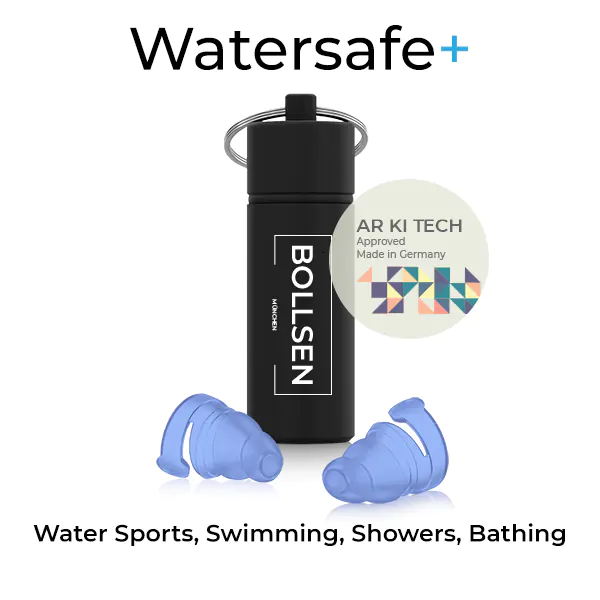
- Watersafe+ Earplugs for Swimming – silicone, moulded fit, adult size
- Kidz+ Children’s Earplugs for Swimming – child-specific canal sizing
Related reading:
– Best ear protection for a perforated eardrum
– Ear protection for showering
– What happens if water gets in ears with ear tubes
– Child ear plugs for swimming



His connection to hearing protection stems from personal experience with sound sensitivity during live events and work in noisy environments, an issue that made him more aware of the long-term risks of unmanaged noise exposure. Today, as both a communicator and a user of BOLLSEN products, he is passionate about raising awareness around the importance of proactive hearing care.
At BOLLSEN, he develops data-driven marketing campaigns, writes SEO-focused articles, and manages communication channels that connect customers with practical knowledge about hearing protection. His work ensures that BOLLSEN’s message—prioritizing health, performance, and sustainability reaches a global audience in an engaging and trustworthy way.
Passionate about writing since childhood, Timotej combines creativity with a strong analytical approach, continuously testing new ideas in digital marketing, performance advertising, and social media. He believes in learning through innovation and collaboration, balancing leadership with openness to new perspectives.
Beyond his professional role, Timotej is committed to a healthy lifestyle and finds inspiration in fitness, sports, and quality time with friends. His personal passion for well-being aligns with BOLLSEN’s core values, making his work not only a career but also a cause he deeply believes in.