
⏱️ Estimated reading time: 16 min

Key Takeaways
If you swim regularly and keep picking up ear infections, you are not alone. Research published in NCBI StatPearls puts the lifetime prevalence of otitis externa (swimmer’s ear) at around 10% of the general population, and regular swimmers face a risk five times higher than non-swimmers. One of the most common complaints in swimming communities is a familiar one: “I get it every single summer without fail. The earplugs I bought just don’t stay in.” The problem is almost never bad luck. It is usually a prevention gap: either no earplug, the wrong earplug, or the right earplug worn incorrectly. At Bollsen, we make earplugs for water and we have helped over 1,000,000 people find the right fit. This guide covers everything you need to build a prevention routine that actually holds.

Why Does Swimmer’s Ear Happen?
Swimmer’s ear develops when water sits in the external ear canal long enough to disrupt cerumen (earwax), the canal’s natural, mildly acidic barrier that inhibits bacterial and fungal growth. According to a 2024 PMC review on otitis externa management, water ingress raises the canal’s pH above its protective range, and once that barrier is compromised, Pseudomonas aeruginosa and Staphylococcus aureus (the two primary pathogens) can colonise the warm, moist environment within 48 hours.
Pool water is a particular culprit. The alkaline chemistry of chlorinated water raises ear canal pH even faster than fresh water, accelerating the disruption of the cerumen barrier. Open water carries its own risks: natural lakes and rivers can contain higher bacterial loads, and swimming in water with poor hygiene ratings directly increases the chance of bacterial colonisation.
The external ear canal epithelium (the skin lining the canal) is thin and easily irritated. Cotton buds, fingernails, and objects inserted to relieve itching cause micro-abrasions that give bacteria a foothold even without prolonged water exposure. This is why the CDC and NHS both emphasise one rule above almost all others: never insert anything into the ear canal to dry or scratch it.
What Is the Full Before, During, and After Prevention Protocol?
Every ranked article on swimmer’s ear prevention offers a scattered list of tips. None of them structures those tips into a coherent routine. The protocol below is built around when each step matters most, so it is easier to follow consistently.
Before You Swim
Insert well-fitted swimming earplugs before you enter the water. A partial fit allows water to seep past the flange and pool against the canal wall, which is arguably worse than no earplug at all since it traps the water in place. Fit is not a minor detail; it is the outcome. A dual-flange design creates two concentric seals, making it far more resistant to displacement during jumps, flip turns, and open-water tumbling.
If you are swimming in outdoor or natural water, check the water quality rating before you go. UK Bathing Water sites are rated by the Environment Agency, and swimming at a Poor-rated location meaningfully increases your pathogen exposure. Earplugs alone do not eliminate that risk; they reduce it.
During Your Swim
Recheck earplug position after any dive, jump, or tumble turn. High-impact entries are the most common cause of earplug displacement. If you feel water in your ear mid-session, pause and reseat the plug before continuing. A swim cap worn over well-fitted earplugs adds a secondary layer of protection, particularly during open-water swims where wave action applies lateral pressure.
After Your Swim
Remove earplugs carefully and tilt your head to each side, gently pulling the outer ear to open the canal and let any residual water drain. If water remains, use a hair dryer on the lowest heat setting held at least 30 cm (12 inches) away from the ear; any closer risks thermal damage to the canal skin.
Apply acidifying drops after every swim: mix one part white vinegar with one part rubbing alcohol and apply 2–3 drops to each ear, then tilt to drain. The acetic acid in the vinegar restores the canal’s natural low pH, and the alcohol accelerates evaporation of residual moisture. Do not use these drops if you have a perforated eardrum, ear tubes (grommets), or an active ear infection, as they must reach an intact canal to be safe.
Does Earplug Fit Actually Change Your Risk?
Well-fitted earplugs create a waterproof seal that prevents water from reaching the canal epithelium entirely, the point at which the pH disruption cascade begins. Poorly fitted earplugs do not just fail to prevent water ingress: the same 2024 PMC paper explicitly notes that ill-fitting earplugs can increase risk by causing micro-abrasions, removing protective cerumen, and trapping contaminated water against the canal wall. Fit is not a comfort preference. It is a clinical variable.
The reason so many swimmers find that earplugs “don’t work” is almost always a fit failure, not a product failure. Single-flange designs often unseat during jumps. Foam earplugs are not designed for water; they absorb moisture rather than repel it. What you need is a waterproof silicone earplug with a dual-flange seal that remains stable under the pressure of impact entries and flip turns.


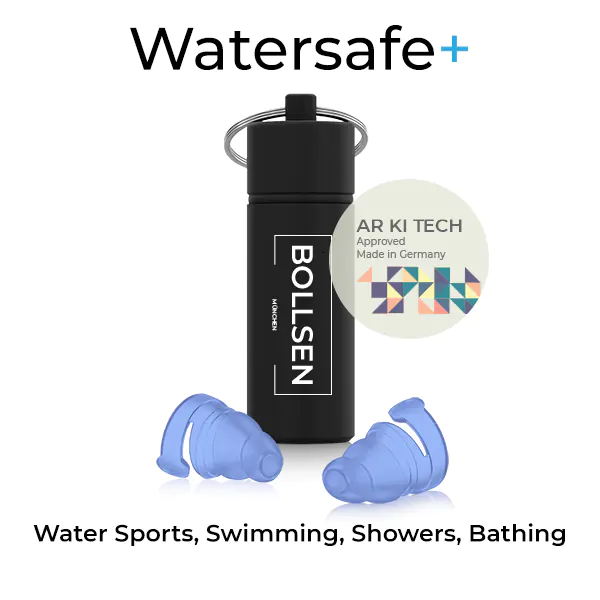
Our Watersafe+ uses a dual-flange silicone design that seals at two points inside the canal, stays in place through flip turns and open-water entries, and is rated waterproof to 3 m depth. It is also suitable for adults with ear tubes, a use case that most swimming earplug designs do not address. For swimmers who have repeatedly tried earplugs without success, the fit is almost always the variable that has changed when Watersafe+ works where others have not. Trusted by over 1,000,000 people and independently certified at 24 dB SNR in dry conditions, it is the earplug we recommend as the foundation of any swimmer’s ear prevention routine. If you want guidance on finding the best option for your specific swimming style, our best earplugs for swimming to prevent swimmer’s ear guide compares the leading designs against the criteria that actually matter for prevention.
For swimmers who have tried multiple earplug designs without success, ear canal shape is often a factor. Our AR KI TECH service uses AI ear-canal analysis to identify the correct earplug size before you buy, reducing returns to just 3% and eliminating the guesswork that leads to fit failure. When the insertion technique itself is uncertain, correct insertion technique for prevention ensures the dual-flange seal seats fully against the canal wall rather than resting at the entrance where it will displace under impact.
Are Swimming Earplugs Safe to Use for Prevention?
Medical-grade silicone swimming earplugs are safe for regular use when inserted correctly and cleaned between sessions. A 2023 AAFP rapid evidence review on acute otitis externa notes there are no clinical trials specifically on home earplug use for swimmer’s ear prevention, but well-fitted plugs are consistently recommended in clinical guidelines as a first-line preventive strategy. The risk profile changes when earplugs are forced into the canal, worn too long without cleaning, or used in an already-infected ear.
The NHS recommends stopping earplug use immediately if you experience discomfort, itching, or discharge. These are early warning signs of irritation or early-stage infection, and continuing use with those symptoms present can worsen the condition. For detailed guidance on what the evidence says about long-term earplug use in swimmers, the article on are swimming earplugs safe to use for prevention? covers the clinical evidence and the common concerns in full.
What About Post-Swim Ear Drops? Do They Actually Work?
Post-swim acidifying drops work by targeting the two conditions that allow Pseudomonas aeruginosa to colonise the canal: elevated pH and residual moisture. White vinegar contains acetic acid, which lowers the canal’s pH back toward its mildly acidic baseline. Rubbing alcohol (isopropyl at 70%) accelerates moisture evaporation and adds a secondary antimicrobial effect. The CDC’s swimmer’s ear prevention guidelines include this formulation specifically.
The reason many swimmers try acidifying drops once and abandon them is practical, not medical: the drops sting briefly, the ratio feels imprecise, and it is easy to forget a step that does not produce an immediate sensation of benefit. Knowing the mechanism helps. You are not disinfecting an infection; you are restoring a pH barrier before bacteria can multiply. That framing makes the routine feel less optional. One part white vinegar to one part rubbing alcohol, 2–3 drops per ear, tilted to drain after 30 seconds. That is the full protocol.
How Do You Prevent Swimmer’s Ear If You Have Ear Tubes?
People with grommets (tympanostomy tubes) face a higher infection risk from swimming because water can travel through the tube into the middle ear, a space with no natural drainage mechanism. Standard prevention advice for intact eardrums does not apply here in one critical respect: do not use post-swim acidifying drops. Acetic acid passing through an open tube can cause significant irritation to the middle ear and eardrum.
The appropriate prevention strategy for people with ear tubes is a high-quality waterproof earplug that creates a reliable seal. Watersafe+ is specifically noted as suitable for adults with ear tubes on its product page: the dual-flange seal prevents water from reaching the tympanic membrane entirely. Always confirm with your ENT before swimming after grommet insertion, as recommendations can vary depending on the type and position of the tube.
Is Swimmer’s Ear Different From Surfer’s Ear?
Swimmer’s ear (otitis externa) and surfer’s ear (exostosis of the ear canal) are two distinct conditions that share only one risk factor: water exposure. Swimmer’s ear is infectious: bacterial or fungal overgrowth in the external canal triggered by pH disruption from water ingress. It resolves with treatment in 7–10 days in 65–90% of cases according to NCBI StatPearls on otitis externa. Surfer’s ear is structural. The body’s response to prolonged cold water and wind exposure causes bony growths to form inside the canal, progressively narrowing it over years.
The prevention overlap is real: earplugs help with both. But surfer’s ear requires consistent earplug use in cold water over years to avoid bony growth, whereas swimmer’s ear prevention is primarily about the per-session protocol. For swimmers curious about the distinction, the article on surfer’s ear, a different condition from swimmer’s ear covers the bony exostosis mechanism, who is at risk, and why cold-water swimmers need earplug protection even if they have never had an infection.
When Should You See a Doctor for Swimmer’s Ear?
Prevention fails sometimes. The early warning signs of swimmer’s ear are itching or mild discomfort inside the canal, a feeling of fullness, and slight redness at the canal entrance. At this stage, stopping swimming and applying acidifying drops can sometimes resolve early-stage irritation before infection takes hold. If pain intensifies, discharge appears, or hearing noticeably decreases, see a GP or ENT promptly.
Acute otitis externa typically resolves in 7–10 days with topical antibiotic drops, and pain usually improves within 48 hours of starting treatment. Do not self-treat with over-the-counter drops if you have a perforated eardrum or ear tubes: this is a case for clinical advice. Swimmers with a history of recurrent infections who are asking whether to continue swimming should read the article on can you swim with an active ear infection? for clinical guidance on timing and risk.
How Do All the Prevention Steps Work Together?
The before/during/after protocol works because each step targets a different point in the infection pathway. Before: well-fitted earplugs block water from ever reaching the canal epithelium. During: correct seating and a swim cap maintain the seal under impact. After: gravity drainage, controlled heat drying, and acidifying drops remove residual moisture and restore pH before the 48-hour bacterial multiplication window closes.
No single step is foolproof on its own. Earplugs without post-swim drying leave residual moisture if any water breaches the seal. Post-swim drops without earplugs reduce risk but do not eliminate it during the swim itself. The protocol’s strength comes from layering. Over 1% of the UK population visits a GP for otitis externa each year, and most of those cases are preventable with a consistent routine.
For swimmers who want the full picture on how earplugs for water reduce otitis externa risk, including fit guidance, insertion technique, and product selection for different swimming styles, visit earplugs for water, our cluster hub covering every use case from pool lap swimming to open water and surfing.
If you want to understand more about the evidence on earplugs for swimmer’s ear prevention, including what the clinical literature actually says about effectiveness and which study findings apply to recreational swimmers versus competitive athletes, that article covers the research in detail.
Swimmer’s ear is predictable, and predictable problems have protocols. The swimmers who stop getting it are almost always the ones who stopped treating prevention as optional.
IMAGE BRIEF filename: blog-uk-how-to-prevent-swimmers-ear-hero.jpg prompt: Adult swimmer standing at the edge of an outdoor pool, wet hair, tilting head sideways with hand raised to ear in a natural post-swim drying gesture, warm afternoon sunlight, clean blue pool water in background. Minimalist lifestyle photography, soft natural light, clean neutral background, no text, no logo, no watermark, wide landscape format, Scandinavian interior aesthetic. alt_text: Swimmer tilting head to drain water from ear after swimming outdoors on a sunny day
His connection to hearing protection stems from personal experience with sound sensitivity during live events and work in noisy environments, an issue that made him more aware of the long-term risks of unmanaged noise exposure. Today, as both a communicator and a user of BOLLSEN products, he is passionate about raising awareness around the importance of proactive hearing care.
At BOLLSEN, he develops data-driven marketing campaigns, writes SEO-focused articles, and manages communication channels that connect customers with practical knowledge about hearing protection. His work ensures that BOLLSEN’s message—prioritizing health, performance, and sustainability reaches a global audience in an engaging and trustworthy way.
Passionate about writing since childhood, Timotej combines creativity with a strong analytical approach, continuously testing new ideas in digital marketing, performance advertising, and social media. He believes in learning through innovation and collaboration, balancing leadership with openness to new perspectives.
Beyond his professional role, Timotej is committed to a healthy lifestyle and finds inspiration in fitness, sports, and quality time with friends. His personal passion for well-being aligns with BOLLSEN’s core values, making his work not only a career but also a cause he deeply believes in.