
⏱️ Estimated reading time: 10 min

Key Takeaways
Reach over your head with the opposite hand and pull your ear up and back. Push the plug in with a slight twist until both flanges sit inside the canal, hold for a few seconds, then check the fit.
Both flanges of a 2-lamella plug should sit inside the ear canal, with only the grip end showing. It should feel snug, never painful.
Cupping your hands over your ears should change the noise very little, a gentle tug should meet resistance, and your own voice should sound louder inside your head. That last effect, occlusion, means the canal is sealed.
Usually the plug never passed the first bend of the canal, so talking and chewing walk it out. Pulling the ear up and back during insertion solves most cases.
After putting on a hard hat, glasses or a respirator, after a long conversation or a break, and whenever the noise seems louder.
Yes. In a 2025 lab trial with foam earplugs, first-time users shown in person how to fit them roughly doubled their measured protection, while an untrained group barely changed.
How to put earplugs in properly is the step most people at work never get shown. Most get handed a pair and nothing else. The rating on the packet assumes a good seal, and a plug sitting half out gives you a fraction of it.
Two complaints come up again and again. “My earplugs keep falling out,” and “they fit fine in the morning but slip by lunch.” Both usually come down to technique. That matters, because HSE estimates around 15,000 workers in Great Britain have hearing problems caused or made worse by work (Labour Force Survey, 2022/23 to 2024/25).
At Bollsen, we are a hearing protection brand trusted by 1,000,000+ people. These steps are written for reusable 2-lamella silicone plugs, the kind we make, and suit most earplugs for work issued on UK sites. Our hub on earplugs for work covers noise levels, UK rules and job-by-job advice for construction, factories and warehouses.
How do you put earplugs in properly?
To put a reusable 2-lamella earplug in properly, you straighten the ear canal by pulling the ear up and back, push the plug in with a slight twist until both flanges are inside, and hold it until it seals.
- Start clean. Wash your hands and check the plug is clean, with no splits in either flange.
- Reach over your head. Right hand over the top of your head for the left ear, and vice versa.
- Pull the ear up and back. Draw the top of the outer ear (the pinna) gently up and back to straighten the canal past its first bend.
- Insert at a slight angle. Hold the plug by its grip or on your index finger and aim slightly forwards.
- Push and twist. Press in with a small twisting motion until both flanges have disappeared into the canal.
- Hold, then let go. Keep a fingertip on it for three to five seconds, release the ear, then run the checks below.
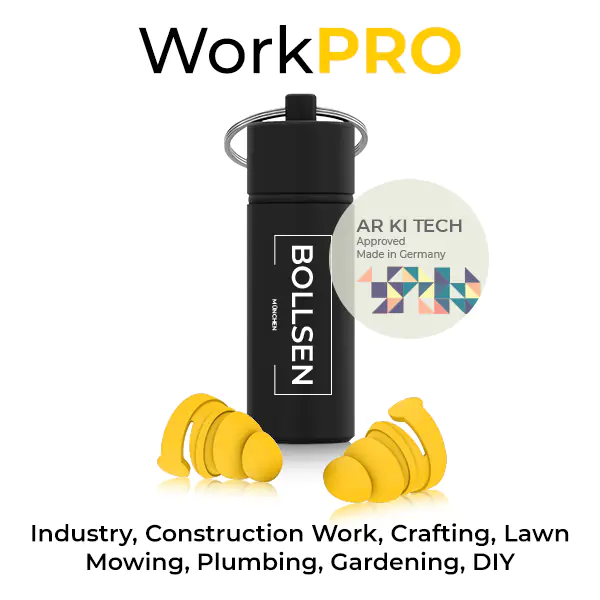
Our WorkPRO earplugs go in exactly this way. They share the 2-lamella silicone body of our whole range, rated SNR 24 dB (H 24 / M 21 / L 19) and tested to EN 352-2, in a yellow colourway supervisors can check at a glance. See the WorkPRO earplugs (SNR 24 dB, £29.95) for the full attenuation figures and low-profile fit under ear defenders.
Do reusable earplugs go in the same way as foam?
Not quite. Foam earplugs follow “roll, pull, hold”, rolled into a thin cylinder, inserted with the ear pulled back and held while they expand. NIOSH’s guide to wearing soft foam earplugs says most of the foam should end up inside the canal.
A silicone plug keeps its shape, so the seal comes from the flanges rather than expansion. The ear pull and the hold stay the same. Our guide to reusable vs foam vs banded earplugs for work compares the three types. Swimming earplugs are a different job, and our step-by-step guide on how to insert swimming earplugs covers keeping water out during lengths and turns.
How do you know if your earplugs are in correctly?
You know your earplugs are in correctly when three quick checks agree: the cup test, the tug test and the own-voice test. Each takes seconds. Do them in the noise you are protecting against.
| Check | How to do it | Good fit | Bad fit means |
|---|---|---|---|
| Cup test | Cup your hands over your ears, then lift them away | The noise changes very little | A big drop means the plug is leaking |
| Tug test | Gently pull the grip end outwards | You feel resistance and slight suction | It slides out easily: re-insert, deeper |
| Own-voice test | Speak a sentence at normal volume | Your voice sounds louder and deeper inside your head (occlusion) | Your voice sounds normal: the canal is not sealed |
The own-voice cue is the occlusion effect. With the canal sealed, your voice travelling through your skull has nowhere to escape, and most people stop noticing it within minutes. A full earplug seal test goes further, but these three checks cover every day.
Signs of a bad fit
Footsteps and machinery sound much the same with the plugs in. The plug walks out when you talk or chew. One ear sounds louder than the other, or the plug hurts after 20 minutes. Any of these means start again from step one.
Why does fit matter more than the rating?
Fit matters more than the rating because the SNR is measured on carefully fitted plugs in a lab, and HSE’s L108 guidance on controlling noise at work tells employers to subtract 4 dB from the rating to allow for real-world use. A well-fitted SNR 24 plug is planned as roughly 20 dB at the ear. A badly fitted one can fall well short of that.
A plug you can fit well every time beats a higher-rated one you cannot, which is why fit comes first when choosing the best earplugs for work for a noisy UK workplace. For the question “how much hearing protection do I need?”, our guide on how much hearing protection do I need works through HSE’s SNR bands with examples.
Does fit training really make a difference?
Fit training makes a large difference. In a 2025 randomised trial by Samelli et al., 52 first-time users were tested with a foam earplug in a lab. Those shown in person how to fit it roughly doubled their measured protection, from 15.5 dB to 31.0 dB, while a group given no training stayed almost flat.

Results varied between people by up to about 12 dB. A 2019 field study of 172 manufacturing workers saw average protection rise from 16.4 to 21.1 dB after training, then slip back. Training works, but it needs repeating.
In the UK, the Control of Noise at Work Regulations 2005 require employers to make hearing protection available from 80 dB(A) and to make sure it is worn from 85 dB(A). HSE’s hearing protection guidance says workers should be shown how to fit it properly, and our guide to earplugs for factory workers covers the production-line view.
When should you re-seat your earplugs during a shift?
Re-seat your earplugs whenever something moves your head, jaw or the skin around your ear. HSE warns that removing protection for even a few minutes considerably lowers the protection you get.
Common triggers include adjusting a hard hat, sliding safety-glasses arms over your ears, tightening a respirator strap, a long conversation, eating and sweating on a hot shift. Our guide to earplugs with a hard hat, glasses and respirator sets out the order to put everything on, and wearing earplugs all day at work covers comfort over a long shift.
Re-insert with clean hands and wash reusable plugs with mild soap and water after each shift. Earplug hygiene at work matters more when the same pair goes in day after day.
What if your earplugs never seal?
If a plug fails the checks every time despite good technique, the likely cause is size. A universal plug fits most ear canals, not all of them. Our AI ear measurement works from two photos of your ears and matches you to a small or medium plug. That is the idea behind WorkPRO with AR KI TECH sizing (S/M), the same yellow 2-lamella plug in the size your ear canals need.



A good seal takes about ten seconds once it becomes a habit. Reach over, pull up and back, push and twist, hold, then check. Do it every time the plugs go back in, and you get far closer to the protection on the packet.

His connection to hearing protection stems from personal experience with sound sensitivity during live events and work in noisy environments, an issue that made him more aware of the long-term risks of unmanaged noise exposure. Today, as both a communicator and a user of BOLLSEN products, he is passionate about raising awareness around the importance of proactive hearing care.
At BOLLSEN, he develops data-driven marketing campaigns, writes SEO-focused articles, and manages communication channels that connect customers with practical knowledge about hearing protection. His work ensures that BOLLSEN’s message—prioritizing health, performance, and sustainability reaches a global audience in an engaging and trustworthy way.
Passionate about writing since childhood, Timotej combines creativity with a strong analytical approach, continuously testing new ideas in digital marketing, performance advertising, and social media. He believes in learning through innovation and collaboration, balancing leadership with openness to new perspectives.
Beyond his professional role, Timotej is committed to a healthy lifestyle and finds inspiration in fitness, sports, and quality time with friends. His personal passion for well-being aligns with BOLLSEN’s core values, making his work not only a career but also a cause he deeply believes in.