
⏱️ Estimated reading time: 13 min

Key Takeaways
Stand near the speaker stacks at a 105 dB gig and the NRR vs SNR earplugs question stops being academic. Regular gig-goers describe earplug shopping as a forced choice between damaging their hearing and hearing the whole set slightly muffled. The rating on the box decides how much of each you get, and the two rating systems behind those numbers do not speak the same language.
We are BOLLSEN, a hearing protection company trusted by 1,000,000+ people, and every pair of earplugs for music we sell in the UK carries an SNR value certified under EN 352-2. Our products are German-tested, independently certified 24 dB, and have featured in Mixmag and BBC Science Focus. NRR, the American counterpart, works to a different standard, and mixing the two up can cost you several decibels of planned protection.
SNR is the number that counts in the UK. Reading it correctly matters more than chasing the biggest figure on the shelf, especially once derating and fit enter the calculation.
What Is the Difference Between NRR and SNR?
NRR (Noise Reduction Rating) is the US labelling standard tested under ANSI S3.19 and mandated by the EPA, while SNR (Single Number Rating) is the UK and EU standard calculated under EN ISO 4869-2, and for the same earplug the SNR rating typically reads 3 to 5 dB higher than the NRR. Both single numbers summarise how much sound the earplug’s acoustic filter design and seal remove under laboratory conditions. Neither is a promise; each is a statistical estimate built from a panel of test subjects.
The physics underneath both labels is identical, and we explain step by step how acoustic filter design creates the SNR rating in our guide to high-fidelity earplugs and their measured attenuation curves. SNR also arrives with a supporting triplet, the H, M and L values, which describe attenuation separately for high, medium and low frequencies.
| NRR (Noise Reduction Rating) | SNR (Single Number Rating) | |
|---|---|---|
| Region | United States | UK and EU |
| Test standard | ANSI S3.19 | EN ISO 4869-2 |
| Legal basis | EPA label requirement, OSHA workplace rules | UKCA/CE marking via EN 352, HSE noise regulations |
| Supporting values | Single number only | H, M and L frequency values |
| Typical relationship | Reads 3–5 dB lower | Reads 3–5 dB higher |
| Real-world adjustment | (NRR − 7) ÷ 2 under OSHA Appendix B | Subtract SNR from venue level, allow for fit |
Which Rating Applies to Earplugs Sold in the UK?
Every earplug legally sold as hearing protection in the UK carries an SNR value, because UKCA and CE marking both require testing to the EN 352 series, and the Health and Safety Executive (HSE) writes all UK noise regulations and guidance in SNR terms.
For earplugs specifically, the product standard is EN 352-2. A plug cannot be certified below H 12, M 11 and L 9, and the declared figures carry a test uncertainty of ±3 dB between 250 Hz and 4 kHz. What SNR means on earplugs is straightforward. It is the certified single-number estimate of how many decibels the plug removes from the sound reaching your eardrum.
Order US-labelled plugs online, though, and the box shows an NRR instead. That mismatch catches out more buyers than any other detail on the packaging.
Can You Convert NRR to SNR?
No exact NRR to SNR conversion exists, because the two ratings use different test panels, different fitting protocols and different statistics. For the same physical earplug, though, the SNR typically lands 3 to 5 dB higher, so an NRR 20 product usually corresponds to roughly SNR 23 to 25.
A rule of thumb that circulates among concert-goers holds that 17 dB SNR is roughly equivalent to NRR 10 to 12 in US terms. The direction matters more than the exact figures. The same physical earplug always scores lower under NRR, so comparing an American label directly against a British one misjudges protection by up to 5 dB.
At concert volume that gap is not trivial. Five decibels separates an estimated exposure of 81 dB from 86 dB at the same show, one side of the UK upper action value or the other.
Why Is Real-World Protection Lower Than the Number on the Box?
Laboratory ratings assume a perfect, experimenter-supervised fit, which is why OSHA subtracts 7 dB from the NRR and halves the remainder for A-weighted noise, so a foam earplug labelled NRR 33 is credited with roughly 13 dB of real-world protection. The method is set out in OSHA 29 CFR 1910.95 Appendix B, and the agency’s simpler field rule just halves the NRR, giving about 16 dB for the same plug.

NIOSH goes further and derates by protector type in its hearing protector criteria document: earmuffs lose 25 percent of their labelled rating, formable foam plugs 50 percent, and all other earplugs 70 percent. European SNR figures sit closer to reality but are not immune, since EN 352-2 itself allows ±3 dB of test uncertainty. A poorly seated earplug can deliver half its rated attenuation whichever label it carries.
Fit is the variable you control. Our AR KI TECH measuring service sizes your earplugs from two photos of your ears, which is one reason our fitting-related return rate sits at 3 percent.
What Does SNR 24 dB Mean at a Concert?
SNR subtracts directly from the sound level around you, so at a 105 dB concert a pair of SNR 24 earplugs brings your estimated exposure to about 81 dB, under the 85 dB(A) upper action value that triggers mandatory hearing protection for UK workers.
Typical concert dB levels run from 100 to 115 dB(A), while the WHO Global Standard for Safe Listening Venues and Events asks venues to stay under 100 dB(A) averaged over any 15-minute period. The same WHO work estimates that around 40 percent of 12 to 35 year olds are exposed to potentially damaging sound levels in entertainment venues. Every extra 3 dB halves the sound energy and halves your safe exposure time.
Every venue sits differently on that scale, so we have compiled concert dB levels and how much protection you need across club nights, arenas and festival main stages. At 110 dB in front of the stacks, the same SNR 24 plugs leave you at 86 dB, which argues for shorter stints near the stage or a few steps back.
What Is the Difference Between 24 and 27 dB Noise Reduction?
Three decibels separate 24 dB and 27 dB of noise reduction, and because the decibel scale is logarithmic that gap halves the transmitted sound energy. At a 105 dB concert, though, the practical outcome is an estimated exposure of 81 dB against 78 dB, both comfortably under the 85 dB(A) upper action value.
Higher attenuation earns its keep in sustained exposure above 110 dB, in orchestra pits, on eight-hour festival shifts or standing beside the PA. Below that, the extra 3 dB mostly costs you clarity, because stronger attenuation makes speech and the mix harder to follow and tempts you to pull the plugs out between songs.
In one NPR listener poll, 71 percent said most shows they attend are too loud, and nearly half of the earplug wearers admitted they hate wearing them but do it anyway. A 24 dB plug you keep in for the whole set protects far more than a 27 dB plug that spends half the night in your pocket.
What SNR Do You Need for Concerts and Festivals?
For typical 100 to 110 dB(A) concert and club exposure, an earplug rated between SNR 18 and SNR 25 brings estimated exposure below the 85 dB(A) upper action value, and once you know your venue’s level you can use SNR to choose the right concert earplug instead of guessing.
Venue level is the starting point, and our buyer’s guide covers how to use SNR to choose the right concert earplug, including fit checks, filter options and when to size up your protection. Musicians should work from their instrument rather than the room: a drum kit produces 100 to 110 dB at the player’s ear and points to SNR 24 to 25, while an acoustic ensemble sitting nearer 90 dB is well served at SNR 15 to 20. The table below matches typical UK settings to a sensible SNR range.
| Setting | Typical level | Suggested SNR | Estimated exposure with SNR 24 |
|---|---|---|---|
| Acoustic or seated venue | 90–95 dB(A) | 15–20 | 66–71 dB |
| Club night or standard gig | 100–105 dB(A) | 20–25 | 76–81 dB |
| Arena or festival main stage | 105–110 dB(A) | 24–25 | 81–86 dB |
| Front of stage, beside the PA | 110–115 dB(A) | 25+, with breaks and distance | 86–91 dB |
Where Does the Music SoundPRO Fit In?
Our Music SoundPRO is a passive 2-lamella earplug in medical-grade silicone, certified at SNR 24 with H 24, M 21 and L 19, and reusable up to 100 times. Like every passive earplug, its attenuation rises with frequency, from 21.9 dB at 63 Hz to 35.3 dB at 8 kHz, so the highs are reduced most. You still hear the music, just quieter, and speech stays understandable with a correct fit.


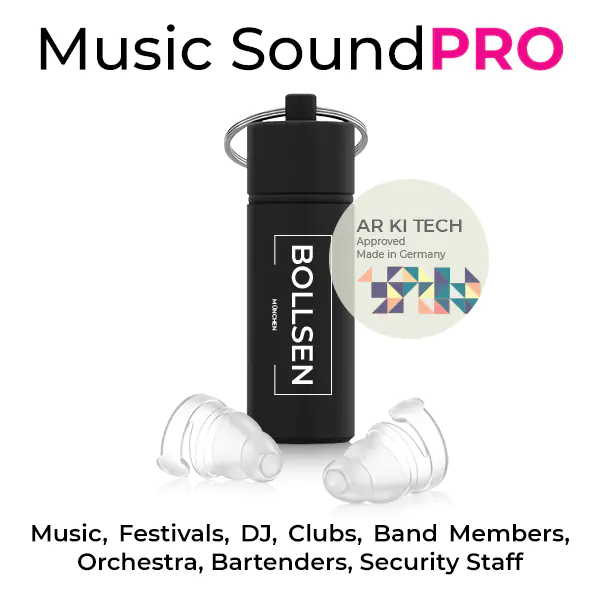
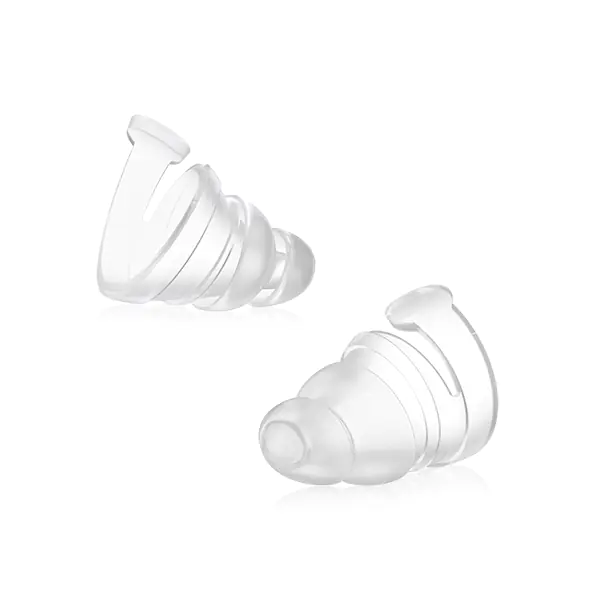
If your exposure sits in the club-to-festival band, our Music SoundPRO 24 dB SNR earplugs publish the full EN 352-2 attenuation table on the product page.
How Do UK Noise Regulations Use SNR?
The Control of Noise at Work Regulations 2005 have covered the music and entertainment sector since April 2008, setting a lower action value of 80 dB(A) daily exposure, an upper action value of 85 dB(A) where hearing protection must be worn, and an exposure limit of 87 dB(A) measured with protection factored in, as explained on the HSE noise regulations pages.
Peak sound pressure carries three parallel values, a 135 dB(C) lower action value, a 137 dB(C) upper action value and a 140 dB(C) limit, set out in the Control of Noise at Work Regulations 2005 on legislation.gov.uk. There is no music-venue exemption; Regulation 11 only permits narrow exemption certificates granted by the HSE case by case.
Sector guidance for venues, HSG260 Sound advice (2008), and the wider L108 Guidance on Regulations (third edition, 2021) both select hearing protection by SNR. Venue staff, engineers and promoters can read a full breakdown of how UK noise regulations use SNR for compliance in our guide covering action values, protection zones and the duties employers owe their staff.
For UK concert-goers the rating that matters is SNR, and using it takes ten seconds. Subtract the SNR from the venue level, check the result lands under 85 dB(A), and allow a few decibels of margin for imperfect fit. An SNR 24 earplug at a 105 dB show leaves you around 81 dB, protected for the full set.
Your hearing does not regenerate, and every gig you protect it at is a gig you will still hear clearly in twenty years. Pick the SNR that matches your venues, fit it properly, and keep it in until the encore ends.

His connection to hearing protection stems from personal experience with sound sensitivity during live events and work in noisy environments, an issue that made him more aware of the long-term risks of unmanaged noise exposure. Today, as both a communicator and a user of BOLLSEN products, he is passionate about raising awareness around the importance of proactive hearing care.
At BOLLSEN, he develops data-driven marketing campaigns, writes SEO-focused articles, and manages communication channels that connect customers with practical knowledge about hearing protection. His work ensures that BOLLSEN’s message—prioritizing health, performance, and sustainability reaches a global audience in an engaging and trustworthy way.
Passionate about writing since childhood, Timotej combines creativity with a strong analytical approach, continuously testing new ideas in digital marketing, performance advertising, and social media. He believes in learning through innovation and collaboration, balancing leadership with openness to new perspectives.
Beyond his professional role, Timotej is committed to a healthy lifestyle and finds inspiration in fitness, sports, and quality time with friends. His personal passion for well-being aligns with BOLLSEN’s core values, making his work not only a career but also a cause he deeply believes in.