
⏱️ Estimated reading time: 12 min

Key Takeaways
If you have searched for high-fidelity earplugs, you have read the same promise on nearly every product page: hear everything unchanged, just quieter. So what are high-fidelity earplugs really, and does that claim hold up for every plug wearing the label? At Bollsen, we are a German-tested hearing protection company trusted by more than 1,000,000 people, and we would rather explain the category honestly than sell you a myth.
Here is the short version. A true flat-filter design uses a tuned acoustic filter to lower bass, mids and treble by a similar amount. Many passive silicone plugs sold under the same hi-fi umbrella do not do that, yet they still beat foam on the thing that matters most at a gig. They keep the music clear instead of turning it into a muffled, bass-heavy blur.
That muffle is the single most common complaint musicians and concertgoers raise about foam. If you are weighing up reusable options, understand the mechanism before you compare products across our guide to earplugs for music so you protect your hearing without losing the detail of the night.
What are high-fidelity earplugs?
High-fidelity earplugs are reusable hearing protectors built to lower loud sound while keeping it clearer and more natural than disposable foam, so music and speech stay recognisable at a safer volume rather than sounding blocked out. The name describes a market category, not a single certified standard.
Within that category sit two different things. At one end are precision acoustic filter earplugs, which use a tiny tuned channel to reduce sound fairly evenly. At the other end are passive silicone plugs, which lower the overall volume without a filter and cut the highest frequencies most.
Both are marketed as hi-fi, and both are a large step up from foam for live music. The honest difference is how faithfully each one preserves the original tone, which is where the label starts to blur.
How does a high-fidelity acoustic filter work?
A high-fidelity acoustic filter works by channelling sound through a tuned resonator, typically designed around 2700 Hz, so the plug lowers bass, mids and treble by a broadly similar number of decibels rather than smothering the top end. Audiology sources describe this resonance as the mechanism behind genuine flat attenuation.
The result is closer to turning a volume knob down than putting a blanket over the band. A filtered plug of this type usually reduces sound by about 10 to 25 dB depending on the filter fitted. For a technical explanation of how tuned filters smooth the response, the audiology publication Hearing Review documents the resonance principle behind musicians’ earplugs.
Do high-fidelity earplugs reduce every frequency equally?
Not always, and this is where most product pages overpromise. Only a precision-tuned acoustic filter comes close to true flat attenuation, where every frequency drops by a similar amount. Many passive silicone plugs sold as hi-fi, including our own Bollsen Music SoundPRO, actually reduce high frequencies more than low ones.
Independent EN 352-2 lab testing of our silicone body shows attenuation rising with frequency, from roughly 22 dB in the low and mid range up to about 35 dB at 8 kHz. That is a normal passive profile, and it is honest to say it is not a flat, tonally faithful filter.
So why do passive silicone music earplugs still sound so much better than foam at a concert? Because they lower the overall level in a controlled way and vent the ear canal, so the music stays clear and present instead of collapsing into mush. Clarity at a gig comes as much from comfortable, even volume reduction as from perfectly flat frequency response.
Why do foam earplugs make music sound muffled?
Foam earplugs make music sound muffled because they expand to seal the ear canal completely and cut the highest frequencies hardest, often rated 30 to 33 dB NRR, which strips out the detail your ears rely on to separate instruments and voices. The result is a bass-heavy, underwater wall of sound.
There are two extra problems. Real-world foam protection is often far lower than the label, because OSHA derates the NRR by roughly half, so an NRR 33 foam plug may deliver closer to 16 dB in practice if it is not inserted deeply. That deep seal also triggers the occlusion effect, the boomy, hollow sensation of your own voice, most noticeable below about 1 kHz.
A vented silicone plug avoids the worst of that boom, which is a big part of why it feels clearer. We break down the experience side by side in our explainer on how music earplugs compare to foam on sound quality, so you can hear why the difference is so obvious at a live show.
How do high-fidelity filters, foam, and passive silicone plugs compare?
The clearest way to see the difference is side by side. A true flat-filter hi-fi earplug preserves tone best, foam reduces the most sound but muffles it heavily, and a passive silicone plug like ours sits in between with strong protection and far better clarity than foam. The table below compares how each type behaves.
| Feature | True flat-filter hi-fi earplug | Foam earplug | Passive silicone plug (e.g. Music SoundPRO) |
|---|---|---|---|
| How it reduces sound | Tuned acoustic filter and resonator | Dense foam expands to seal the canal | 2-lamella silicone body seals and vents |
| Typical reduction | About 10 to 25 dB (filter dependent) | 30 to 33 dB NRR (nearer 16 dB real-world) | SNR 24 dB (H24, M21, L19) |
| Attenuation across frequencies | Closest to flat and even | Rises sharply, highs cut most | Rises with frequency, highs cut most |
| Effect on music | Most natural, tonally faithful | Muffled and bass-heavy | Clearer and far less muffled than foam, just quieter |
| Occlusion or own-voice boom | Low, vented filter | High, deep seal | Reduced by 2-lamella venting |
| Reusability | Reusable | Usually single use | Reusable up to 100 times |
| Best suited to | Musicians wanting flat studio response | Short-term, low-cost, disposable use | Concerts and festivals wanting protection with clear sound |
Where does a passive silicone plug like Music SoundPRO fit in?
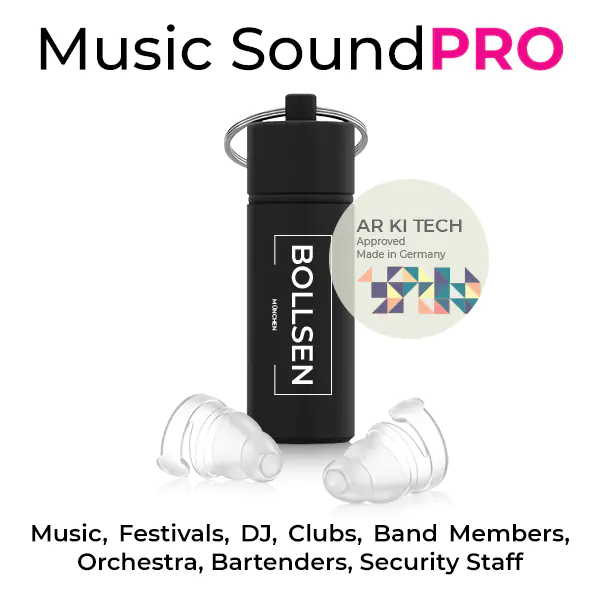
A passive silicone plug like Music SoundPRO fits the crowd who want reliable, comfortable protection at concerts and festivals rather than studio-grade flat response, lowering the volume by an SNR of 24 dB so the music stays clear and far less muffled than foam. It is honest, everyday hearing protection, not a mixing-desk tool.
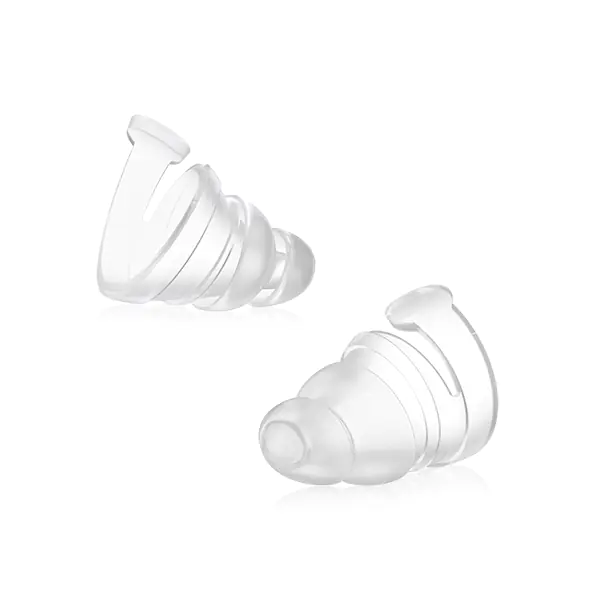
Our Bollsen Music SoundPRO is a passive, transparent 2-lamella silicone plug rated SNR 24 dB (H24, M21, L19), German-tested and independently certified, and reusable up to 100 times. It will not deliver perfectly flat, studio-faithful sound, but it brings a loud gig down to a safer level while keeping the music clear and present.
If you mostly need dependable protection that still lets you enjoy the show, our Music SoundPRO high-fidelity earplugs are made for festivals, clubs and live venues where volumes routinely hit 100 to 115 dB. Fit matters here more than anything, because a plug only protects and sounds right when it seals correctly.
Because fit decides both comfort and how much sound actually gets through, we built AR KI TECH ear measurement to photograph your ears and match the right size, which keeps our return rate near 3 percent. A plug that seals well is quieter, clearer and more comfortable across a long night.
How much reduction do you actually need? The WHO notes that sound below 80 dB is unlikely to damage hearing, while 100 dB is safe for only about 20 minutes a week, so a two-hour set far exceeds safe limits without protection. You can read the exposure guidance from the WHO on safe listening levels and the CDC on noise and hearing loss, which sets an 85 dBA limit over eight hours with a 3 dB exchange rate.


Are high-fidelity earplugs worth it?
For anyone regularly around loud music, high-fidelity earplugs are worth it, and the common hesitation online is almost always the upfront price rather than any doubt that they work. Reusable plugs change the maths quickly.
A reusable silicone plug used up to 100 times works out at pennies per gig, against a fresh pair of disposable foam plugs every night. Protecting your hearing also helps prevent tinnitus and the hearing fatigue that follows loud shows, and the NHS guidance on tinnitus lists loud music as a leading, preventable cause.
If you want to compare specific options before your next event, our roundup of the best high-fidelity earplugs for concerts walks through what to look for so you can match protection to the volume you face. It pairs naturally with everything explained here.
High-fidelity earplugs are a category, not a promise. A precision filter gets you closest to flat, tonally faithful sound, foam gets you the most reduction at the cost of clarity, and a passive silicone plug sits in between with strong protection and far cleaner sound than foam.
Be a little sceptical of any plug that claims to leave music completely unchanged. What you can reasonably expect from a good passive plug at SNR 24 dB is a quieter, clearer night, and ears that still feel fine the next morning. Protect them once, properly, and you get to keep enjoying live music for decades.

His connection to hearing protection stems from personal experience with sound sensitivity during live events and work in noisy environments, an issue that made him more aware of the long-term risks of unmanaged noise exposure. Today, as both a communicator and a user of BOLLSEN products, he is passionate about raising awareness around the importance of proactive hearing care.
At BOLLSEN, he develops data-driven marketing campaigns, writes SEO-focused articles, and manages communication channels that connect customers with practical knowledge about hearing protection. His work ensures that BOLLSEN’s message—prioritizing health, performance, and sustainability reaches a global audience in an engaging and trustworthy way.
Passionate about writing since childhood, Timotej combines creativity with a strong analytical approach, continuously testing new ideas in digital marketing, performance advertising, and social media. He believes in learning through innovation and collaboration, balancing leadership with openness to new perspectives.
Beyond his professional role, Timotej is committed to a healthy lifestyle and finds inspiration in fitness, sports, and quality time with friends. His personal passion for well-being aligns with BOLLSEN’s core values, making his work not only a career but also a cause he deeply believes in.